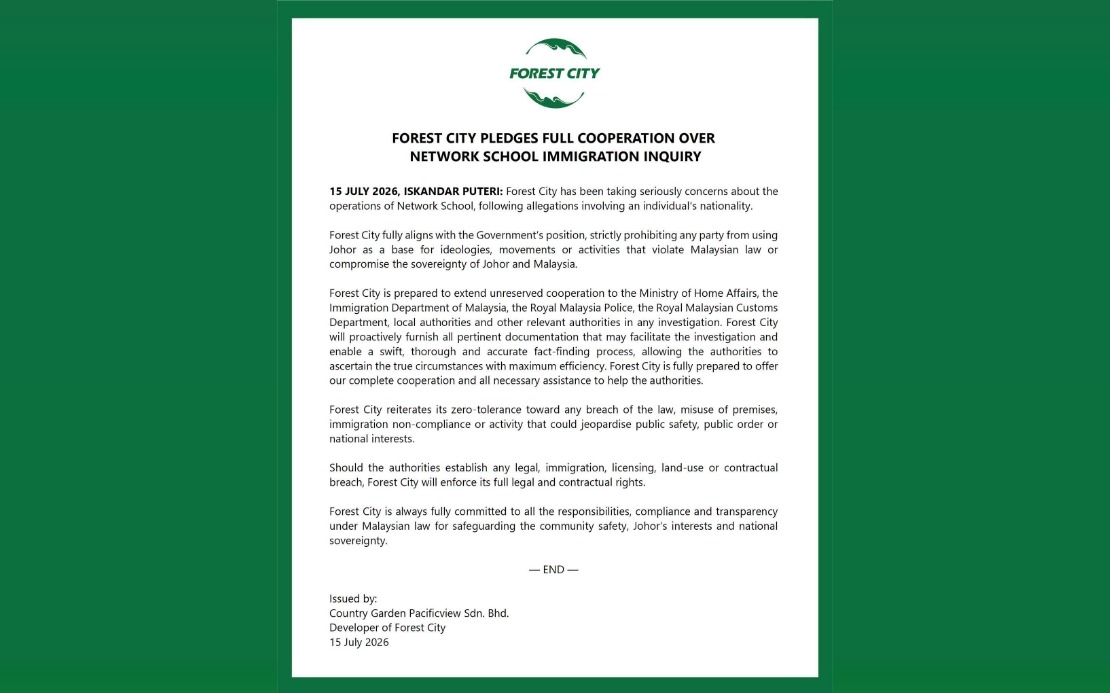
Country Garden Pacificview, the developer of the Forest City mixed-use development in Johor Bahru, has committed itself to providing comprehensive support to government agencies investigating the controversial Network School operation. The announcement came as renewed focus falls on educational and residential facilities within the massive waterfront project following allegations that individuals holding Israeli citizenship participated in programmes at the school.
The developer's statement represents a strategic move to distance Forest City from any potential legal violations whilst reaffirming its alignment with the Malaysian government's position on sovereignty and national security. By explicitly endorsing the authorities' investigative approach, Country Garden Pacificview seeks to maintain its operational standing and investor confidence during what has become a sensitive matter touching on geopolitical sensitivities in the region.
Officially, the developer indicated readiness to cooperate with multiple enforcement and administrative bodies, including the Home Ministry, Immigration Department, Royal Malaysia Police, Royal Malaysian Customs Department, and local councils. This broad-based commitment signals recognition that the investigation spans immigration compliance, security concerns, and potential breaches of local regulations governing the development's commercial and educational spaces.
A critical aspect of the developer's position centres on documentation. Country Garden Pacificview stated it would voluntarily provide all records relevant to the inquiry, aiming to expedite a comprehensive and accurate fact-finding process. This proactive approach to transparency may prove essential in establishing whether proper vetting procedures were followed for individuals enrolling in Network School programmes and whether residency or operational permits were correctly processed.
The company has also emphasised its zero-tolerance stance toward unlawful activities, property misuse, immigration violations, and actions compromising public safety. This declaration serves dual purposes: it reinforces the developer's commitment to maintaining standards within Forest City whilst potentially insulating the broader development from reputational damage associated with the specific investigation.
The investigation gained momentum when Johor Menteri Besar Datuk Onn Hafiz Ghazi publicly called for authorities to examine Network School operations, citing concerns that individuals allegedly used alternative national passports to gain entry into Malaysia. This revelation suggests possible coordinated movement across borders or deliberate circumvention of immigration processes, raising questions about document verification and due diligence protocols at immigration checkpoints.
In response to these concerns, the Immigration Department conducted an on-site inspection of 266 foreign nationals representing 40 countries within Forest City. Initial findings indicated that all inspected individuals possessed valid immigration documentation, though this preliminary assessment does not necessarily conclude the broader investigation into the Network School's operational practices and the circumstances under which particular individuals obtained their entry permits.
For Malaysian policymakers and residents, the incident underscores persistent vulnerabilities in monitoring foreign nationals within private developments, particularly those with significant commercial and residential populations. Forest City, as a sprawling integrated township, presents unique enforcement challenges given its size, mixed-use character, and the transient nature of its expatriate population. The investigation will likely inform future regulatory approaches to large-scale foreign development projects.
The geopolitical dimension cannot be understated. Malaysia's longstanding Palestinian solidarity and cautious approach to Israeli-related activities mean that allegations of Israeli citizen participation in educational programmes within a major development carry symbolic weight beyond immigration compliance issues. Public perception that such activities might occur unchallenged in Malaysian territory could provoke political consequences for developers and government agencies.
The Network School investigation reflects broader tensions between Malaysia's commitment to attracting foreign investment and talent whilst maintaining strict oversight of activities that might conflict with national foreign policy positions. Country Garden Pacificview's immediate and extensive cooperation declaration demonstrates industry understanding that such matters require rapid, transparent resolution to preserve project viability and community trust.
For investors and expatriate communities in Johor and throughout Malaysia, the situation demonstrates that authorities take security and sovereignty concerns seriously regardless of a development's profile or the economic interests involved. The investigation's outcome will likely shape how future educational ventures involving foreign nationals are structured and monitored within residential developments.
As the investigation progresses, the developer's cooperation framework will be tested. The availability of comprehensive documentation, facility access for inspections, and staff coordination with authorities will determine whether the inquiry can conclusively establish what occurred at Network School and whether any regulatory or legal violations warrant further action. For Forest City, managing this process effectively may prove as important as the investigation's substantive findings in restoring investor and public confidence.

