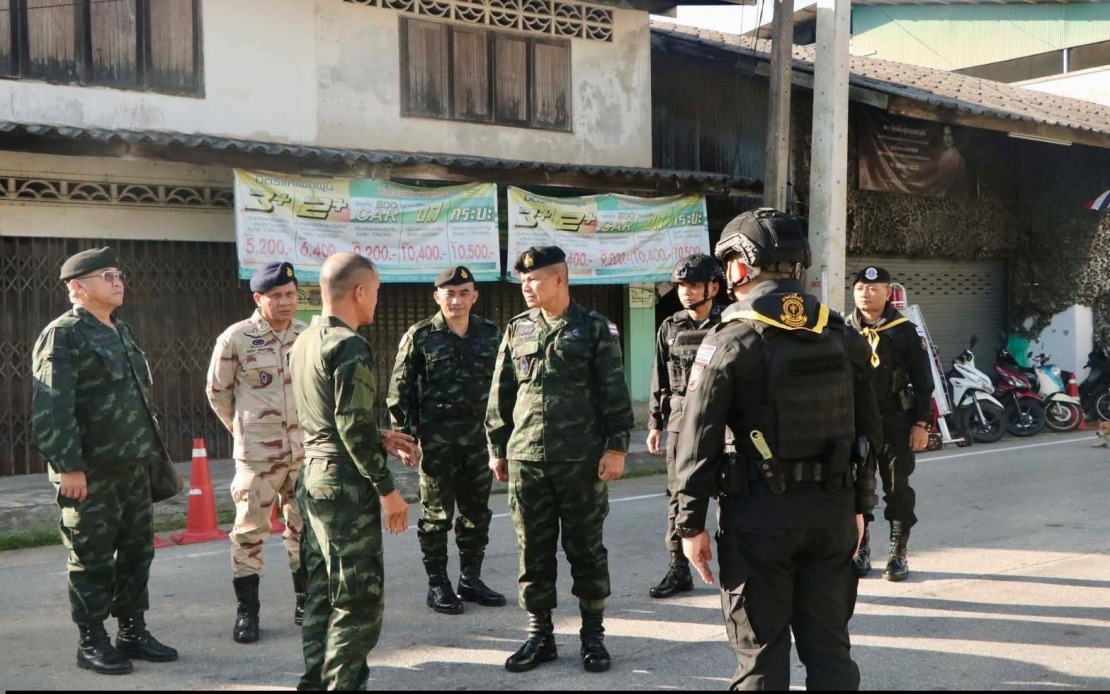
An armed assault on a ranger checkpoint in Thailand's southern Narathiwat province has claimed the lives of five security personnel and left six civilians wounded, marking another escalation in violence plaguing the restive border region. The attack unfolded at approximately 6.45 pm local time on Wednesday at the 4509 Ranger Company checkpoint positioned on Sami Hill in Rangae District, according to initial accounts provided by senior military officials who surveyed the scene the following day.
Lieutenant General Norathip Phoyanok, who commands the Fourth Army Region and oversees the Internal Security Operations Command's fourth regional division, disclosed that the assault involved a coordinated volley of gunfire and explosive devices. Witnesses and investigators determined that more than six perpetrators, whose identities remain unknown, launched the attack while wearing dark clothing and face coverings. The militants deployed both conventional firearms and improvised pipe bombs against the checkpoint's defenders, demonstrating tactical coordination typical of organized militant operations in the zone. Their rapid exit from the location in a black four-wheel-drive vehicle suggested premeditated planning and familiarity with local escape routes.
Among the casualties were a three-year-old child and an elderly civilian, underscoring the indiscriminate nature of such attacks and their broader societal impact beyond direct military losses. The deaths of five rangers represent a significant blow to security operations in the district and highlight the persistent vulnerability of outposts despite their fortified positions and armed presence. Forensic teams subsequently established a secure perimeter around the checkpoint to preserve evidence and document the scene comprehensively, though investigators indicated that identifying those responsible would require sustained effort.
The incident prompted an immediate security response from provincial administration. Narathiwat Governor Boonchuai Hormyamyen issued directives to consolidate protective measures across twelve administrative districts within the province, with particular emphasis on the demarcation line shared with Malaysia. This expansion of security protocols reflects official concern that the attack may signal intensified militant activity or a strategic shift in targeting. Enhanced checkpoints, increased patrols, and closer coordination between military units, police divisions, and civilian authorities represent the standard response framework deployed when violence clusters suggest organized campaigns rather than isolated incidents.
Southern Thailand has endured persistent instability rooted in historical grievances, ethno-religious tensions, and transnational criminal networks that exploit weak governance in border zones. The Narathiwat region specifically has served as a contested space where various armed groups operate, from separatist factions pursuing autonomy to criminal enterprises leveraging porous frontiers for smuggling operations. Civilians bear disproportionate costs through regular disruptions to commerce, education, and normal life, whilst security forces face the dual burden of counterinsurgency operations and conventional peacekeeping duties.
For Malaysia, developments in Narathiwat carry direct implications given the province's position along the shared border and the historical movement of militants, weapons, and contraband across the international boundary. Malaysian law enforcement agencies maintain surveillance protocols and coordinate intelligence with Thai counterparts to prevent spillover incidents and restrict operational sanctuaries for transnational threats. The checkpoint attack demonstrates that despite security investments, determined armed groups retain capacity to strike defended positions, a sobering assessment for all border-adjacent states.
The timing of this assault amid reported upticks in violence suggests possible seasonal or strategic patterns requiring analysis. Militant organizations often intensify operations during specific periods to maximize political impact or exploit seasonal changes that favour their operational methods. Investigators will likely examine whether the attack correlates with recent developments in regional politics, prior arrests of key figures, or inter-group rivalries that occasionally manifest through dramatic public actions designed to reassert presence and capability.
Thailand's security establishment faces the persistent challenge of balancing counterterrorism imperatives with protection of civilian populations and maintenance of routine governance. The expansion of security operations across multiple districts carries economic costs and may generate civilian resentment if implementation proves heavy-handed or if residents perceive authorities as collectively suspecting entire communities of harbouring militants. Successful stabilization efforts throughout Southeast Asia have demonstrated that security measures prove most effective when paired with addressing underlying grievances and enabling inclusive political dialogue.
The investigation's progression will likely involve cross-border intelligence sharing, forensic analysis of recovered weapons and explosives, and interrogation of any suspects apprehended during subsequent operations. Regional security mechanisms may be activated to trace the financing, procurement, and command structures behind the attack. Thailand's commitment to stability in Narathiwat carries implications for the broader region's security architecture, particularly as transnational threats and militant networks show increasing sophistication in coordinating activities across state boundaries and exploiting ungoverned spaces.

