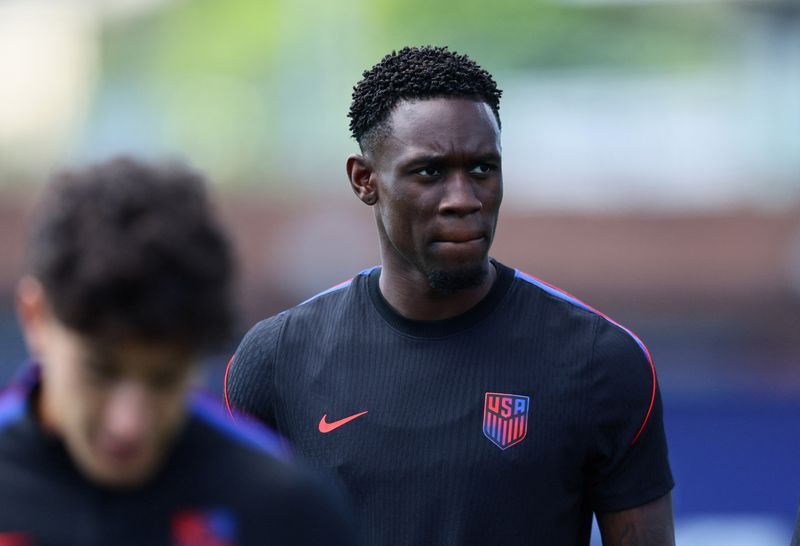
FIFA's decision to suspend the automatic one-match suspension issued to United States striker Folarin Balogun following his red card drew sharp condemnation from multiple European football bodies on Sunday, with critics arguing that the reversal—reportedly made after U.S. President Donald Trump contacted FIFA President Gianni Infantino—compromises the sport's fundamental principles and opens the door to political interference in competition.
The ruling, announced ahead of Monday's World Cup knockout encounter against Belgium, allowed Balogun to remain eligible for selection, a move that immediately triggered alarm among football's regulatory bodies. The controversy centres not on whether the original red card was justified, but rather on FIFA's authority to suspend an automatic disciplinary sanction that is, according to established regulations, mandatory rather than discretionary. This distinction proved crucial to the objections filed by multiple federations within hours of the announcement.
The Royal Belgian Football Association's formal statement highlighted the apparent contradiction in FIFA's own rulebook. While Article 27 of the FIFA Disciplinary Code does grant the disciplinary committee power to suspend enforcement of sanctions, Article 66.4 unambiguously stipulates that a red card automatically triggers suspension for the team's subsequent match—precisely as has occurred with all other sending-offs during this World Cup tournament. The Belgian federation's intervention suggested that FIFA had selectively invoked one article while circumventing another, creating legal incoherence at the highest level of football governance.
German Football Association President Bernd Neuendorf escalated the criticism by directly calling for FIFA to clarify whether Trump's reported telephone conversation with Infantino preceded the decision. Neuendorf characterised the situation as potentially damaging to football's credibility, arguing that any perception of political pressure undermining sporting decisions must be promptly and conclusively addressed. His statement represented an unusually direct challenge to FIFA's independence, framing the episode not as a sporting matter but as a question of institutional integrity.
The competitive implications troubled observers across Europe. Multiple football figures questioned how consistency could be maintained when other players had served automatic suspensions under identical circumstances during the same tournament. If one player's ban could be suspended via executive discretion, why should others be bound by regulations that suddenly appeared negotiable? This logical inconsistency threatened to establish a precedent that would require equal treatment of comparable infractions going forward—a consequence that could destabilise disciplinary standards throughout the remainder of the competition.
For Southeast Asian and other regional observers, the episode underscores a broader tension in global sports governance: the increasing intersection between politics and athletic competition, and the vulnerability of international sporting bodies to pressure from powerful nations. Malaysia and other countries compete in tournaments governed by rules that, when applied selectively based on political considerations, diminish trust in the fairness of international competition. The episode demonstrates how decisions made in distant corridors of power can affect the competitive balance in ways that smaller football nations have little capacity to challenge.
One notable voice suggested that characterising the initial decision as a red card error rather than a reversible sanction might have offered FIFA an alternative pathway—arguing that VAR and match officials had fundamentally misjudged the incident. However, this interpretation conflicts with the official record, which confirmed that both the referee and VAR team had reviewed the footage and determined a sending-off was warranted. Attempting to retrospectively reframe the incident as a mistaken red card rather than a correctly issued sanction that was subsequently suspended only compounds the credibility problem.
The timing amplified the controversy. Mid-tournament reversals of disciplinary decisions are exceptionally rare, with football operating on the principle that fairness demands consistent application of rules regardless of when infractions occur. Suspending a suspension with four days remaining in a knockout stage—rather than allowing the decision to stand and addressing any perceived injustice through post-tournament reviews—signalled to other teams and federations that fundamental rules might be negotiable depending on external pressure and political connections.
For the United States, observers acknowledged that a potential victory over Belgium would carry an asterisk that could never be fully erased. Even if the American team progressed and ultimately performed well, the narrative would forever include questions about whether their advancement rested on sporting merit or administrative intervention. This represents a form of reputational damage that no federation should willingly accept, suggesting that the political pressure applied may have underestimated the long-term consequences of the decision for American football credibility.
FIFA's authority to govern football globally depends fundamentally on the perception that its decisions reflect established rules consistently applied, rather than outcomes determined by which participating nation can exercise the greatest political influence. The Balogun decision tested that principle severely, with European football bodies signalling through their swift and pointed statements that FIFA's credibility hangs in balance. As the tournament progresses, observers will watch closely whether FIFA acknowledges the concerns raised or attempts to move past the controversy—a choice that itself will send powerful signals about whose interests the governing body ultimately serves.

