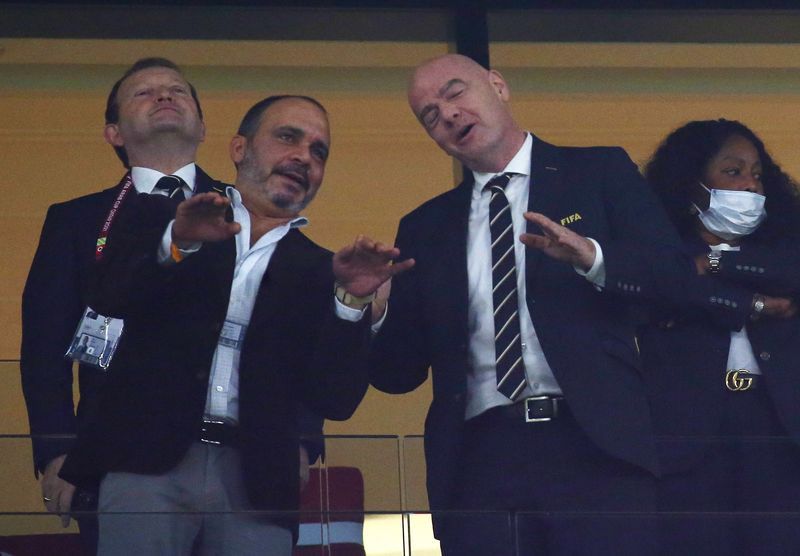
Jordan's national football team and coaching staff have finally received payments they were owed for reaching the final of the 2025 Arab Cup in Qatar, according to Prince Ali bin Hussein, president of the Jordan Football Association. The announcement came on Thursday, just two days after Prince Ali made stark allegations that FIFA had engaged in what amounted to financial coercion, offering to resolve the kingdom's administrative problems in exchange for his endorsement of FIFA President Gianni Infantino. The timing of the payment release—coming immediately after his public accusations—has amplified questions about governance practices within world football's ruling body during a politically fraught period for its leadership.
The most striking aspect of this dispute is the extended timeline of the non-payment. Jordan qualified for the Arab Cup final in December, yet the prize money remained outstanding for eight months. In the interim, the Jordanian FA was forced to navigate administrative challenges without resources that should have been allocated automatically. This delay is not typical administrative friction; it represents a systematic withholding of contractually due compensation at a time when Prince Ali was being approached by FIFA to support Infantino's continued presidency. The coincidence raises serious questions about whether payments were deliberately held hostage pending political alignment, a practice that would constitute a fundamental breach of FIFA's governance principles.
Prince Ali's allegations centre on conversations that occurred during the World Cup period, when he claims FIFA officials made clear that his backing for Infantino "would go a long way to helping our FA out." This statement was not made in the abstract. It came at a specific moment when Jordan's association was actively awaiting funds it had legitimately earned through its team's performance. The implicit bargain—provide political support and receive what is owed to you—sits uncomfortably within any credible framework of international sporting administration. Whether FIFA's communications constituted explicit blackmail or implied quid pro quo arrangements, the appearance of conditioning financial obligations on political loyalty is deeply troubling for an organization that claims to uphold integrity in global football.
The underlying context involves Infantino's failed attempt to secure commercial advantages through a controversial proposal to sell stakes in World Cup broadcasting and commercial rights. That scheme collapsed after fierce resistance from confederations and national football associations worldwide, leaving the FIFA president politically weakened heading into a leadership election cycle. In this vulnerable position, securing endorsements from regional federation leaders became critical. Prince Ali's experience suggests that at least some of these endorsement efforts were tied to resolving outstanding financial matters, creating a system where political capital could be traded for access to legitimately earned money.
Prince Ali's statement on Thursday carefully calibrated his response to the sudden payment arrival. He thanked FIFA's administration for delivering the funds while simultaneously refusing to soften his political position. This distinction matters significantly. He explicitly stated that receiving the money would not alter his assessment of FIFA's leadership or his refusal to endorse Infantino in the upcoming election. By separating the practical resolution (receiving due payments) from the political judgment (maintaining opposition to current leadership), Prince Ali avoided appearing to be bought off while still holding FIFA accountable for past conduct. His words effectively framed the payment as belated compliance with basic obligations rather than a generous gesture deserving gratitude.
The wider implications for Southeast Asian football deserve consideration. Smaller federations within Asia face similar vulnerabilities when dealing with FIFA's financial ecosystem. Prize distributions, tournament allocations, and infrastructure funding flows from FIFA through complex channels where political leverage and administrative priorities intersect. If precedent has been established that withholding payments can encourage political support, other regional associations may face comparable pressures. Malaysian, Thai, Vietnamese, and Indonesian football bodies operate within the same FIFA structure where such practices could theoretically occur, making Prince Ali's willingness to publicly expose these dynamics potentially protective for other Asian confederations.
FIFA's institutional response has been notably thin. The organization declined to comment on Prince Ali's specific allegations of coercive conduct, instead issuing a general apology for mistakes regarding the failed World Cup rights proposal. In a crisis meeting held in Morocco on Wednesday, FIFA's leadership reaffirmed support for Infantino without addressing the substance of corruption accusations. This silence is strategically revealing. A robust denial would have been straightforward if the allegations were baseless; instead, FIFA's leadership chose to let the matter pass without substantive engagement. The payment itself, released immediately after public accusations, appears to be an attempt to move past the controversy through administrative compliance rather than institutional accountability.
Prince Ali framed this situation as symptomatic of recurring problems that materialize around FIFA presidential election cycles. His observation identifies a structural pattern: whenever Infantino's position has faced serious challenge, controversies around governance, transparency, and potentially corrupt practices tend to surface. The frequency of such accusations during leadership transitions suggests that FIFA's electoral system creates perverse incentives where federation leaders can extract concessions by threatening to withdraw support. Whether explicitly coordinated or emerging from individual federation leaders recognizing their leverage, this dynamic corrupts FIFA's internal politics and subordinates the sport's governance to factional maneuvering.
The release of Jordan's payment after public allegations represents a pyrrhic victory for Prince Ali. He secured what should never have been withheld, but the manner of its release—only after accusation and public pressure—confirms the essential problem he identified. Legitimate financial obligations to football associations should not depend on federation leaders first making corruption allegations public. The fact that payment was necessary following a news-generating accusation exposes FIFA's administrative system as one where money flows are conditional on political performance rather than straightforward contractual obligations. This sets a troubling precedent for how international sporting bodies manage their relationships with member federations throughout Asia and the world.

