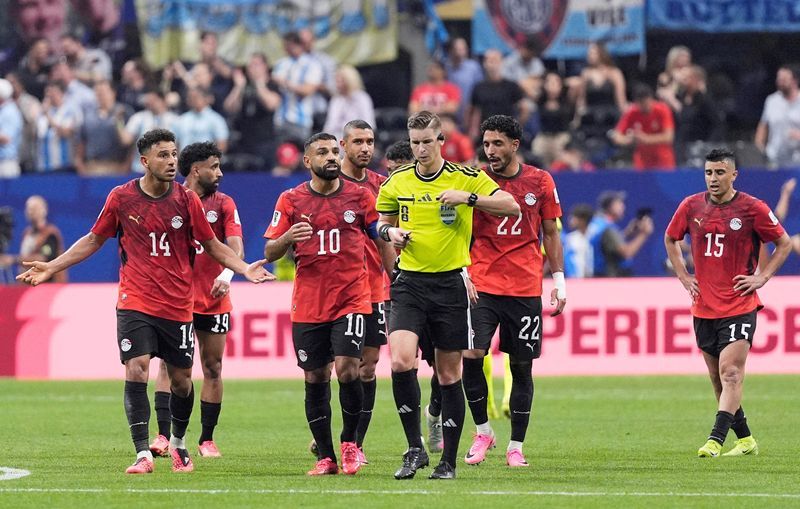
The governance of international football came under intense scrutiny this week when FIFA's most senior refereeing official moved to silence mounting criticism over the controversial round-of-16 match between Argentina and Egypt. Pierluigi Collina, who heads FIFA's refereeing department, publicly rejected claims of improper officiating in the encounter that saw Argentina overturn a two-goal deficit to secure a dramatic stoppage-time winner courtesy of Enzo Fernandez, a result that sent Egypt crashing out of the tournament.
The Egyptian Football Association had mounted a forceful protest following their team's elimination, arguing that critical moments in the match had been adjudicated unfairly. Coach Hossam Hassan suggested after the final whistle that the referee might have succumbed to external pressure designed to keep Argentina—a traditional powerhouse in world football—in the competition. The association's formal statement pointed to "several key incidents" that had raised "serious concerns" about the consistency and impartiality of the refereeing decisions, claiming these determinations "directly influenced the course of the game" in ways favourable to the Argentine side.
Collina's response, delivered through an interview published on FIFA's official digital platform, was unambiguous in its defence of the officials involved. He stressed that while constructive technical debate about specific referee judgments would always form a legitimate part of football discourse, accusations questioning the integrity of World Cup officials crossed a line that FIFA would not tolerate. The refereeing chief appeared particularly concerned about the potential consequences of such allegations, warning that unfounded claims of bias could endanger match officials and expose their families to threats and harassment.
Central to Egypt's grievances was the disallowance of a goal scored by Mostafa Zico in the second half. The Egyptian federation contended that the foul cited in the build-up to the strike was non-existent, representing what they viewed as an egregious error that fundamentally altered the match's trajectory. According to Collina's explanation, the Video Assistant Referee system had correctly identified contact between Egyptian defender Marwan Attia and Argentine defender Lisandro Martinez during the attacking sequence that preceded Zico's finish. Collina reiterated FIFA's position that "a foul is a foul" regardless of whether it appeared obvious to observers at the stadium or watching broadcasts, emphasizing that VAR's role included identifying infractions the on-field referee might have missed.
Equally contentious was the moment immediately preceding Argentina's winning goal, when Mohamed Salah appeared to be brought down by opponent Julian Alvarez. The Egyptian camp viewed this as a clear penalty that should have been awarded, potentially altering the match's conclusion. Collina defended the decision not to penalise Alvarez's challenge, arguing that both the referee on the pitch and the VAR team had assessed the contact as "normal football contact" rather than a foul worthy of a penalty kick. The FIFA official drew a technical distinction, noting that defenders who touch the ball first and then make routine physical contact have not committed an offence, whereas deliberately stepping on an opponent's foot constitutes a clear violation.
The controversy highlights deepening tensions within international football regarding the application of technology in refereeing decisions. While VAR was introduced to enhance accuracy and eliminate clear errors, its implementation has frequently generated fresh disputes, particularly when subjective judgment remains necessary. Collina acknowledged this inherent tension, conceding that some decisions would always involve an element of interpretation. However, he insisted that FIFA remained satisfied with how VAR protocols had been consistently applied across all matches in the tournament.
For Malaysian and Southeast Asian football enthusiasts, this dispute carries particular relevance as it underscores how even the world's most prominent football competition remains subject to controversial decision-making. The incident demonstrates that access to video technology does not automatically eliminate disagreement over refereeing judgments, especially when determining whether contact constitutes a foul or falls within acceptable physical play. These questions matter beyond Argentina and Egypt, shaping how football is officiated globally and influencing confidence in the sport's fundamental fairness.
Collina's emphatic assertion that FIFA refereeing cannot be influenced by anyone—a statement notably including FIFA president Gianni Infantino himself—aimed to underscore the organization's commitment to referee autonomy. The refereeing chief positioned FIFA's system as insulated from political or commercial pressures that might theoretically favour particular nations or outcomes. Whether this assurance would satisfy Egypt's football authorities remained unclear, though the federation's broader complaint touched on questions of consistency that extend beyond any single match.
The episode reveals ongoing friction between different visions of how football should be governed in the modern era. Traditional perspectives emphasize the referee's authority and the need to accept on-field decisions as final, while contemporary approaches increasingly invoke technology to revisit and potentially overturn those decisions. Egypt's complaints suggest that technology alone cannot resolve fundamental disagreements about what constitutes fair play, particularly when the rules themselves permit subjective interpretation of contact and intention.
Looking forward, this controversy may prompt further refinement of VAR protocols and clearer guidance on distinguishing between fouls and normal football contact. The incident also raises questions about transparency in post-match review processes and whether FIFA should provide more detailed public explanations of contentious decisions, beyond official statements. For football governance across Asia and the world, the Argentina-Egypt match serves as a reminder that institutional credibility rests not merely on technological capability but on demonstrating consistent, predictable, and transparently defensible decision-making. Collina's intervention represented an attempt to restore that confidence, though critics might argue that detailed engagement with the specific technical judgments rather than sweeping statements about integrity would have proven more persuasive.

