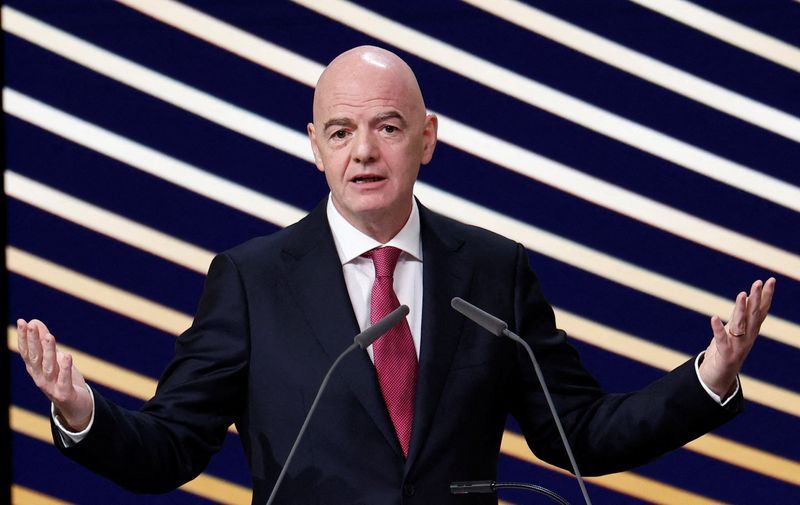
FIFA President Gianni Infantino confronts an unexpectedly turbulent path to re-election as his leadership of world football's governing body comes under sustained attack from multiple continental confederations. The catalyst for the current crisis stems from a controversial proposal to bring private equity investment into the World Cup, a scheme that has fractured the coalition of support upon which Infantino had relied. National football associations in Serbia, Sweden, and Wales have formally withdrawn their endorsement, signalling a broader rebellion among member federations that could reshape the political landscape heading into the 2027 FIFA presidential election scheduled for March 18 in Morocco.
The failed private equity initiative reveals deeper fissures within FIFA's governance structure that extend beyond the immediate controversy. The proposal, which would have sold a minority stake in the World Cup to private investors, triggered an unusually coordinated response from football's regional powerbrokers. Each confederation has articulated distinct but complementary objections, suggesting this represents not a temporary disagreement but a fundamental challenge to Infantino's vision for football's commercial future. The rebellion demonstrates that even a sitting president enjoying substantial institutional advantages cannot push through transformative changes without building broader consensus among the governing bodies that ultimately wield electoral power.
Victor Montagliani, who leads CONCACAF, the confederation governing North American and Caribbean football, has emerged as a likely challenger to Infantino. The Canadian businessman commands significant leverage given that his confederation hosts the 2026 World Cup, the first tournament staged in North American territory since 1994. While CONCACAF rejected Infantino's private equity scheme, the confederation has stopped short of the wholesale boycott that UEFA declared, suggesting Montagliani may be positioning himself as a middle-ground alternative who can unite fractured federations while maintaining pragmatic engagement with FIFA's commercial ambitions.
Europe's football establishment has coalesced around its own succession concerns. UEFA President Aleksander Ceferin, the Slovenian administrator, boycotted the World Cup final last month in protest over longstanding disputes with FIFA leadership. His dramatic absence underscored UEFA's status as perhaps the most economically powerful and politically influential confederation, commanding nearly a third of FIFA's voting strength through its member nations. The European confederation has articulated the most forceful critique of Infantino's governance, alleging that the private equity proposal exposed systematic failures in FIFA's consultation mechanisms and decision-making transparency that demand institutional correction.
The Asian Football Confederation has added its own voice to the swelling chorus of criticism. Sheikh Salman bin Ibrahim Al Khalifa, a senior Bahraini official serving as AFC vice president on FIFA's Council, has consistently opposed Infantino's more expansive visions for tournament restructuring, including the proposed expansion to 64 teams. The AFC's formal statement regarding the private equity initiative went beyond simple opposition, contending that the proposal laid bare fundamental weaknesses in FIFA's governance architecture that require systematic reform. This positioning suggests that Asian federations may use the 2027 election as leverage to demand greater institutional accountability and consultation before major commercial decisions.
Qatari sports entrepreneur Nasser Al-Khelaifi, who heads Paris Saint-Germain, has attracted backing from European officials as a leading alternative candidate. According to recent political reporting, continental football elites have begun rallying support around the Qatari executive, viewing him as someone who can navigate the intersection of commercial sophistication and political acceptability. His candidacy potentially bridges the divide between those seeking continuity in FIFA's commercial trajectory and those demanding governance reform, though his outsider status and complex relationships within European football also present vulnerabilities.
Lise Klaveness, president of the Norwegian Football Federation, represents perhaps the most unconventional option among potential successors. As one of global football's most prominent women executives, Klaveness has distinguished herself through principled opposition to Infantino's World Cup privatisation proposal. Her leadership of Norway's federation, one of Europe's most vocal and independent voices within UEFA, positions her as a candidate who could capitalise on growing demands for governance transparency and ethical reform. However, her relative distance from FIFA's internal power structures and the historical dominance of male leaders in the presidency raise questions about whether traditional power brokers would unite behind her candidacy.
The current succession crisis reflects deeper tensions within FIFA regarding the balance between commercial expansion and institutional legitimacy. Infantino's tenure has pursued aggressive monetisation strategies, but the recent controversy suggests these ambitions have outpaced the political consensus required for their implementation. The private equity debacle has provided a focal point for longstanding grievances about consultation, transparency, and the concentration of decision-making authority within the presidency. Multiple federations view the 2027 election as an opportunity to reassert member influence over FIFA's strategic direction and impose structural constraints on executive prerogative.
Regional dynamics complicate the presidential succession picture considerably. North America's hosting of the 2026 World Cup elevates CONCACAF's political weight during the transition period, potentially strengthening Montagliani's hand. UEFA's economic dominance and institutional cohesion position Ceferin or his preferred successor as formidable contenders regardless of other considerations. Meanwhile, the AFC's growing commercial importance and voting bloc strength mean that any viable candidate must secure explicit backing from major Asian federations. The interplay among these regional powers will likely determine the outcome more decisively than individual personality or policy positions.
For Malaysian and Southeast Asian football stakeholders, the succession contest carries tangible implications for how FIFA will govern future World Cup tournaments and structure continental competitions. Changes to the presidency could reshape how FIFA approaches the commercial development of football in Asia, influences the allocation of media and sponsorship revenues, and determines tournament expansion policies affecting regional qualification pathways. Southeast Asian federations maintain modest voting power within the AFC structure but have been attentive to governance questions, suggesting that transparency and consultation become central campaign issues. The next FIFA president will inherit an institution substantially weakened by governance controversies and facing sustained pressure to demonstrate responsiveness to member federations across all continents.

