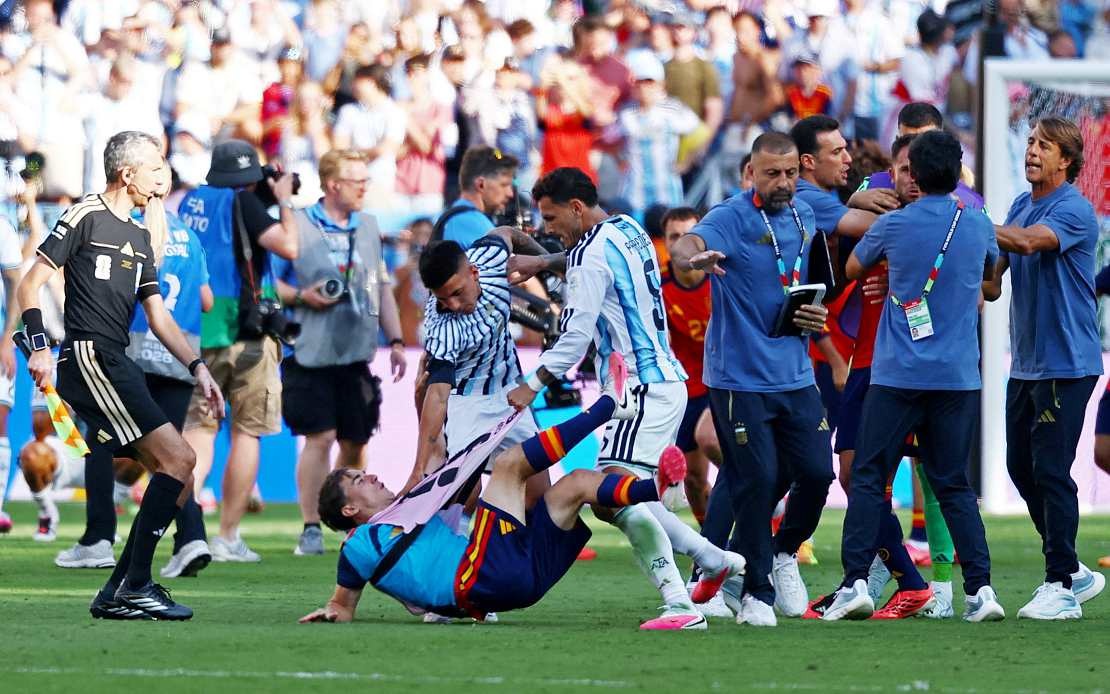
Football's governing body FIFA has initiated a formal investigation into Argentina's conduct during their World Cup final defeat to Spain, signalling that the tournament's climactic match has left lingering disciplinary questions beyond the final scoreline. The decision to appoint a Disciplinary and Ethics Prosecutor marks an escalation from the initial review of match reports, indicating that officials identified sufficient cause for deeper examination of events that occurred in New Jersey after the closing whistle.
The most visible incident spurring the inquiry involved Argentina midfielder Leandro Paredes, who appeared to throw punches at Spanish players as they celebrated victory on the pitch. While the South American side emerged as runners-up, the altercation between Paredes and Spain's triumphant squad has drawn scrutiny from football's disciplinary authorities, who must now determine whether such conduct violated the FIFA disciplinary code. The confrontation exemplifies the intensity that characterised this particular World Cup final, though the focus has now shifted from sporting excellence to regulatory compliance.
Argentina's physical approach throughout the tournament had already drawn commentary from observers and officials alike. During their semi-final victory over England, the team faced further criticism for their robust playing style, with midfielder Enzo Fernandez receiving a straight red card for accumulating two bookable offences. This pattern of aggressive conduct, culminating in the post-match incident with Spanish players, has positioned Argentina at the centre of FIFA's enforcement attention as the investigation proceeds.
The scope of FIFA's inquiry extends beyond the immediate post-match altercation. Uncertainty remains about whether investigators will also examine Argentina's display of a banner asserting Argentine sovereignty over the Falkland Islands following their England victory. Such political gestures have become a contentious area within international football regulation, and the specific act potentially contravenes Article 34.3 of the tournament's regulatory framework. The Argentine Football Association (AFA) previously incurred financial penalties for a comparable incident during a 2014 friendly match against Slovenia, establishing precedent for how FIFA might respond should this matter fall within the investigation's remit.
FIFA's approach to political expression through sporting platforms has become increasingly stringent in recent years. The contrast with UEFA's enforcement is instructive: European football's governing body imposed match bans on Spain's Rodri and Alvaro Morata after they engaged in chanting about Spain's territorial claims to Gibraltar following their Euro 2024 victory. This demonstrates that UEFA adopted a more severe disciplinary stance than FIFA has historically employed for comparable infractions, raising questions about consistency in how international football bodies enforce regulations against political gestures.
The broader context of FIFA's enforcement philosophy illustrates deepening tensions between players' freedom of expression and organisational regulatory requirements. During the 2022 World Cup in Qatar, FIFA explicitly warned the English Football Association that captain Harry Kane faced sporting sanctions—beginning with a yellow card—if he wore the 'OneLove' rainbow-coloured armband at a tournament held in a country where homosexuality is criminalised. This decision generated substantial international controversy, with many arguing that FIFA's neutrality stance inadvertently suppressed human rights advocacy by athletes.
For Malaysian observers of international football governance, Argentina's situation offers important insights into how regulatory frameworks function at the highest levels of sport. The investigation process itself remains opaque, with FIFA's official statement indicating that further details would emerge only after the prosecutor's report reaches completion. This procedural timeline leaves Argentina in a state of uncertainty regarding potential disciplinary consequences, which could range from financial penalties to match bans for implicated players.
The incident also raises questions about FIFA's consistency in applying its disciplinary code. Different infractions appear to receive varying levels of scrutiny depending on the political or social context, yet the organisation maintains that its regulations operate neutrally across all member associations. Argentina's investigation therefore serves as a test case for whether FIFA's enforcement mechanisms function equitably or whether geopolitical considerations influence the severity of punishments.
From a Southeast Asian perspective, this situation underscores broader governance challenges facing international sports bodies. Regional football associations navigating FIFA's complex regulatory landscape must understand that conduct extending beyond traditional on-field play—including post-match behaviour and political expression—now falls within investigative purview. Teams competing at the highest levels must ensure comprehensive awareness among players and staff regarding acceptable conduct across all phases of competition and celebration.
The appointment of a Disciplinary and Ethics Prosecutor signals that FIFA intends to conduct a thorough examination rather than dismiss the matter through cursory review. Argentina now faces the prospect of waiting for formal findings that could carry competitive and financial implications. The investigation's outcome may also establish precedents influencing how similar future incidents receive treatment, potentially affecting numerous nations' approaches to player conduct management during major tournaments.
Ultimately, the investigation represents FIFA's attempt to maintain regulatory authority and establish clear boundaries around acceptable behaviour, even as questions persist about the consistency and appropriateness of its disciplinary framework. For Argentina, the process ahead involves cooperating with investigators while the footballing world awaits clarification on whether post-match celebrations and political gestures will incur formal sanctions, a determination that extends well beyond the sporting sphere into broader questions about football's role in expressing national identity and political positions.

