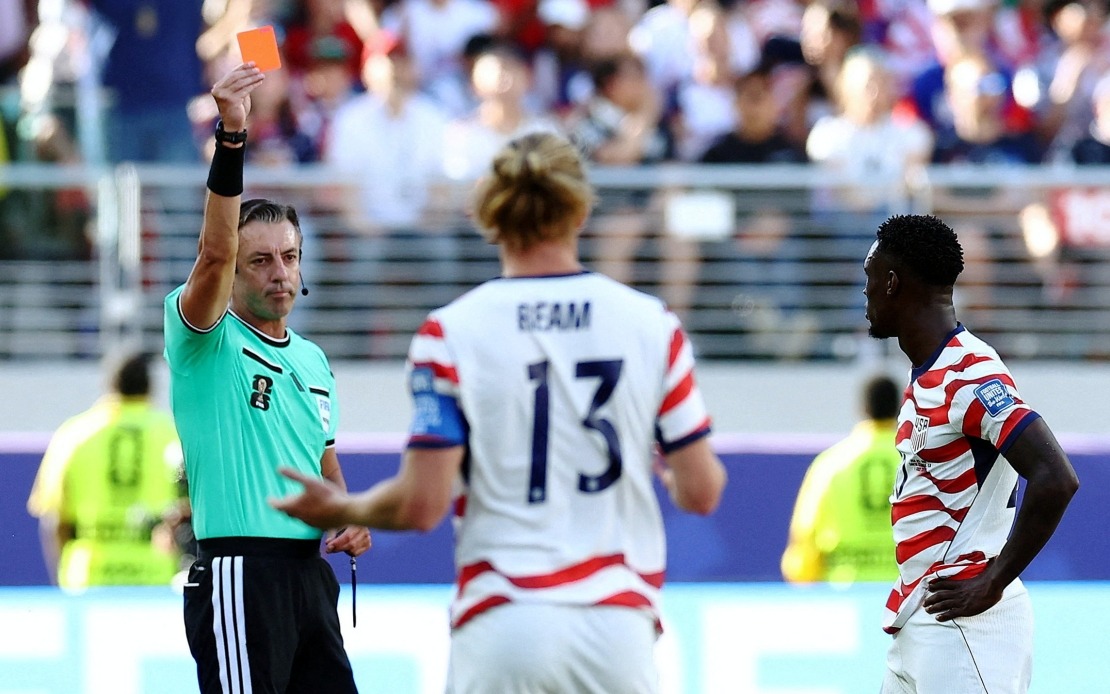
FIFA has moved swiftly to defend Brazilian referee Raphael Claus after United States President Donald Trump questioned the official's judgment in a World Cup match, marking an unusual intervention by a sitting head of state in football's refereeing decisions. The controversy centres on Claus's handling of a red card incident involving American striker Folarin Balogun during last week's last-32 encounter with Bosnia and Herzegovina, sparking an extraordinary chain of events that has drawn Trump's personal attention to the tournament's officiating standards.
The incident unfolded when Claus sent off Balogun following a review of the play using the video assistant referee system. However, the decision was controversially suspended on Sunday, clearing the way for Balogun to feature in the subsequent last-16 fixture against Belgium. The United States ultimately lost that match 4-1 in Seattle on Monday, a heavy defeat that may have amplified frustration over the earlier controversial call. Trump's public criticism of Claus on Monday effectively escalated the dispute beyond the typical post-match discussion, introducing political pressure into what is normally a purely sporting matter.
FIFA's response has been characteristically robust in defending its officiating personnel. The world football governing body issued a formal statement characterising Claus as "one of the world's leading professional referees and a valued member of Team One" at the tournament. The statement further emphasised that Claus has "consistently demonstrated the highest standards of professionalism and integrity" throughout his career, framing the official as a custodian of the game's values rather than a subject of legitimate criticism.
Pierluigi Collina, FIFA's chief of referees, reinforced this institutional backing by noting that Claus is competing in his second World Cup, having previously been selected for the 2022 tournament in Qatar. Collina's endorsement is particularly significant because he holds the technical authority over all match officials at the competition and has direct oversight of their performance standards. By characterising Claus as "experienced and highly respected," Collina signalled that FIFA maintains "full confidence" in the Brazilian official and would not be pressured into second-guessing its personnel based on external political considerations.
The controversy carries implications for how football governing bodies manage relationships with powerful political figures. Trump's direct intervention, coupled with reports that FIFA President Gianni Infantino received a personal phone call from the US leader requesting a "review" of the red card decision, illustrates the delicate diplomatic position international sports organisations navigate. Infantino offered only a general tribute to match officials without directly addressing Trump's concerns or naming Claus, suggesting an attempt to acknowledge the political pressure whilst maintaining institutional independence.
Claus's standing within FIFA's refereeing hierarchy may actually be elevated by this controversy. There is speculation that the Brazilian official could be considered for the tournament final, a position typically reserved for the most trusted and experienced arbiters. The fact that Brazil has exited at the last-16 stage removes any potential perception of bias if Claus were to officiate the championship decider, a factor that may even strengthen rather than weaken his candidacy for football's most prestigious match.
The broader context of this dispute touches on the increasing scrutiny applied to VAR decisions and officiating transparency in modern football. While fans, coaches, and now politicians frequently question refereeing decisions, FIFA's unwavering support for Claus suggests the organisation believes the decision-making process, though perhaps controversial, followed established protocols and technical standards. The governing body appears determined not to allow external pressure to undermine the authority of match officials, recognising that capitulating to such demands would compromise the integrity of competition.
For Southeast Asian football followers and officials, this incident demonstrates how major tournaments function under intense international scrutiny. Malaysian referees and administrators monitor how FIFA navigates political pressure and defends its personnel, as these precedents inform expectations for regional and continental competitions. The case illustrates that once officials are selected and deployed, FIFA typically stands firmly behind their decisions rather than retreating under pressure, an approach that maintains the credibility of the refereeing system even when individual calls prove unpopular.
Infantino's broader statement about respecting referees and the rules that govern football appears designed to establish a principle applicable beyond this specific incident. By invoking the fundamental necessity of officials to the sport's functioning, FIFA's leadership has positioned the Claus controversy within a larger framework about maintaining professional standards and avoiding the politicisation of sporting decisions. This rhetorical approach seeks to depersonalise the dispute and reframe it as a matter of systemic principle rather than individual judgment.

