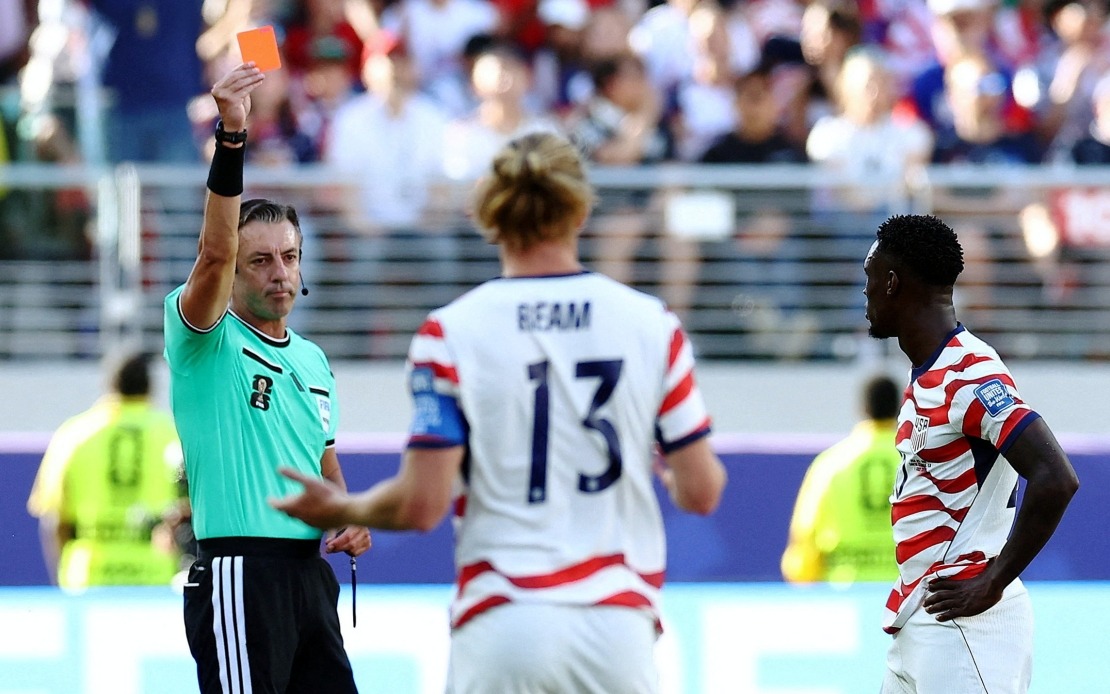
FIFA has made a controversial decision to suspend the one-match ban imposed on United States striker Folarin Balogun, making him available for Monday's World Cup round-of-16 encounter against Belgium in Seattle. The ruling, announced on Sunday, immediately sparked diplomatic friction with the Belgian Football Association, which has declared its "astonishment" at what it views as a departure from established disciplinary precedent and fair play principles.
Balogun received his red card during America's 2-0 group-stage victory over Bosnia and Herzegovina on July 1 after an incident in which he stamped on defender Tarik Muharemovic. The FIFA Disciplinary Committee found him in breach of Articles 14 and 66 of the FIFA Disciplinary Code and initially handed down a standard one-match suspension. However, citing Article 27 of the same code, FIFA subsequently suspended enforcement of the ban, subjecting it instead to a one-year probationary period.
The suspended ban arrangement means Balogun, who has been among the tournament's leading scorers with three goals for the United States, will be free to participate in a fixture that carries enormous knockout-stage significance. The winner advances to the quarterfinals, making his potential availability particularly consequential. FIFA's statement clarified that should Balogun commit another comparable infringement during his probationary year, the original suspension would automatically activate alongside any additional sanctions warranted by the new offense.
Belgium's response underscores legitimate concerns about the consistency and transparency of major tournament regulations. The Royal Belgian Football Association has argued forcefully that FIFA's invocation of Article 27 contradicts the explicit language of Article 66.4, which establishes automatic suspension for any player receiving a direct red card in tournament play. Belgium contends that this automatic suspension provision has been uniformly applied to every other red card issued throughout the current World Cup, establishing a clear precedent that should not be overridden without justification.
Further strengthening Belgium's objection is their citation of Article 10.5 of the FIFA World Cup 2026 Competition Regulations, which mandates automatic suspension for players dismissed by direct red card or second yellow, pending potential additional penalties. This regulatory framework, Belgium argues, represents the governing principle for contemporary World Cup discipline. The Belgian federation has additionally pointed out that FIFA reinforced this automatic suspension requirement through official correspondence distributed to all participating members on May 12, with further reminders during pre-match coordination sessions and training workshops.
The controversy highlights an inherent tension within FIFA's disciplinary architecture between discretionary suspension mechanisms and automatic punishment provisions designed to ensure transparent, uniform enforcement. Article 27's allowance for suspending sanctions appears, in Belgium's interpretation, to function as an exception that should be deployed rarely and only under extraordinary circumstances meriting deviation from standing tournament protocols. That a star player's involvement in a major knockout fixture appears to have influenced the application of this exception naturally generates suspicion about whether competitive advantage considerations have overridden regulatory consistency.
From a Malaysian and regional Southeast Asian perspective, this incident carries implications beyond the immediate contest. FIFA decisions at major tournaments establish precedent and influence how international football governance is perceived globally. Permitting discretionary exceptions to seemingly categorical tournament rules, particularly when they advantage established footballing nations with knockout-stage stakes on the line, raises questions about whether FIFA's regulatory framework operates with the impartiality and predictability that smaller and less influential footballing nations can rely upon. Such perceptions, accumulated over time, can affect the legitimacy of international sporting governance in the region.
The United States has not qualified for a World Cup quarterfinal since 2002, making this round-of-16 tie their chance to achieve a significant milestone after two decades. This context, while understandable from an American sporting perspective, should not determinatively shape the application of tournament discipline. Belgium, meanwhile, arrives as a more established knockout-stage performer, yet faces the immediate disadvantage of preparing for a crucial match against a squad boosted by the availability of one of its most productive offensive players.
Belgium's formal notification that it is exploring all available options to protect its interests signals potential escalation. Whether this translates to formal appeals to FIFA's regulatory bodies, requests for independent review of the disciplinary decision, or other advocacy remains unclear. Nonetheless, the federation's principled stance reflects the competitive stakes and their genuine belief that FIFA has deviated from established norms without adequate justification.
FIFA officials presumably concluded that Article 27's discretionary provisions justified this exception, though their public reasoning has been minimal. The federation may have weighted considerations such as the severity of the offense relative to other red cards in the tournament, the proportionality of banning a key player from a knockout fixture for a single incident, or other contextual factors not explicitly disclosed. Transparency regarding such reasoning would strengthen public confidence in the decision.
Ultimately, the immediate sporting outcome will either validate FIFA's judgment or be cited as evidence of its shortcomings. Should the United States progress and Balogun plays a pivotal role, questions about fairness may intensify. Conversely, if Belgium prevails decisively, the controversy may recede somewhat, though the precedent-setting aspects would remain problematic for future tournament administration. Either way, this incident demonstrates how discretionary regulatory powers, when applied inconsistently or without clear justification, can undermine the perception of impartial governance in international sport.

