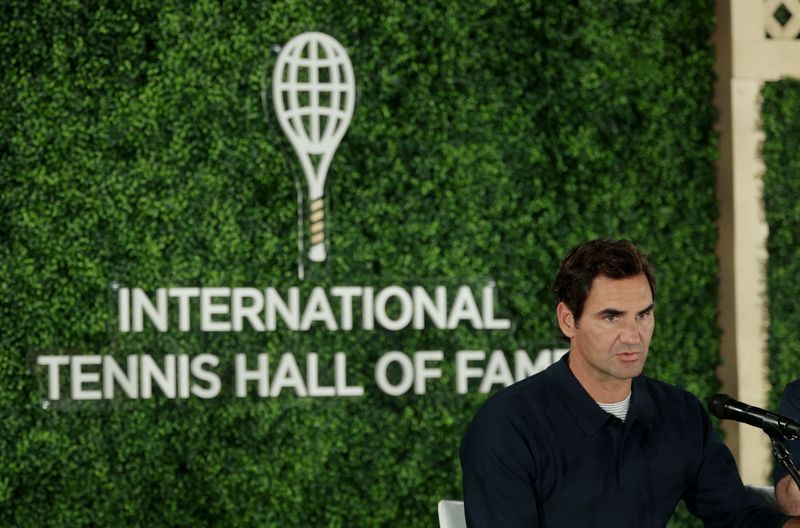
Roger Federer's enshrinement in the International Tennis Hall of Fame marks a significant milestone for the Swiss tennis legend, offering him a platform to contemplate the dimensions of his career that extend far beyond the gleaming trophies that adorned his prime years. The 45-year-old, who will be formally inducted in Newport on Saturday alongside acclaimed broadcaster Mary Carillo, emphasised that this recognition carries a profoundly different weight compared to the tangible victories and ranking points that punctuated his playing career.
Federer's resume stands as a testament to sustained excellence across two decades of elite tennis. His record encompasses eight Wimbledon championships, six Australian Open titles, five U.S. Open crowns, and the 2009 French Open—together representing a complete collection of Grand Slam victories. Beyond these major tournaments, his résumé includes Olympic doubles gold earned alongside Swiss compatriot Stan Wawrinka in 2008 and a pivotal role in Switzerland's 2014 Davis Cup triumph. When he retired in 2022, Federer had accumulated 103 ATP Tour titles and spent 310 weeks occupying the world number one ranking, figures that underscore his dominance of the professional circuit.
Yet at a news conference moderated by Hall of Fame president Patrick McEnroe, Federer articulated a vision of his legacy that transcends these statistical achievements. He expressed hope that his contribution to tennis would ultimately be assessed through a broader lens than the trophy cabinet alone. Instead, he pointed toward his collaborative efforts with sport leaders across multiple stakeholder groups—from ATP officials and Grand Slam tournament representatives to player councils—where he invested considerable time and influence to reshape professional tennis from within.
A tangible manifestation of these behind-the-scenes contributions has been the fundamental restructuring of tennis economics. Federer highlighted how prize purses across the professional circuit have expanded substantially, particularly for competitors in early-round matches who constitute the vast majority of the touring professional cohort. This democratisation of tennis earnings represents a meaningful shift in accessibility to professional tennis as a viable career path. He emphasised that such improvements extend beyond prize money alone, encompassing enhanced training facilities, better medical support systems, upgraded media infrastructure, and superior stadium amenities that benefit everyone participating in the professional ecosystem.
This strategic thinking about the sport's structural evolution reflects Federer's understanding that professional tennis thrives when opportunities exist across the competitive spectrum. By advocating for improvements in first and second-round compensation and working conditions, he has helped ensure that the base of the professional tennis pyramid widens, creating sustainable livelihoods for thousands of players who will never win Grand Slams or break into the top rankings. Such systemic improvements have profound implications for emerging tennis markets, particularly in Southeast Asia and the broader developing world, where professional tennis represents a genuine economic opportunity for talented athletes from middle-income backgrounds.
Federer's reflections on his own psychological relationship with pressure and expectation offer nuanced insight into the mental dimensions of elite sport performance. He acknowledged that his trajectory from gifted Swiss teenager to global sporting icon was accompanied by mounting external pressures and scrutiny. Rather than viewing this as an obstacle, he reframed his early embrace of championship venues and high-stakes situations as a deliberate psychological positioning. He preferred the brightness of Centre Court to the relative obscurity of secondary practice courts, suggesting that confronting elite challenges head-on rather than avoiding them shaped his competitive identity.
However, Federer's candid acknowledgment of the psychological toll inherent in elite sport competition adds important texture to discussions about athlete wellbeing. He described how the relentless external commentary surrounding professional athletes can create an overwhelming cognitive environment, wherein performers are reduced to binary assessments of victory or defeat. This observation resonates particularly with contemporary discussions about mental health in professional sports, where athletes increasingly report anxiety and burnout stemming from constant evaluation and judgment. Federer's assertion that he generally managed to retain enjoyment despite these pressures suggests resilience developed through intentional psychological management, though he notably did not claim this experience was universally accessible to all competitors.
Looking toward his post-retirement future, Federer indicated openness to various pathways for contributing to professional tennis. He mentioned the possibility of eventually captaining the Laver Cup, a team-based exhibition event that brings together elite players in a competitive format designed for global audiences. He also expressed interest in mentoring emerging players and potentially transitioning into commentary roles. These possibilities reflect his recognition that professional athletes possess valuable experience and perspective that can enrich the sport after their competitive careers conclude. His continued attendance at three to five events annually demonstrates deliberate effort to maintain connection and relevance within the professional tennis community.
Federer's articulation of his post-retirement motivations—specifically the emotional and intellectual rejuvenation derived from remaining engaged with the sport—highlights how elite athletes often struggle with the transition from competition to retirement. The prospect of identifying meaningful contributions that align with his existing expertise and passion appears central to his plans for this new chapter. For Southeast Asian tennis communities and emerging markets, Federer's continued involvement offers potential benefits, as his global platform and credibility could help amplify development initiatives and opportunities within the region.

