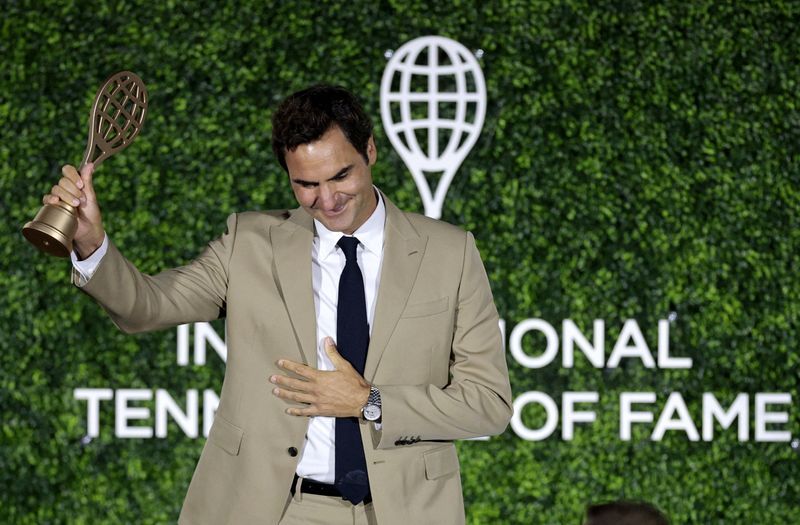
Roger Federer, one of sport's greatest champions, formally entered the International Tennis Hall of Fame in Newport, Rhode Island on Saturday, marking the culmination of a career that redefined modern tennis. The 20-time Grand Slam title holder was visibly moved throughout the ceremony, sharing personal reflections with an audience that included fellow inductee broadcaster and journalist Mary Carillo. For Federer, the honour transcended the typical trappings of athletic achievement, representing instead a profound recognition of a life devoted to excellence, creativity and the pure love of competition.
The Swiss maestro's induction speech revealed a competitor whose motivations extended far beyond the pursuit of trophies and records. Federer emphasised that while his career produced eight Wimbledon crowns—a men's record at the time of his retirement—along with six Australian Open titles, five U.S. Open victories and one French Open championship, these accomplishments emerged from a deeper personal philosophy. He articulated that his primary ambition was never the accumulation of fame or ranking points, but rather the opportunity to dedicate his professional existence to an activity that ignited genuine passion within himself and those around him.
The three-hundred-and-ten weeks Federer spent ranked as world number one underscore the consistency of his dominance across four decades of professional tennis. Yet in his remarks, he prioritised substance over statistics, choosing instead to emphasise the intangible qualities that defined his approach to the sport. His playing style became legendary for its fluidity and innovation—the serve-and-volley technique, the unpredictable return-of-serve attack he famously termed the SABR, and his willingness to construct points with tactical audacity rather than mere power. These elements, combined with his signature headband and the eccentric habit of wearing two pairs of socks, created an unmistakable identity that transcended the baseline.
Federer's comments about still composing his love letter to tennis carried profound significance for a player who retired in 2022 after accumulating 103 ATP Tour titles. Rather than treating his induction as a formal farewell, he framed it as a transition point in an ongoing relationship with the sport. The emotional moments came as he acknowledged the people instrumental in his journey—his coaches, medical team, and crucially, his wife Mirka, whose steadfast partnership provided the foundation for his professional achievements. This recognition of the human infrastructure behind athletic success offered a counterpoint to the tendency in sports narratives to isolate individual brilliance from its supporting ecosystem.
The significance of Federer's induction resonates particularly across Asia, where his influence on tennis participation and viewership proved transformative. His rivalry with Rafael Nadal captivated global audiences and elevated the sport's profile in regions previously underrepresented in tennis' commercial consciousness. For Malaysian and Southeast Asian tennis enthusiasts, Federer represented a model of sporting grace—a player whose technical mastery was matched by comportment and respect for opponents, coaches, and the game itself. His ability to inspire audiences transcended geographic boundaries, making his entry into the Hall of Fame a moment of significance for international tennis communities.
In his address, Federer explicitly connected his career achievements to his childhood experiences in Basel, Switzerland, where at thirteen years old he worked as a ball boy and watched professional tennis with wide-eyed fascination. This autobiographical grounding demonstrated how early exposure and genuine passion could evolve into sustained excellence across nearly two decades at the sport's highest level. For young aspiring players across Southeast Asia, this narrative pathway offers instructive lessons about the relationship between early enthusiasm and professional development, suggesting that sustainable achievement emerges from authentic interest rather than purely strategic career planning.
Federer's reflections on playing across multiple generations of champions—from Andre Agassi and Lleyton Hewitt through Andy Roddick, Rafael Nadal, and Novak Djokovic—illuminated the evolution of professional tennis during his competing years. His willingness to embrace changing tactics and conditioning standards while maintaining his distinctive playing philosophy demonstrated adaptive excellence. Rather than lamenting how the sport transformed around him, Federer positioned himself as an active participant in tennis' continuous development, constantly experimenting with approaches that surprised opponents and entertained audiences.
Looking forward, Federer articulated a vision for professional tennis that balances the sport's increasing globalisation and acceleration with preservation of its foundational values. He advocated for maintaining the amateur spirit among professionals, emphasising the importance of camaraderie between competitors and encouragement of authentic self-expression. This perspective carries particular relevance for Southeast Asian tennis development, where the influx of international competition and professional opportunities could potentially dilute local tennis cultures if not carefully managed. Federer's emphasis on retaining the human elements of athletic competition offers a template for regions navigating the tension between professionalisation and community engagement.
The Swiss champion's call for future players to pursue innovation and intellectual curiosity within competitive frameworks reflected his own career philosophy. He encouraged the next generation to question conventional tennis wisdom and take calculated risks that could advance the sport's technical and tactical evolution. This prescriptive message—that professional excellence and creative experimentation need not conflict—extends beyond tennis into broader conversations about how developing sporting nations can foster both competitive success and distinctive playing styles that reflect local traditions and preferences.
Federer's induction represents a temporal marker in tennis history, yet his continued engagement with the sport suggests that his most significant contributions may extend beyond his playing record. His articulation that tennis will remain central to his life despite retirement from competition indicates an intention to remain influential in shaping the sport's future direction. For Malaysian readers and Southeast Asian tennis observers, Federer's Hall of Fame moment serves as a reminder that sporting legacies encompass not merely championship tallies but the philosophies, values, and inspirational examples that athletes leave for subsequent generations of competitors and enthusiasts.

