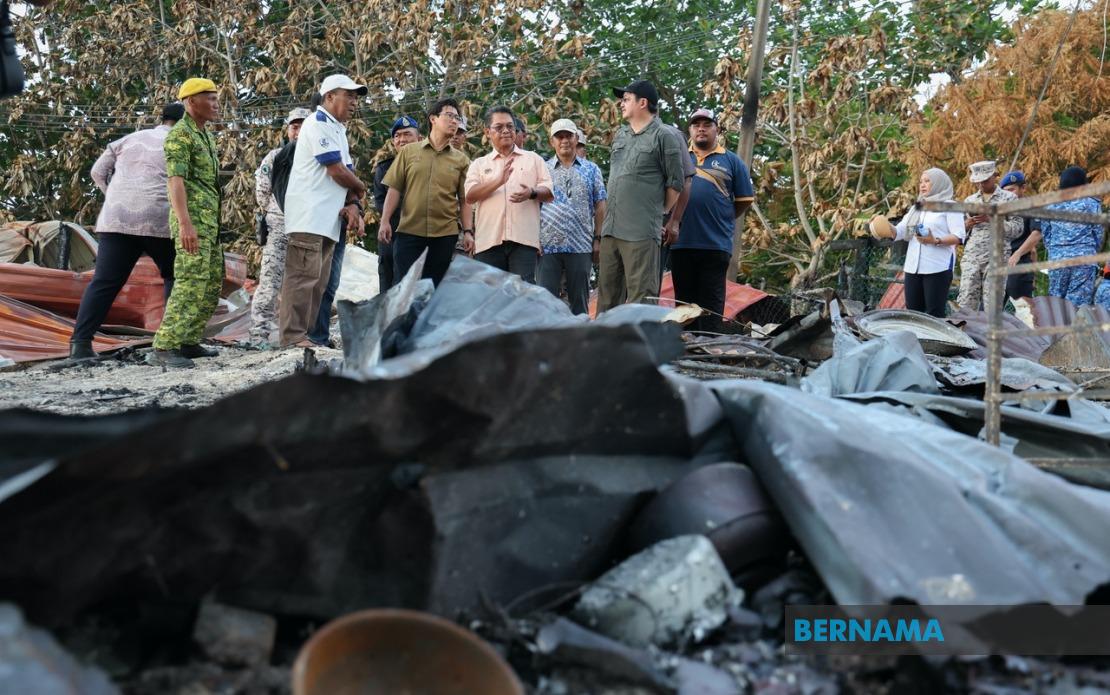
A fire that swept through Kampung Nunuyan Laut in the early hours of yesterday morning has prompted swift federal intervention, with the Prime Minister's Department (JPM) moving to support the affected community. The blaze, which erupted around 3 am, destroyed 28 residential structures and displaced more than 100 residents across 29 households, making it a significant humanitarian crisis for the coastal settlement in Sandakan. Immediate assistance has already been mobilised, with wheelchairs provided for elderly residents requiring mobility support and other essential relief measures put in place to alleviate the immediate hardship facing survivors.
Datak Mustapha Sakmud, Minister in the Prime Minister's Department responsible for Sabah and Sarawak affairs, visited the disaster site alongside Sandakan Municipal Council (MPS) president Datuk Walter Kenson to assess the scale of destruction and coordinate the response. Acknowledging the urgency of the situation, Mustapha outlined a multi-agency approach wherein the JPM's Implementation Coordination Unit (ICU) would work in tandem with MPS and other relevant government bodies to conduct a comprehensive needs assessment. This systematic evaluation is essential for determining the full scope of assistance required and ensuring that relief efforts target the most vulnerable among the victims.
One of the immediate priorities identified involves restoring critical infrastructure that affects daily life for residents, particularly schoolchildren who depend on maritime transport to reach educational facilities. The jetty serving as a crucial link for school commuters has sustained damage, and Mustapha made clear that preventing further disruption to children's education is a key concern driving federal action. He instructed MPS to escalate infrastructure repair requirements to the ICU so that essential facilities can be restored promptly, underscoring the government's commitment to minimising the cascading effects of the disaster on the broader community.
The complexity of addressing the fire's aftermath is compounded by an underlying land tenure issue. Datuk Walter Kenson revealed that the affected residents have been living on privately owned property, with two separate landowners involved. This situation necessitates a more intricate resolution process that goes beyond standard disaster relief procedures. Rather than simply relocating displaced families arbitrarily, authorities must engage with private landholders while simultaneously exploring alternative settlement options that provide dignified and sustainable housing solutions.
The Rural Development Department has been tasked with determining the most appropriate relocation pathway for the displaced families, with consideration being given to utilising village reserve land as a potential site for resettlement. This approach reflects a longer-term vision that extends beyond temporary sheltering, aiming instead to establish a permanent community solution. By involving the Rural Development Department in the planning process, the government is applying expertise in community development and ensuring that any relocation scheme is designed with sustainability and livelihood considerations in mind.
Beyond securing land for relocation, authorities have committed to providing comprehensive basic amenities necessary for inhabitants to rebuild their lives with dignity. Electricity connections, reliable water supply systems, and adequate transportation infrastructure including a new jetty are all being factored into the reconstruction blueprint. This holistic approach acknowledges that restoring housing alone is insufficient; survivors require access to essential services and connectivity to participate fully in economic and social activities.
The disaster highlights the vulnerability of maritime communities in Sabah, where residents often occupy informal settlements on land they do not own, creating complex challenges during emergencies. Pulau Nunuyan Laut, as a coastal locality, exemplifies this pattern of land use that characterises many fishing villages throughout the region. The coordination between federal, state, and municipal authorities in this instance demonstrates an awareness of these structural issues and a determination to use the crisis as an opportunity to formalise and improve residents' security of tenure and living conditions.
For Malaysian policymakers and regional observers, the response to the Pulau Nunuyan fire underscores the need for proactive disaster preparedness mechanisms in informal settlements. Maritime communities often lack adequate fire prevention infrastructure and emergency response capabilities, making them disproportionately vulnerable to conflagrations. The systematic assessment and relocation planning being undertaken here could serve as a model for other at-risk settlements across Sabah and Sarawak.
The involvement of multiple government agencies in coordinating the response reflects lessons learned from previous disasters and represents an evolution in Malaysia's disaster management approach. By establishing clear roles for the ICU, MPS, the Rural Development Department, and other stakeholders from the outset, the government aims to prevent the fragmentation and delays that sometimes plague post-disaster operations. The emphasis on consulting with private landowners also signals recognition that sustainable solutions require negotiating with diverse stakeholders rather than imposing top-down mandates.
Looking forward, the successful relocation and rehabilitation of Pulau Nunuyan residents will depend substantially on the follow-through capacity of implementing agencies and the adequacy of budgetary allocations. The commitment to restore the schoolchildren's transport jetty demonstrates political will to address specific community needs, but the broader infrastructure development—electricity, water systems, and permanent housing—will require sustained effort and resources. For the 100-plus displaced residents whose homes have been reduced to ash, the coming weeks and months will determine whether the initial government assistance translates into genuine recovery and improved circumstances.

