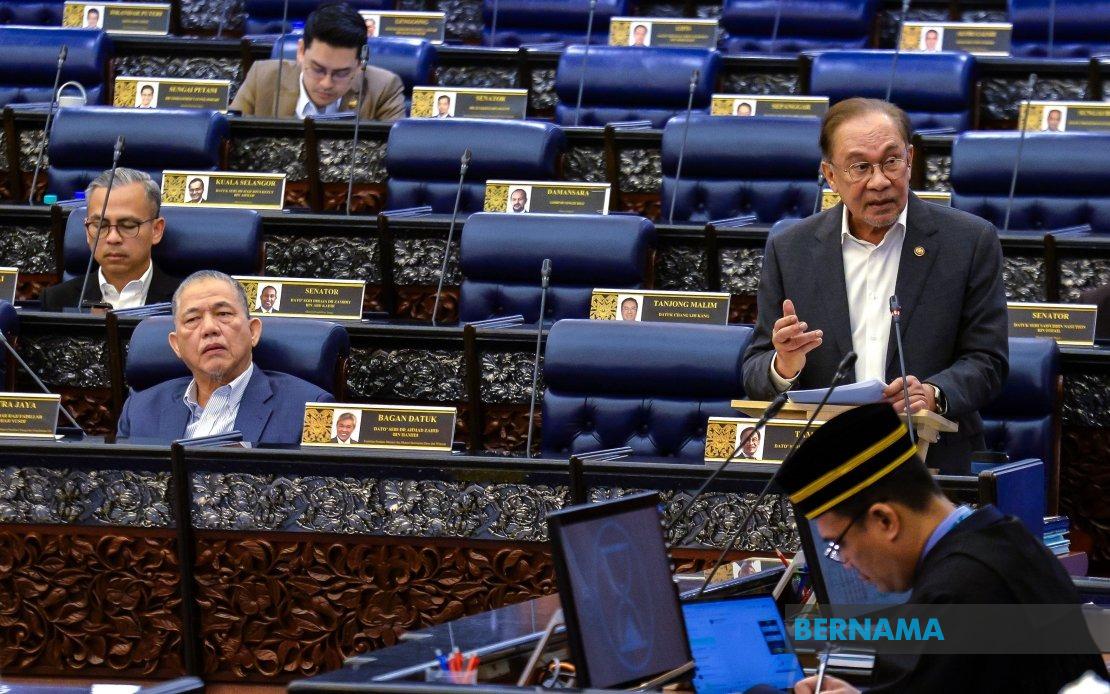
Prime Minister Datuk Seri Anwar Ibrahim has moved to quell growing concerns about fairness in how Kuala Lumpur distributes federal funds to the states, reaffirming during parliamentary proceedings on June 30 that allocations are determined fundamentally by development requirements and public welfare rather than tax collection records. His defence came in response to questions about whether the distribution system disadvantages certain states, a persistent grievance that has surfaced repeatedly across Malaysia's political landscape in recent months.
The allocation framework functions asymmetrically by design, with Anwar clarifying that the vast majority of Malaysian states receive substantially larger federal injections than the tax revenue they generate locally. This redistribution mechanism serves as a wealth-transfer mechanism from more economically productive regions towards areas with greater development deficits. The Prime Minister identified Selangor and Penang as the notable exceptions to this pattern, both states demonstrating tax collection capabilities that exceed their federal allocations—a distinction reflecting their status as Malaysia's economic growth engines.
Underscoring the MADANI Government's commitment to addressing regional disparities, Anwar enumerated the specific project categories that inform allocation decisions. Flood mitigation infrastructure represents a critical allocation driver, particularly relevant given Malaysia's vulnerability to seasonal flooding that disproportionately affects certain peninsular and East Malaysian regions. The Pan Borneo highway upgrade initiative, a sprawling development undertaking across Sarawak and Sabah, commands substantial federal resources as a strategic infrastructure priority intended to unlock economic potential in East Malaysia and improve inter-regional connectivity.
Additional allocation priorities reflected in the distribution include comprehensive road network expansion, enhanced water drainage and sanitation systems addressing basic service deficiencies in underdeveloped areas, targeted poverty reduction programmes, and educational infrastructure development. The government's approach treats these investments as essential prerequisites for equitable national development rather than discretionary spending subject to revenue-based calculations. This philosophical position fundamentally rejects the notion that states should receive federal support proportional to their fiscal contribution, instead grounding allocations in measurable socioeconomic gaps and infrastructure backlogs.
During the Ministerial Question Time session in the Dewan Rakyat, Anwar responded directly to concerns raised by Datuk Seri Doris Sophia Brodi of GPS-Sri Aman, who questioned whether federal distributions constituted an equitable arrangement given the revenue collection-allocation disparity across states. The query reflected longstanding anxieties among several state governments, particularly in more economically marginalized regions, that they receive insufficient resources relative to either their populations or the scope of their development challenges.
The Prime Minister seized the parliamentary opportunity to benchmark the current administration's performance against its predecessor, asserting that the MADANI Government has allocated higher absolute amounts to states including Kedah, Terengganu, and Kelantan compared to what these states received under previous federal leadership. This comparative framing aims to demonstrate that the current government has genuinely prioritized redistribution toward traditionally underserved regions rather than perpetuating historical allocation patterns that may have disadvantaged opposition-governed territories.
The allocation methodology also reflects the constitutional and administrative reality that federal-state fiscal relations in Malaysia have historically operated through transfers rather than autonomous state revenue generation. While states possess certain taxation powers, the federal government controls the majority of tax bases and traditionally redistributes revenue through formula-driven allocations and discretionary grants. Understanding this dynamic is crucial for Malaysian observers, as it underpins ongoing federalism debates regarding autonomy, accountability, and regional development equity.
For Southeast Asian governance observers, Malaysia's allocation system illustrates broader tensions between centralized resource control and subnational equity aspirations that characterize many middle-income developing nations. The emphasis on needs-based distribution rather than revenue-based entitlement represents a deliberate policy choice with distinct ideological and practical implications. It commits central governments to addressing regional imbalances but simultaneously concentrates power over development priorities at the federal level, potentially limiting state governments' ability to shape their own investment agendas.
The MADANI Government's emphasis on transparent, needs-based allocation criteria also responds to political pressures from opposition-led or marginalized states seeking credible assurances that they are not being deliberately starved of resources as political punishment. By anchoring decisions to measurable development gaps and infrastructure deficiencies, the government attempts to depoliticize what remains fundamentally a contested process. However, the allocation framework's complexity—involving multiple federal agencies, various funding mechanisms, and competing priorities—means that perceptions of unfairness can persist despite official explanations.
Looking forward, the sustainability of this allocation approach depends partly on federal fiscal capacity. If the government's revenue collection stagnates or declines, maintaining allocations to states while funding other national priorities becomes increasingly difficult. Additionally, as states develop and reduce infrastructure deficiencies, the needs-based justification for asymmetric allocations may require recalibration, potentially opening new rounds of interstate fiscal negotiations and disputes.

