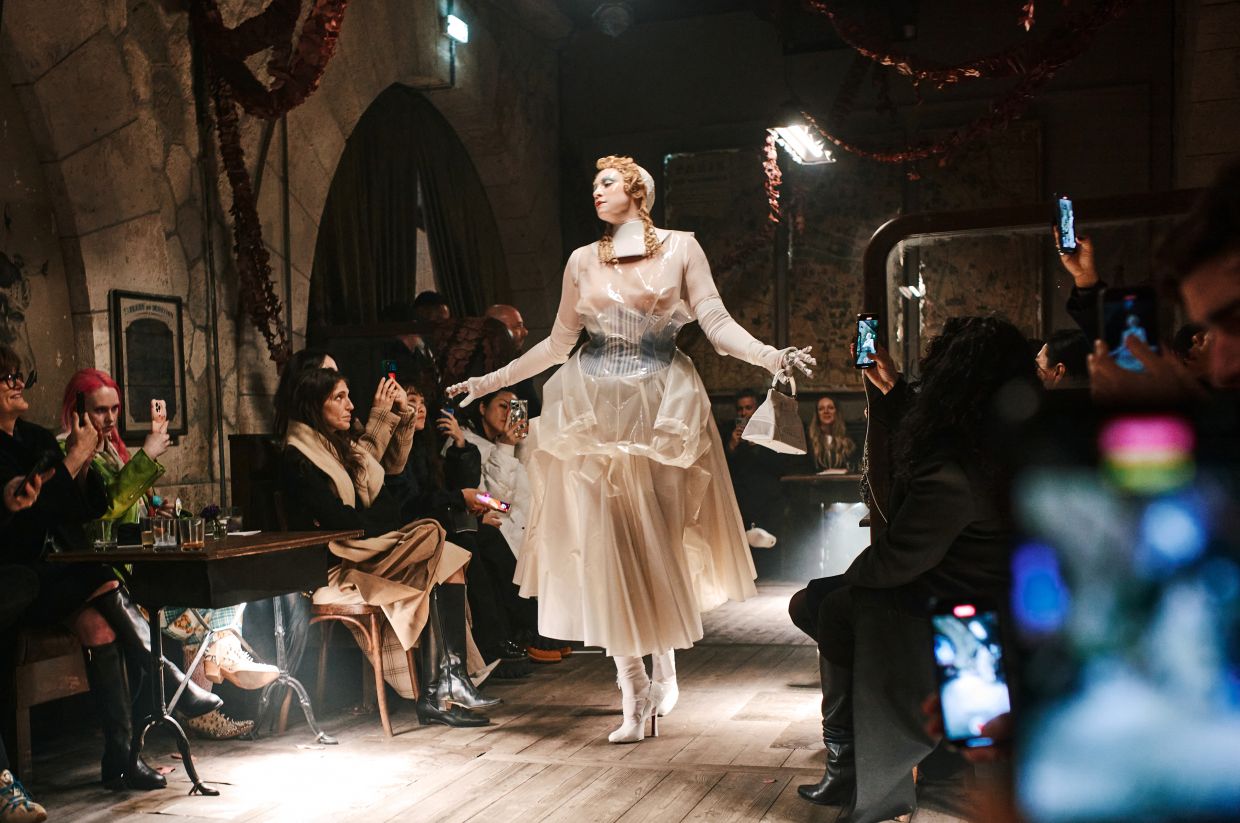
The Metropolitan Museum of Art convened an unusual gathering in May, assembling fashion industry luminaries and Jewish community leaders in closed-door discussions about whether a major retrospective of designer John Galliano could proceed without reigniting wounds or appearing tone-deaf to rising antisemitism. The initiative reflected a broader institutional anxiety: how should the art world balance artistic legacy against historical transgression, and can a figure who committed a documented hate crime achieve genuine rehabilitation within the public sphere?
Galliano's career trajectory reads as two distinct narratives. Between 1996 and 2011, he reinvented Christian Dior from an established French heritage brand into a global luxury juggernaut, pioneering architectural silhouettes and fantastical runway presentations that transcended conventional fashion into theatrical experience. His mastery of the bias-cut, his narrative world-building, and his technical innovation positioned him among the most consequential contemporary designers in the industry's modern era. Fashion institutions, critics, and collectors have long regarded his contributions as undeniable and foundational to how luxury fashion evolved in the early twenty-first century.
Then came February 2011. Video footage emerged of Galliano making shocking antisemitic remarks in a Paris bar, including the statement "I love Hitler." The fallout was immediate and severe: he was dismissed from Dior, convicted of hate crimes in a French court, and became a pariah within an industry that, despite its progressive self-image, has complex historical relationships with accountability. For over a decade, his professional exile seemed complete, though hardly absolute—the fashion world is ultimately driven by commercial viability and artistic relevance, not moral consistency.
What followed was what museum officials and community leaders are calling his period of "teshuvah," the Jewish principle of genuine repentance and transformation. Galliano entered rehabilitation, worked with London-based rabbis to study Judaism and Holocaust history, and consulted with Anti-Defamation League officials. In 2014, he emerged as creative director of Maison Margiela, a position he has held successfully for a decade. His designs now regularly appear on red carpets worn by celebrities including Zendaya, Amal Clooney, and Tyla. His vintage pieces set auction records. To much of fashion's public, he has been rehabilitated.
Yet the proposed Met exhibition—which would make him only the third living designer ever to receive a solo show at the institution, alongside Yves Saint Laurent and Rei Kawakubo—arrived at a moment of heightened sensitivity. Antisemitic incidents have surged across New York and North America. Recent attacks, including a stabbing outside a Manhattan Jewish community centre, have sharpened community concerns about institutional priorities and whose narratives get amplified through prestigious platforms. Jewish leaders approached the museum's announcement with neither automatic approval nor reflexive rejection, but rather with hard questions about process, accountability, and what a responsible exhibition might accomplish.
Museum director Andrew Bolton has framed the retrospective not as a straightforward celebration but as a complex reckoning. He plans an "orientation gallery" that will explicitly address what he terms "the rupture" defining Galliano's career—the 2011 incident and its consequences—alongside his artistic achievements. This structural choice represents a deliberate curatorial decision to deny visitors the comfort of artistic appreciation unmoored from historical accountability. Bolton has committed to using Galliano's own words rather than sanitising language, rejecting euphemisms in favour of clarity. He is also developing an online forum to facilitate ongoing community dialogue beyond the exhibition's physical space.
Rabbi Joshua Davidson of Temple Emanu-El, located blocks from the Met, articulated what many Jewish community leaders sought: not the exclusion of Galliano from cultural institutions, but rather the weaponisation of the exhibition as an educational opportunity. These leaders saw potential for the show to become a teaching platform about antisemitism's dangers, the mechanics of hate speech, and pathways toward accountability—themes urgently relevant given contemporary resurgence of such rhetoric across Western societies. This framing transforms the exhibition from a retroactive career survey into a civic intervention.
Rabbi Rick Jacobs of the Union For Reform Judaism described his May meeting with Galliano, emphasizing what he characterised as the designer's genuine openness and clarity rather than rehearsed talking points. Jonathan Greenblatt of the Anti-Defamation League publicly stated that Galliano's efforts to repair damage and learn from his incident "should be applauded." These endorsements did not emerge from naive forgetting but rather from careful judgment that Galliano's demonstrated commitment to understanding the harm he caused warranted institutional second chances—provided those institutions handled the opportunity responsibly.
Bolton's hesitation about the exhibition, which he conceived as early as 2010 but did not pursue seriously until 2024, underscores how institutional decision-making around controversial figures has evolved. He explicitly denied that delays stemmed from fear regarding Galliano's past, yet the timing and the extensive community consultation suggest otherwise. The museum's caution reflects broader uncertainty about how cultural institutions should navigate designer rehabilitation in an era when social media scrutiny and community activism constrain institutions' ability to compartmentalise artistic genius from personal conduct.
The Galliano retrospective thus becomes a test case for how the fashion world—historically comfortable celebrating genius divorced from moral examination—might mature into acknowledging complexity without abdication. Fashion has indeed moved past initial discomfort with Galliano; his commercial rehabilitation is complete. Whether cultural institutions can simultaneously honour his undeniable contributions while meaningfully reckoning with the harm his words caused represents an unresolved question. The exhibition's success will depend less on its catalogue or installation aesthetics than on whether it resists the temptation to resolve this tension prematurely, instead holding both truths simultaneously: that Galliano transformed fashion and that his antisemitic hate speech demands continuing accountability.
For Malaysian and Southeast Asian observers, this moment offers instructive parallels regarding how institutions in diverse, multicultural societies should navigate figures whose personal conduct contradicts their professional contributions. The Met's approach—engaging affected communities as partners rather than obstacles, building accountability into exhibition architecture, and refusing false reconciliation—potentially models institutional responsibility beyond fashion, with implications for how cultural institutions globally confront difficult legacies.
The exhibition remains scheduled to launch with the 2025 Met Gala, fashion's most prominent annual event. Whether it becomes a meaningful reckoning or an uncomfortable celebration will depend on whether the institution maintains its commitment to clarity and complexity through opening night and beyond, resisting inevitable pressure to prioritise spectacle over substance.

