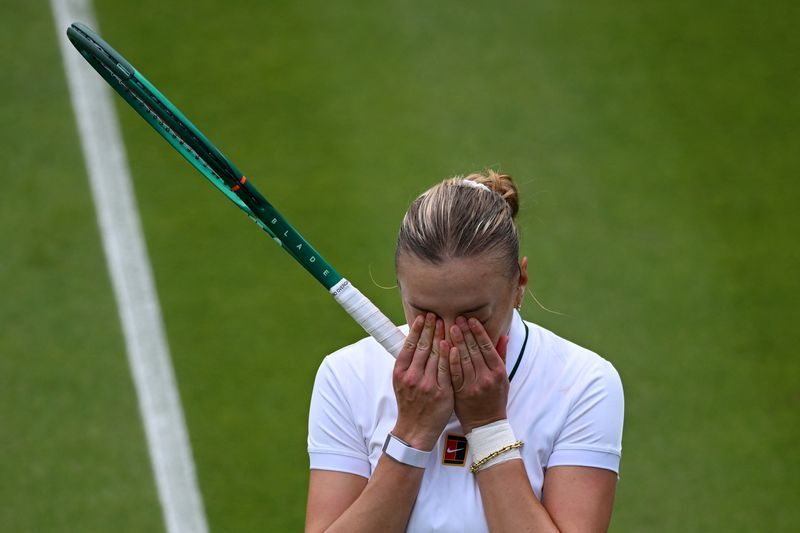
Amanda Anisimova is banking on the presence of loved ones to fuel her Wimbledon campaign this year, having experienced the tangible benefits of their support during her breakthrough run to last year's championship match. The American tennis player has repeatedly emphasised how the emotional backing of those closest to her transforms the experience of competing at the All England Club, creating an environment that extends beyond the purely competitive realm of professional tennis. For Anisimova, Wimbledon has evolved into something more than just another Grand Slam venue—it has become a place where family connections and athletic ambition intersect in meaningful ways.
During her remarkable 2023 campaign, Anisimova was accompanied by her sister Maria and extended family members, with her young nephew Jackson emerging as a crowd favourite in the stands. His presence became particularly memorable during her quarter-final victory, when he joined celebrations on court, creating moments that transcended typical tournament experiences. These personal touches illustrate how the traditional formality of Grand Slam tennis can be humanised through family attendance, transforming solitary athletic pursuits into shared family narratives that gain resonance across generations.
Following her opening-round victory over Lina Gjorcheska with a commanding 6-3 6-2 scoreline on Tuesday, Anisimova revealed that her sister had already made concrete travel arrangements several months in advance, signalling confidence in her ability to progress deep into the tournament. This forward planning demonstrates the mutual belief within her immediate family circle regarding her competitive capacity at the venue. Such logistical commitments, while seemingly mundane on the surface, reflect the psychological scaffolding that supports elite athletes navigating the pressures of major tournaments.
The emotional weight of her previous Wimbledon experience remains evident in Anisimova's reflections. She acknowledged the sting of the 6-0 6-0 defeat to Poland's Iga Swiatek in last year's final, a loss that represented the ultimate disappointment after such an extraordinary run. Yet rather than dwelling on that setback, she frames her family's support as something that softened the blow and provided meaning beyond victory and defeat. The ability to process tournament outcomes within a supportive family framework offers psychological resilience that purely individual processing cannot provide.
Anisimova's observations about her nephew reveal an interesting temporal dimension to family involvement in professional sports. She expressed a desire for Jackson to eventually comprehend the significance of his Wimbledon experiences, suggesting that she is thinking beyond the immediate present toward how these moments will be understood and valued in years to come. This perspective indicates maturity in recognising that some experiences gain their full value only through retrospective understanding, and that family documentation of these moments creates lasting archives that transcend the fleeting intensity of tournament competition.
Beyond the central emotional narrative, Anisimova's comments underscore a broader truth about professional sports psychology: the significance of proximity to support systems during high-pressure competition. When athletes can transition from match intensity to familial comfort relatively seamlessly, the cognitive load associated with tournament participation diminishes. Having her sister, in-laws, and friends present in London creates multiple opportunities for decompression and normalcy that athletes competing far from home cannot access as readily.
Last year's Wimbledon breakthrough followed by her U.S. Open final appearance—where she fell to Aryna Sabalenka—positioned Anisimova among the sport's rising stars. However, she emphasised that Wimbledon occupies a distinct psychological space in her competitive landscape. The combination of grass-court traditions, the tournament's historical prestige, and the fortuitous presence of her support network creates conditions that she experiences as qualitatively different from other major championships. This emotional geography matters significantly in professional sports, where venue-specific confidence and familiarity often correlate with improved performances.
The practical arrangements her family has made, including her sister's advance flight purchase and the presence of in-laws who genuinely enjoy the experience of watching tennis at this venue, speak to a family culture that embraces Anisimova's professional trajectory. This organic support differs substantially from contracted support staff or hired coaches—it emerges from genuine personal relationships and investment. For Malaysian readers familiar with strong family-oriented sports cultures across Southeast Asia, Anisimova's reliance on kinship networks will resonate as a deeply human element within the often-sterile environment of professional tennis.
The intersection of personal relationships and professional ambition that Anisimova describes reflects evolving attitudes within tennis toward the integration of private life and public performance. Rather than maintaining the traditional separation between personal and professional spheres, contemporary players increasingly acknowledge how emotional support from loved ones enhances their competitive capacity. This represents a subtle but significant shift in how elite athletes conceptualise the requirements for success at the sport's highest levels.
As Anisimova continues her campaign in London, she carries not only the weight of redemptive ambitions following last year's final loss, but also the concrete presence of family members who have invested time and resources in supporting her pursuit. This dual motivation—the desire to perform well for herself and to reward the faith her family has demonstrated—creates psychological layers that purely individual athleticism cannot capture. Whether this support system will translate into another deep run remains uncertain, but her belief in its significance appears genuinely rooted in previous experience and continuing confidence in the people around her.

