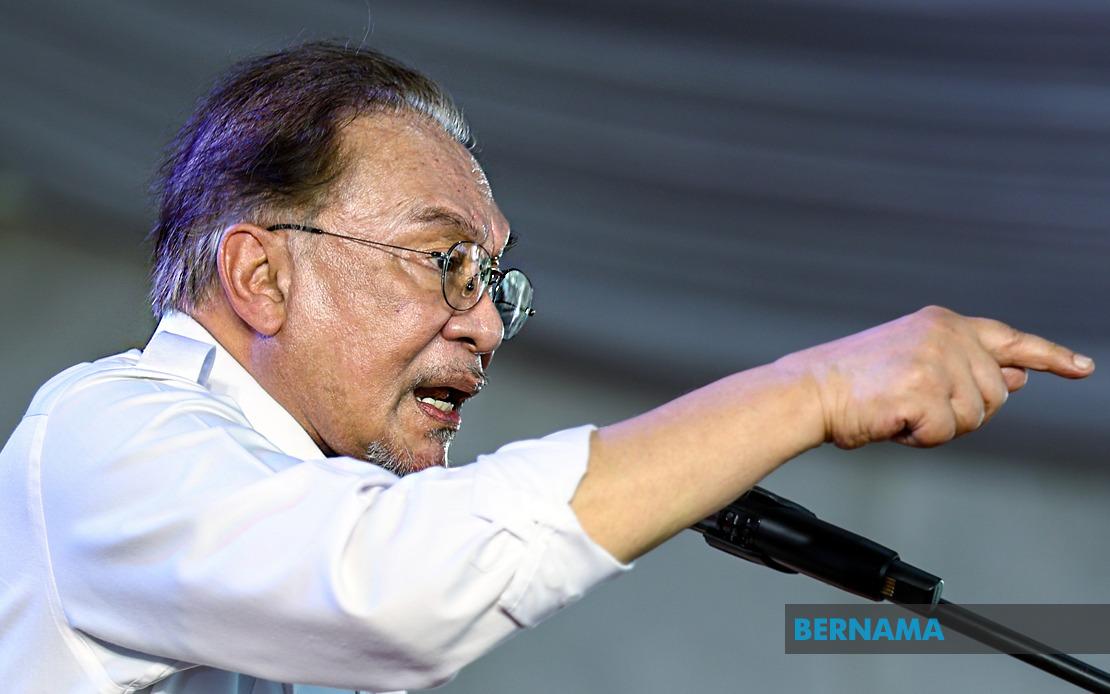
Prime Minister Datuk Seri Anwar Ibrahim has underlined the importance of impartial and inclusive governance across the country's federal, state and municipal structures, arguing that such an approach stands as a cornerstone for preserving Malaysia's unity and ensuring lasting political stability. Speaking during a hi-tea gathering with community representatives in Johor Bahru on July 4, Anwar stressed that while the MADANI Government has instituted national-level reforms, implementation challenges persist in translating these commitments into tangible outcomes at subnational and grassroots administrative levels.
The Prime Minister clarified that fair governance does not equate to automatic approval of every petition or application submitted by citizens and organisations. Rather, he emphasized that the essence of equitable administration lies in providing all communities with a genuine platform to articulate their concerns, present substantive arguments, and demonstrate their case through a process that is visibly and demonstrably impartial. This distinction is crucial, as it acknowledges the reality that not all requests can or should be granted, yet maintains that the decision-making apparatus must operate with transparency and consistency in accordance with established legal frameworks and constitutional principles.
Anwar's remarks carry particular resonance in the Malaysian context, where governance decisions frequently attract scrutiny regarding their fairness across different demographic and religious groups. The Prime Minister's emphasis on procedural transparency serves as a reminder to state governments and local authorities that their role extends beyond mere administrative execution; they must actively cultivate channels of meaningful dialogue with their constituents while remaining anchored to existing legislation and established governance norms. This balancing act—between openness to community input and adherence to legal constraints—remains a persistent challenge across Malaysia's decentralised governance structure.
Beyond the mechanics of administrative fairness, Anwar articulated a broader vision of national progress that transcends conventional economic metrics. He argued that Malaysia's advancement cannot be adequately measured through gross domestic product figures or investment statistics alone. Instead, the true marker of national success encompasses the country's capacity to nurture social cohesion, foster compassionate interactions among citizens, and cultivate reciprocal respect among its ethnically, religiously and culturally plural population. This perspective reframes the development agenda away from purely technocratic indices toward human-centred indicators of wellbeing and social harmony.
The Prime Minister, who concurrently serves as Finance Minister, cited encouraging economic trends that reflect this inclusive growth model. Malaysia's economic expansion is now permeating beyond traditional commercial concentrations such as the Klang Valley and Penang, extending investment flows into emerging regional hubs including Negeri Sembilan, Melaka and Johor. The establishment of the Johor-Singapore Special Economic Zone (JS-SEZ) exemplifies this geographic diversification, while parallel development initiatives in Sabah and Sarawak signal an attempt to distribute economic opportunity across the federation more equitably. Such spatial rebalancing of investment and growth carries implications for political stability, as it potentially ameliorates regional grievances regarding unequal development benefits.
Anwar issued a cautionary note regarding Malaysia's adoption of transformative technologies and systemic transitions, particularly concerning artificial intelligence, digital infrastructure modernisation and the transition toward renewable energy systems. He insisted that these technological and structural transformations must remain firmly rooted in moral principles, cultural sensitivity and religious values rather than proceeding as purely technocratic exercises divorced from societal contexts. This framing acknowledges persistent anxieties within Malaysian society regarding the pace and direction of modernisation, and reaffirms the legitimacy of faith-based and cultural considerations in shaping the nation's technological trajectory.
Central to Anwar's address was his concern about persistent deployment of racial and religious narratives that strain Malaysia's social fabric and corrode national unity. He explicitly called upon religious leaders to exercise greater responsibility in promoting authentic faith, compassion, justice and intergroup understanding within their respective faith communities. This appeal reflects recognition that Malaysia's religious leaders exercise considerable influence over public opinion and communal attitudes, and bear responsibility for either mitigating or exacerbating sectarian tensions through their public messaging and institutional conduct.
The Prime Minister further emphasised that governmental and political leaders must themselves become custodians of factual accuracy and integrity in public discourse. They must actively resist the temptation to exploit communal identities and religious sentiments for narrow political advantage, and instead provide their publics with reliable information and honest analysis. This appeal to leadership accountability addresses a real problem in Malaysian political culture, where opportunistic invocation of identity-based grievances has historically proven electorally efficacious even when factually questionable or empirically unsubstantiated.
Anwar grounded his governance philosophy in the aspirations of ordinary Malaysians, observing that most citizens harbour fundamentally similar desires: access to quality education for their children, healthcare for family members, functional community infrastructure, and constitutional protections for their religious and cultural practices. He noted that these freedoms and entitlements were enshrined in Malaysia's founding constitutional settlement by the nation's founders, and thus represent reaffirmation of established principles rather than novel demands. This rhetorical move serves to position inclusive governance not as a departure from Malaysian tradition but as a return to its foundational commitments.
The presence of Deputy National Unity Minister R Yuneswaran at the gathering underscored the federal government's institutional commitment to the themes articulated by the Prime Minister. The attendance of the deputy minister responsible for national cohesion signalled that these principles constitute not merely the personal philosophy of the Prime Minister but rather formal government policy. This institutional reinforcement carries significance for state and local administrators who might otherwise regard such exhortations as aspirational rhetoric rather than binding administrative expectations.
Anwar's extended commentary on governance fairness occurs within a broader Malaysian context marked by periodic communal tensions and persistent questions regarding equitable treatment across religious and ethnic lines. His systematic enumeration of both procedural fairness principles and the underlying social values they serve suggests a government acutely aware of the fragility of national cohesion and the necessity of consistent demonstration of impartiality across all administrative functions. The emphasis on community engagement and transparent decision-making at subnational levels acknowledges that governance legitimacy ultimately derives not from federal pronouncements but from daily interactions between citizens and local officials, making the conduct of state and municipal administrations crucial to broader national stability.

