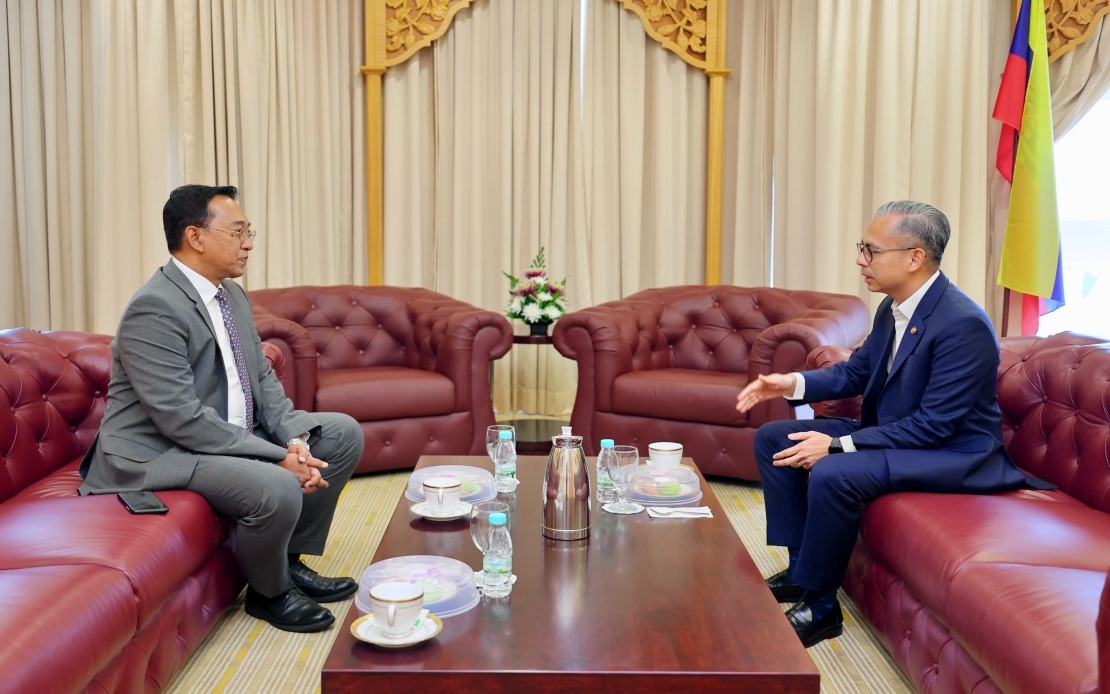
Malaysia's Communications Minister Datuk Fahmi Fadzil has held a courtesy meeting with Anwar Udzir, the country's newly appointed Ambassador to Lebanon, in a session aimed at deepening diplomatic coordination between the two officials and reinforcing Malaysia's engagement in Middle Eastern affairs at a critical juncture.
The encounter, which took place in Kuala Lumpur, served as an opportunity for Fahmi to acquaint himself with Udzir's diplomatic objectives and to establish a foundation for ongoing collaboration on matters of national interest. Through a social media announcement, Fahmi outlined the meeting's significance, emphasising that such engagements are essential for fostering stronger institutional bonds and facilitating the exchange of perspectives on pressing regional and international developments.
Anwar Udzir formally received his credentials as Malaysia's diplomatic representative to Lebanon from His Majesty Sultan Ibrahim, King of Malaysia, on May 18, 2026. This appointment represents Malaysia's commitment to maintaining active representation in the Levantine nation, a region of considerable geopolitical importance given its proximity to ongoing conflicts and its role as a hub for cross-regional diplomacy and trade.
Fahmi expressed confidence in Udzir's capacity to discharge his ambassadorial responsibilities, offering his best wishes for the diplomat's tenure in Beirut. The minister hoped that Udzir would achieve notable success in advancing Malaysian interests and presenting the nation's positions on the international stage, particularly within forums where Lebanon's influence and voice carry weight across the broader Middle Eastern sphere.
The relationship between the two officials is not newly forged. Fahmi recalled that his acquaintance with Udzir developed during the preceding year when the ambassador and his professional team played instrumental roles in orchestrating the Asia-Pacific Telecommunity Ministerial Meeting in Tokyo, Japan. That experience demonstrated Udzir's organisational competence and his familiarity with coordinating multilateral engagements, qualities that would serve him well in his new posting to one of the Middle East's most complex and strategically significant capitals.
Lebanon's importance to Malaysia extends beyond diplomatic courtesy. The nation serves as a window into Middle Eastern affairs for Southeast Asian governments seeking to understand regional dynamics, sectarian tensions, and the interplay of international powers competing for influence. Malaysia's presence through its embassy in Beirut underscores the country's broader engagement with the Arab world and its commitment to maintaining dialogue across diverse political contexts.
For a communications minister to personally meet with an ambassador reflects the administrative framework's recognition that diplomatic channels increasingly intersect with information strategy and public communications. In an era when Malaysia seeks to amplify its voice on international platforms and counter misinformation about its policies and positions, ambassadors function as crucial communicators who must articulate national perspectives effectively to host governments and local media.
The timing of this meeting also signals Malaysia's interest in reinforcing its diplomatic presence amid wider geopolitical turbulence affecting the Middle East. With Lebanon facing persistent economic challenges, political fragmentation, and the spillover effects of regional conflicts, Malaysia's continued diplomatic engagement demonstrates a willingness to maintain relations and explore areas of mutual benefit even during periods of regional instability.
Anwar Udzir's prior experience in organising international telecommunications meetings suggests his diplomatic portfolio may encompass technology and connectivity initiatives—areas where Malaysia seeks to position itself as a bridge between developed and developing nations. The Asia-Pacific Telecommunity framework, which Malaysia actively participates in, reflects shared interests in digital infrastructure, cybersecurity, and cross-border communications that resonate with contemporary development priorities.
Fahmi's public recognition of this meeting through social media demonstrates how modern diplomacy operates transparently and leverages digital platforms to communicate government activities to citizens. By documenting such encounters, Malaysian officials reinforce the narrative that the country maintains active and purposeful international engagement across multiple regions and issue areas.
Moving forward, the establishment of rapport between Fahmi and Udzir should facilitate smoother coordination when communications and information matters intersect with Lebanese affairs or when Malaysia needs to articulate positions to Arab League member states and other regional forums where Lebanon plays an active role. This foundational meeting thus represents not merely a ceremonial courtesy but a practical investment in maintaining effective diplomatic channels.

