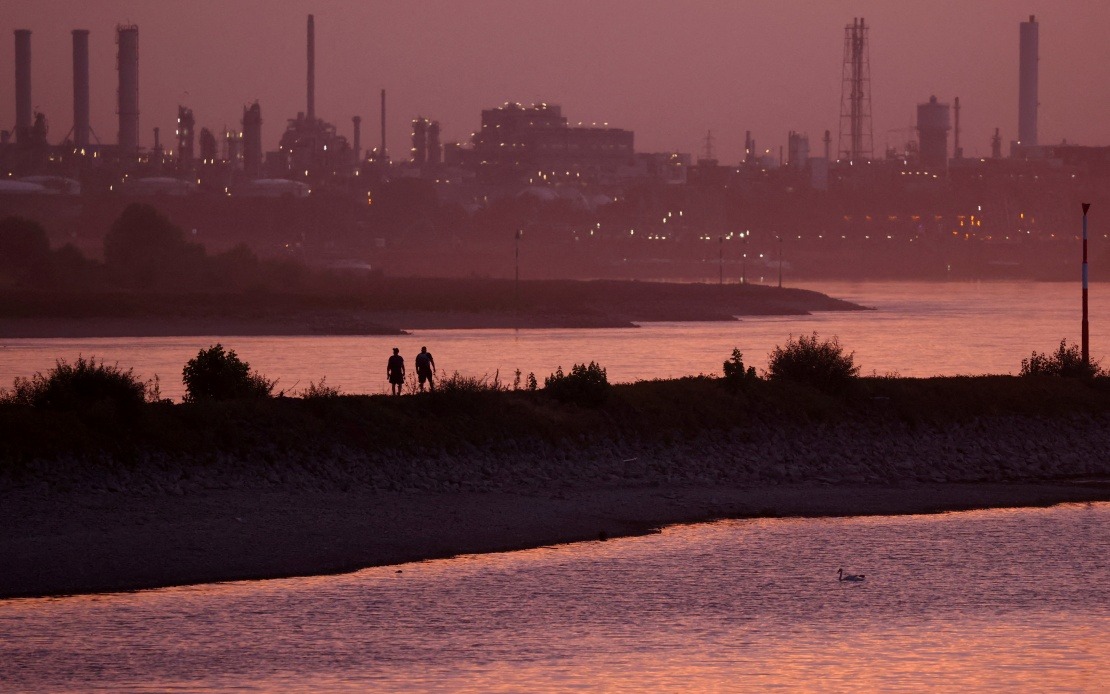
German explosives specialists were mobilised on Thursday to safely defuse a substantial World War II-era bomb discovered near Cologne after the Rhine river receded to its lowest documented level. The recovery of the munition, a United States aerial device weighing 500 kilogrammes, represents a hazard that had remained hidden beneath the river's waters for nearly 80 years until the region's unprecedented drought conditions exposed it to daylight.
The discovery underscores how climate extremes are reshaping the landscape and revealing consequences of historical warfare across Europe. The Rhine, serving as a critical economic artery for Western Europe's inland shipping sector, has become increasingly vulnerable to disruption as weather patterns shift toward prolonged periods of heat and water scarcity. Communities along the waterway now face dual challenges: managing the immediate perils of exposed ordnance while adapting to transportation systems designed for far different hydrological conditions than those now becoming regular occurrence.
Authorities in Cologne determined that approximately 360 individuals required evacuation from the vicinity surrounding the bomb's location within a 400-metre protective radius. This population encompasses residential areas, including an elderly care facility whose residents needed relocation, as well as commercial operations such as personnel stationed at nearby RTL television studios. The evacuation illustrated how historical conflicts continue to impose contemporary costs on modern urban centres, disrupting daily routines and necessitating emergency response coordination across multiple institutions.
The bomb itself came to light on Wednesday evening at Rheinpark, a recreational area that had previously been safely submerged. Its identification triggered formal defusing procedures, though authorities had not released specific timing details for the operation by Thursday morning. The deliberate pace of such interventions reflects the extreme caution required when handling aged explosives whose structural integrity cannot be guaranteed after decades of environmental exposure.
Water level measurements at Cologne's gauge reflected the severity of the hydrological crisis. The reading dropped to 67 centimetres on Thursday, matching an exceptionally low mark set merely days before, with forecasters predicting further decline to 66 centimetres later that day. These measurements translate into genuine operational constraints: vessels navigating the Rhine have been compelled to dramatically reduce cargo loads, forcing shipping companies to deploy additional trips for equivalent volumes or route freight through alternative, less economical channels. The economic implications reverberate through supply chains spanning multiple countries, as manufacturers and distributors confront increased transportation expenses and delivery delays.
The underlying cause stems from an extended period of elevated temperatures and minimal precipitation affecting the broader Rhine basin. Meteorological data indicates that recovery remains uncertain, with hydrologists projecting only marginal water level increases in the immediate future. Without substantial rainfall across upstream watersheds, the river faces potential to approach or establish new record lows, intensifying pressures on commerce and exposing additional hazards that might include further unexploded ordnance from wartime campaigns.
Historically, German waters have yielded numerous World War II munitions as environmental conditions shifted. The Rhine and other major waterways became repositories for weaponry that was either jettisoned by aircraft under attack, lost during defensive operations, or deliberately deposited to prevent seizure. Specialist teams have grown accustomed to managing such discoveries, though the accelerating frequency prompted by persistent low water conditions has strained municipal emergency resources. Each incident demands careful coordination between military authorities, civilian emergency services, and affected communities.
For Southeast Asian observers, the Rhine situation carries particular relevance given comparable vulnerabilities in the region's own crucial waterways. The Mekong River, vital to agricultural production and commerce across multiple nations, faces mounting pressure from upstream dam construction, climate variability, and seasonal extremes. Malaysia's own river systems have experienced unprecedented disruptions during recent drought periods and flooding cycles, suggesting that the challenges confronting European communities today may foreshadow difficulties requiring adaptive capacity from regional governments.
The coincidence of wartime debris exposure during climate emergencies also raises broader questions about infrastructure adaptation. Transportation networks, power generation facilities, and water management systems throughout Europe were engineered assuming relatively stable hydrological conditions. As those assumptions prove increasingly unreliable, significant investment will be required to reconfigure infrastructure for greater resilience amid temperature fluctuations and precipitation variability. The €360 million economic burden of reduced Rhine shipping represents only one component of climate-related disruption now materialising across the continent.

