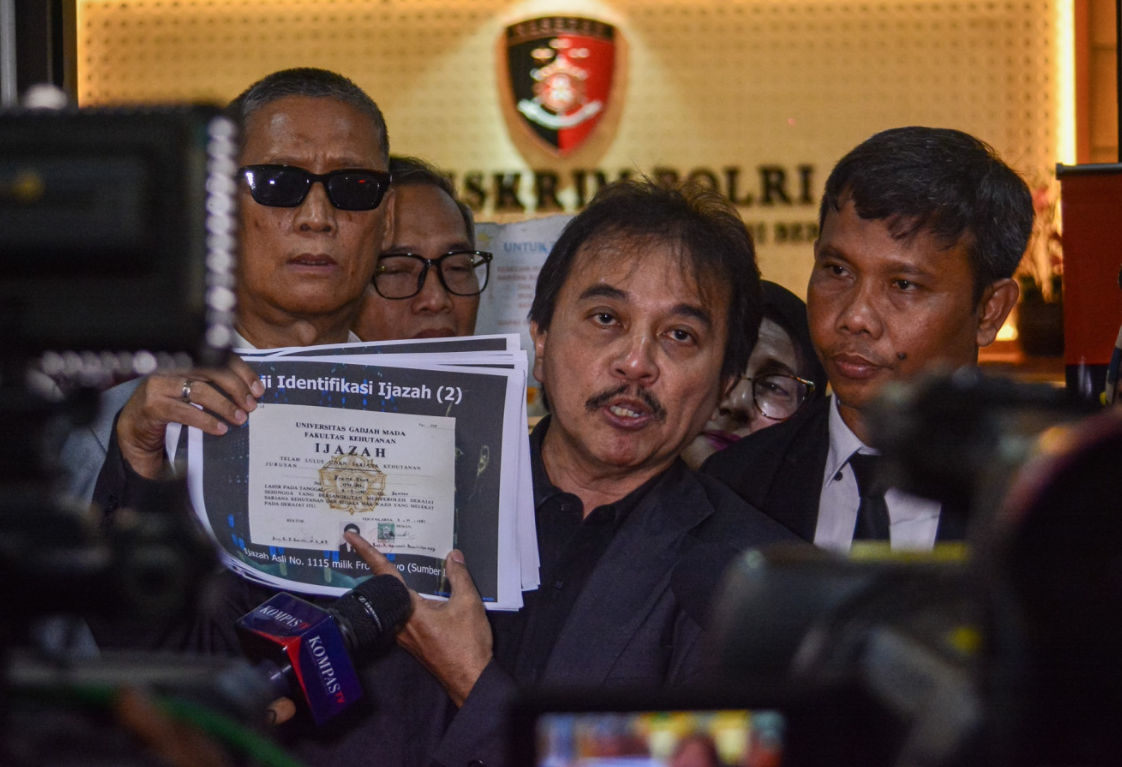
The Jakarta Police have placed former youth and sports minister Roy Suryo and health activist Tifauzia 'Tifa' Tyassuma under detention on charges of defamation connected to the contentious case surrounding former president Joko 'Jokowi' Widodo's university diploma. Both individuals were apprehended on Friday, June 19, at their homes as part of escalation procedures ahead of prosecution proceedings. The move represents a significant turning point in what has become one of Indonesia's most persistent political controversies, raising fresh questions about press freedom and the limits of public criticism in Southeast Asia's largest democracy.
According to Roy's legal representative Ahmad Khozinudin, the detentions were carried out in accordance with standard investigative protocols. The Jakarta Police's General Crimes Directorate indicated that the arrests were necessitated by procedural requirements before transferring the case dossier to the Jakarta Prosecutor's Office. Investigation director Sr Comr Iman Imanuddin explained that the detention measure aimed to prevent administrative delays and complete mandatory steps including medical examinations and evidence verification. He characterised the action as routine procedure within Indonesia's criminal justice framework, emphasising that it followed the completion of the police investigation phase.
Both suspects face allegations that extend beyond simple defamation to include charges of manipulating electronic documents. Prosecutors contend that Roy and Tifa falsified or altered digital evidence to substantiate their claims regarding the authenticity of Jokowi's academic credentials. These charges fall under the Electronic Information and Transactions (ITE) Law, a statute that has drawn international criticism from human rights organisations concerned about its potential for abuse in silencing dissent. Conviction under this law carries a maximum prison sentence of six years.
The diploma dispute itself stretches back to 2019, when initial questions about Jokowi's university qualifications first surfaced on social media platforms. What began as social media chatter evolved into a prolonged institutional struggle involving civil lawsuits, police investigations, and court proceedings across multiple years. The controversy has persisted through various government administrations and has attracted participation from numerous public figures and activists beyond Roy and Tifa. The sheer longevity of the dispute underscores deep divisions within Indonesian politics regarding transparency, accountability, and presidential governance.
The National Police formally resolved the matter in May 2025 by declaring Jokowi's diploma authentic and closing their investigation into forgery allegations. However, this official determination did not settle the controversy. In July 2025, a case review hearing took place during which critics including Roy Suryo continued to voice scepticism about the police conclusion. Roy's persistence in challenging the official narrative, despite the authorities' determination and despite apparent political risks, highlights the contentious nature of the underlying claims and the strong convictions held by those questioning the diploma's legitimacy.
Roy's background adds complexity to the detention. As a former minister under Susilo Bambang Yudhoyono's administration, he occupies a position within Indonesia's political establishment, yet he has positioned himself among Jokowi's critics on this particular issue. His arrest therefore represents a break with typical patterns of elite protection in Indonesian politics, where former government officials often enjoy informal immunity from prosecution. The detention of a former minister on defamation charges signals a willingness to pursue cases regardless of the suspect's previous governmental status, though sceptics might view it as selective enforcement targeting political opponents.
Roy and Tifa's legal counsel Refly Harun responded sharply to the detention, arguing that the measure was unnecessary and disproportionate. He noted that his clients had consistently complied with police summonses and reporting obligations throughout the investigation. Refly pointed out that the case transfer to prosecutors was not scheduled until Monday, making the weekend detention seemingly premature. This complaint raises procedural questions about whether the detention served investigative necessity or served other purposes, such as amplifying public messaging or limiting the suspects' ability to prepare their defence.
The authorities had originally identified eight individuals as suspects in the defamation case. However, three of these suspects—Eggi Sudjana, Damai Hari Lubis, and Rismon Sianipar—had charges dropped following mediation proceedings. This partial resolution suggests that some flexibility exists within the prosecution's approach, though Roy and Tifa were not among those benefiting from negotiated settlement. The differential treatment raises questions about the criteria applied in determining which suspects proceed to formal prosecution and which are permitted to resolve matters through alternative mechanisms.
The detention comes at a sensitive moment for Indonesia's political environment. Questions about press freedom and the scope of permissible criticism have become increasingly prominent across Southeast Asia as populist and authoritarian tendencies have strengthened in various national contexts. The ITE Law itself has emerged as a controversial instrument, criticised for enabling the suppression of legitimate political discourse under the guise of combating defamation or false information. Indonesia's approach to this particular case may signal to journalists, activists, and ordinary citizens the boundaries of acceptable speech regarding government figures and policies.
For Malaysian observers, this case offers instructive parallels regarding how governments in the region handle politically sensitive allegations. Malaysia's own experiences with high-profile defamation cases, politically motivated prosecutions, and debates over the Sedition Act and other speech-restricting legislation provide comparable contexts. The willingness of Indonesian authorities to pursue former government officials and activists on defamation charges, especially when the underlying allegations concern matters of significant public interest, reflects broader regional trends toward criminalising political opposition and critical speech.
The diplomatic and institutional ramifications extend beyond the individuals involved. If Roy and Tifa are convicted under the ITE Law, the outcome will establish important precedent regarding what constitutes actionable defamation in cases involving government figures and public matters. It may also influence behaviour among other potential critics, creating a chilling effect on public discourse about elite institutions and governance. These consequences would reverberate throughout Indonesian civil society and potentially influence standards across Southeast Asia.
Looking forward, the case will likely proceed through preliminary hearings and formal prosecution phases. The defence's arguments regarding detention proportionality may ultimately shape how courts evaluate the overall case. International attention from human rights monitors and press freedom organisations will probably intensify if the prosecution progresses toward conviction. For Indonesia, the diploma case—now extending into serious criminal prosecution—represents a moment of reckoning about the boundaries between protecting reputation and preserving space for legitimate public accountability mechanisms.