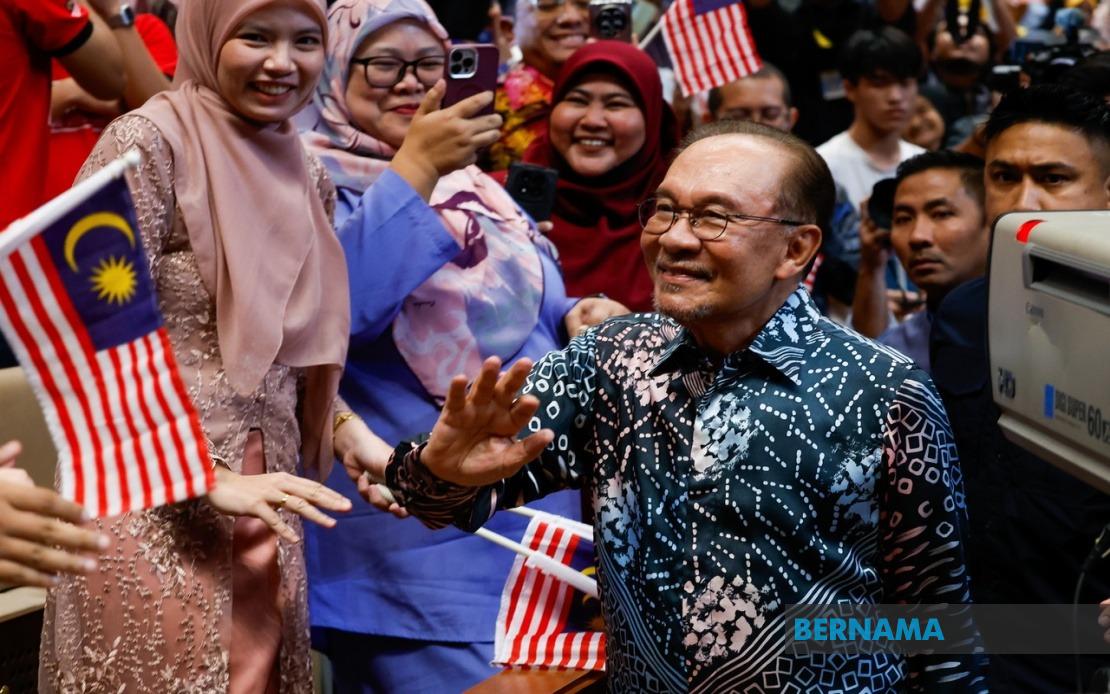
Prime Minister Datuk Seri Anwar Ibrahim has called on all Malaysians to actively cultivate and preserve the spirit of independence within themselves, framing it as a foundational requirement for national progress. Speaking during the National Day address at the Putrajaya International Convention Centre, Anwar distinguished between independence as a political concept and the deeper, more personal dimension of independent thinking and character that he believes must permeate Malaysian society.
Anwar's framing of independence transcends the conventional understanding of national sovereignty achieved at Merdeka. Instead, he positioned the concept as an internal quality—a mindset and emotional commitment that every citizen must develop and maintain. This distinction carries significant weight in Malaysian political discourse, suggesting that formal independence means little without corresponding psychological and spiritual transformation among the populace. The Prime Minister argued that building such individual and collective consciousness represents the primary challenge facing the nation as it navigates contemporary complexities and internal divisions.
Central to Anwar's message was an explicit call for national unity that crosses communal and geographic boundaries. He invoked the vision of Malaysia's founding fathers, emphasising that their conception of unity was never narrowly based on racial, district, or regional lines. Instead, the original national compact envisioned successive generations of all citizens working together toward common objectives. This historical framing provides contemporary relevance, suggesting that Malaysia's foundational principles remain valid guides for addressing present-day challenges, though their implementation requires renewed commitment from current and future populations.
The Prime Minister articulated a specific hierarchy within the proposed unity framework, acknowledging Malays and Bumiputeras as the core while insisting that all communities bear equal responsibility for defending constitutional rights and advancing justice. This formulation attempts to balance constitutional provisions recognising indigenous communities' special position with an inclusive national vision. For Malaysian policymakers and citizens, this statement reflects ongoing efforts to reconcile competing visions of national identity and belonging—a perennial tension in multiethnic societies structured around constitutional protections for specific groups.
Anwar's invocation of the need to "rebuild from the ruins" carries implicit recognition that Malaysia currently faces significant challenges threatening national cohesion and institutional integrity. This language suggests deterioration requiring restoration rather than mere incremental improvement. The metaphor positions the independence spirit as civilisational infrastructure requiring reconstruction, implying that existing institutional and social frameworks have suffered meaningful damage that must be remedied through deliberate, unified action across communal lines.
The emphasis on defending rights and upholding justice as core objectives of national unity reflects particular concerns within contemporary Malaysian governance. These twin commitments suggest preoccupation with institutional accountability, rule of law, and equitable treatment—issues that have occupied significant space in Malaysian political debates in recent years. By framing these as elements intrinsic to the independence spirit itself, Anwar positioned them not as partisan political positions but as fundamental values embedded in Malaysia's foundational compact and national identity.
Anwar's address occurred within the context of Malaysian politics characterised by complex coalition dynamics, competing constitutional interpretations, and ongoing discussions about national direction. His emphasis on unity across generations and communities implicitly addresses fragmentation observers have noted in Malaysian political and social discourse. For regional analysts, the speech reflects a prime minister attempting to articulate unifying national narratives while navigating fractious domestic political terrain where different constituencies hold conflicting visions of proper governance and resource distribution.
The presence of senior government figures including Deputy Prime Minister Datuk Seri Dr Ahmad Zahid Hamidi, Communications Minister Datuk Seri Fahmi Fadzil, and Chief Secretary to the Government Tan Sri Shamsul Azri Abu Bakar underscored the importance placed on this message within the government apparatus. Their attendance signalled broader administration endorsement of the Prime Minister's articulated vision regarding national values and priorities. For observers monitoring Malaysian governance, such symbolic endorsements provide indicators about government consensus on foundational principles guiding policy development.
Implementing the vision Anwar articulated requires addressing practical challenges extending beyond rhetorical commitment. Translating abstract ideals about independence spirit and cross-communal unity into concrete policies and institutional practices remains perpetually difficult in plural societies. Malaysia's experience demonstrates that constitutional provisions and political declarations, while necessary, insufficient alone guarantee genuine social cohesion or shared national purpose. The gap between aspirational rhetoric and institutional reality often proves substantial, requiring sustained effort, institutional reform, and genuine political will across competing interests and constituencies.
For Malaysian readers, Anwar's message carries implications extending beyond ceremonial National Day observances. His emphasis on individual responsibility for maintaining independence spirit suggests that national progress depends fundamentally on citizen engagement rather than exclusive reliance on government action. This framing distributes responsibility for national success across society while potentially placing obligations on citizens themselves to transcend communal and regional identities in pursuit of common objectives. Whether such aspirational appeals effectively motivate behavioural change or reshape political attitudes remains an open question in Malaysian political dynamics.
The speech also reflects broader regional conversations about national identity in Southeast Asia. As developing economies throughout the region navigate globalisation, technological disruption, and geopolitical shifts, questions about foundational national values and citizen commitment to national projects resurface periodically. Malaysia's approach, emphasising continuity with founding principles while demanding renewed individual and collective commitment, mirrors concerns expressed by leaders throughout Southeast Asia attempting to maintain social coherence amid rapid transformation and competing transnational influences.

