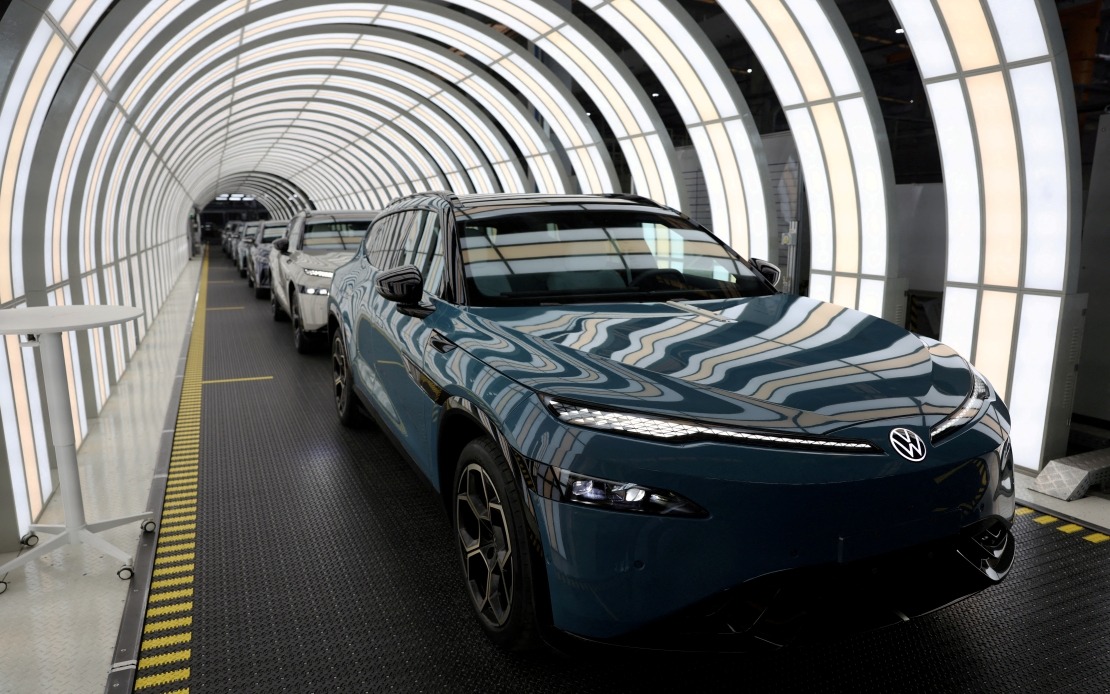
Western car manufacturers have increasingly brought electric vehicle production back to Europe in response to tariffs imposed by the European Union on Chinese-made vehicles, according to research by transport advocacy group Transport & Environment. The shift reveals how trade barriers are reshaping global automotive supply chains and prompting strategic relocations of manufacturing capacity away from China. The finding highlights the complex interplay between protectionist measures and industrial reallocation that will have ripple effects across Southeast Asian markets dependent on auto sector dynamics.
Data compiled from production and sales figures by GlobalData and analysed by T&E demonstrates a marked decline in the proportion of Chinese-manufactured battery electric vehicles sold in Western European brands across the continent. During the first quarter of 2025, China-made EVs represented just 23 per cent of total sales from Western marques, compared to 38 per cent throughout 2024. The study encompassed major manufacturers including BMW, Dacia, Volvo, Smart and Tesla, providing a comprehensive snapshot of industry behaviour across premium and volume segments. This contraction of 15 percentage points within a single year underscores the rapid reorientation of production strategies following the EU's tariff introduction in 2024.
Tesla experienced a particularly pronounced reduction in its reliance on Chinese manufacturing for the European market. The electric vehicle pioneer saw its share of China-made vehicles in Europe's overall EV market contract from 23 per cent to 19 per cent across the same period. This adjustment reflects Tesla's ability to leverage its existing European manufacturing footprint, particularly its Brandenburg facility in Germany, to meet regional demand while circumventing tariff exposure. The company's relatively modest decline compared to some rivals underscores the competitive advantages accruing to manufacturers with established European production infrastructure prior to the tariff regime's introduction.
Despite the tariff environment, Chinese automakers have not retreated from the European market. Imports from Chinese manufacturers, notably BYD and Geely, have continued expanding despite the trade barriers introduced in 2024. Industry analysts attribute this persistence to surplus production capacity accumulated in China that seeks profitable outlets regardless of tariff costs. The commercial logic remains compelling: even with tariffs applied, exporting vehicles from existing Chinese facilities can remain economically viable for companies operating with low marginal costs on excess capacity. This dynamic suggests that tariffs alone may prove insufficient to meaningfully suppress Chinese market participation without complementary policy measures.
One notable casualty of the tariff framework has been SAIC, whose European sales have declined sharply since 2024 began. The company faces tariff rates substantially higher than those imposed on competitors BYD and Geely, a differential reflecting the EU's investigation findings that SAIC benefited more extensively from state subsidies integrated throughout its supply chain architecture. This elevated tariff treatment demonstrates the EU's willingness to apply differentiated rates based on subsidy analysis, creating asymmetric competitive conditions within the Chinese EV sector and effectively penalising companies deemed to have received deeper state support. The SAIC situation illustrates how tariff policy can become a tool for shaping industrial outcomes beyond simple import suppression.
Chinese manufacturers have simultaneously adapted by accelerating plans to establish production facilities within Europe itself, effectively sidestepping tariffs through local manufacturing. Since the EU initiated its subsidy investigation in 2023, Chinese automakers have announced plans for ten production facilities across the continent. This transition represents a fundamental shift in strategy: rather than exporting finished vehicles, manufacturers are instead investing capital to build production infrastructure within tariff boundaries. Such facility investments signal long-term commitment to European markets and suggest that tariff barriers may ultimately prove more effective at encouraging manufacturing relocation than demand suppression.
Among other adaptations, Chinese automakers have redirected export emphasis toward plug-in hybrid vehicles, a category subject to different regulatory treatment than fully electric vehicles. Plug-in hybrids originating from China have captured an expanding share of the EU market, rising to 13 per cent from 3 per cent in 2024. This expansion demonstrates manufacturers' sophistication in navigating regulatory frameworks: by shifting product mix toward vehicle categories with less stringent tariff treatment, companies can maintain sales momentum while avoiding the highest tariff rates applied to pure battery electric vehicles. The strategic reorientation toward plug-in hybrids reflects an ongoing cat-and-mouse dynamic between trade policy and industrial adaptation.
For Malaysian and broader Southeast Asian readers, these developments carry significant implications. The EU's tariff-driven reshaping of global automotive supply chains influences the investment calculus for manufacturers considering regional production hubs. Companies reassessing where to locate EV manufacturing capacity in Asia may increasingly view European protectionism as a cautionary precedent, potentially accelerating direct investment in Southeast Asian facilities as alternative export platforms. Furthermore, the successful demonstration of trade barriers in redirecting production patterns may embolden policymakers across Asia to consider similar measures, potentially fragmenting the region's automotive sector and complicating supply chain integration.
The tariff environment also affects technology transfer and competitive dynamics in regional markets. As Western manufacturers strengthen European production capacity and Chinese companies accelerate local manufacturing investments, global EV technology and manufacturing expertise becomes less concentrated in China's traditional export hubs. This dispersal could create opportunities for Southeast Asian nations to attract skilled manufacturing investment and automotive supply chain activity, provided policy frameworks remain stable and competitive. However, it simultaneously signals potential disruption to existing supply arrangements and manufacturing partnerships that regional players have developed with Chinese automotive interests over recent years.
The broader strategic implication extends to the nature of future global automotive competition. The EU experience demonstrates that well-designed tariff policies, coupled with scale of market access, can compel manufacturers to invest in manufacturing infrastructure rather than simply absorb tariff costs. This logic may increasingly apply to other regions, including Southeast Asia, where growing domestic EV markets and production ambitions could justify similar protective trade measures. The question becomes whether such policies will promote genuine industrial development or merely divert supply chains without deepening technological capability or manufacturing sophistication in protected markets.

