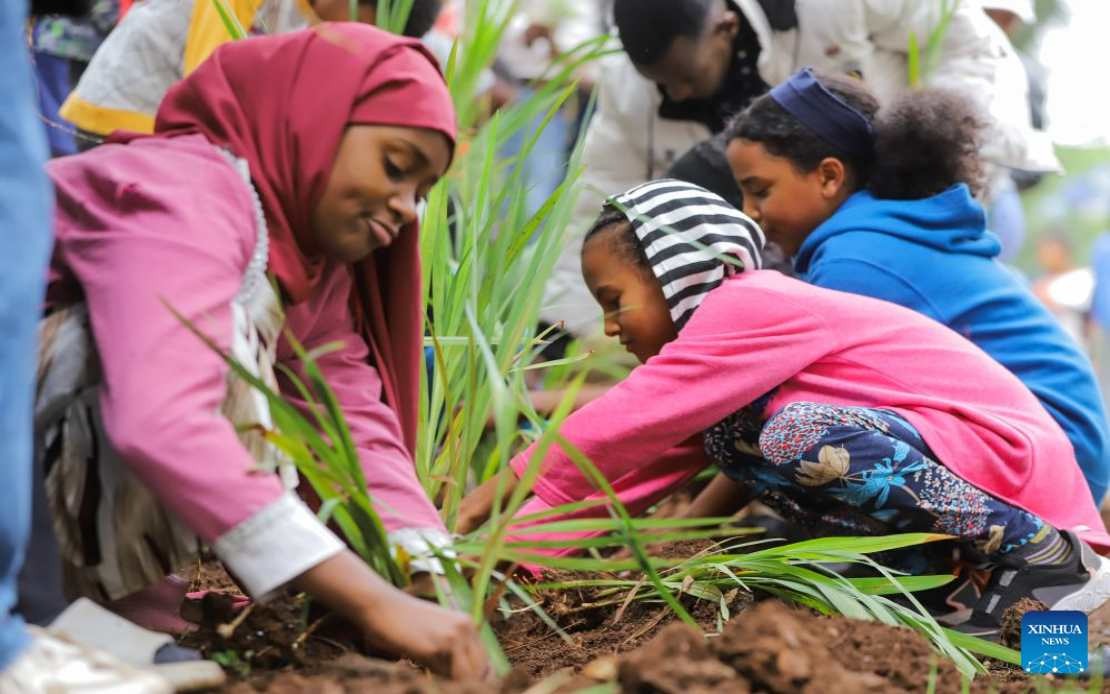
Ethiopia has executed an unprecedented environmental mobilisation, with millions of citizens and foreign residents participating in a nationwide tree-planting exercise on Monday aimed at establishing 800 million seedlings in a single day. The massive coordinated effort represents a milestone in the country's commitment to large-scale reforestation and environmental restoration, demonstrating the logistical capability to organise such campaigns across diverse geographical and demographic segments of the nation.
The initiative forms part of Ethiopia's flagship Green Legacy Initiative, a programme launched by Prime Minister Abiy Ahmed in 2019 that has evolved into one of Africa's most ambitious environmental projects. This year's target extends beyond the single-day campaign, with authorities aiming to plant more than 8 billion seedlings throughout the rainy season, reflecting the scale of the country's reforestation ambitions and the resources dedicated to reversing decades of deforestation and landscape degradation.
Participants ranged across Ethiopian society, from schoolchildren to healthcare workers and community members. Edilawit Legesse, a thirteen-year-old from the Alembank neighbourhood on Addis Ababa's periphery, represented the youth engagement component, marking her third consecutive year of participation. Similarly, Hewan Legesse, a nurse mobilised through her hospital in the Entoto Mountain area, exemplified how institutional participation amplified the campaign's reach, with organised groups bringing coordinated efforts to planting sites throughout the capital and beyond.
Prime Minister Abiy Ahmed characterised the annual one-day planting exercise as a unifying moment transcending social and professional boundaries. Speaking on social media following his own participation, he framed the initiative as embodying collective action across Ethiopian society, emphasising eight years of continuous environmental commitment and describing the programme as driven by grassroots public engagement rather than top-down governmental mandates alone. This framing proved significant for legitimating large-scale environmental policies within democratic contexts increasingly attentive to public participation and ownership.
The Green Legacy Initiative has progressively evolved from a singular annual event into a comprehensive environmental programme addressing multiple ecological and economic objectives. Beyond immediate tree-planting metrics, the initiative targets restoration of degraded landscapes, recovery of lost forest coverage, enhancement of climate resilience through deforestation mitigation, and biodiversity conservation. These layered objectives acknowledge that reforestation alone cannot sustain environmental recovery without complementary ecosystem restoration practices.
With the addition of over 8 billion trees this year, Ethiopia advances toward its overarching goal of planting 50 billion trees since the initiative's 2019 inception. This cumulative target positions Ethiopia among nations undertaking the most extensive afforestation programmes globally, though implementation challenges remain substantial. The concentration of planting activities during the rainy season reflects ecological realities governing seedling survival rates, though long-term survival rates and monitoring mechanisms remain subjects requiring transparency and independent verification to assess genuine environmental impact beyond initial planting statistics.
For Southeast Asian observers, Ethiopia's model offers instructive parallels and contrasts with regional reforestation efforts. While Indonesia, Malaysia, and other regional nations have announced substantial tree-planting targets, Ethiopia's demonstrated capacity for mass mobilisation and sustained year-on-year commitment suggests that environmental outcomes depend equally upon institutional continuity and political will alongside resource allocation. The integration of youth participation and professional groups through coordinated institutional arrangements provides a replicable template for countries seeking to scale environmental initiatives beyond government agencies.
The initiative's connection to Ethiopia's stated objective of achieving green, lower-middle-income economic status reflects evolving global understandings linking environmental restoration to economic development. This framing diverges from older narratives positioning environmental protection as incompatible with economic growth, instead presenting reforestation as foundational infrastructure for sustainable development. For developing economies across Africa and Asia confronting simultaneous imperatives of poverty reduction and environmental degradation, this narrative carries considerable policy implications.
Climate resilience enhancement emerges as a central rationale within the Green Legacy Initiative's framework, addressing Ethiopia's documented vulnerability to droughts, flooding, and shifting precipitation patterns. Tree cover expansion theoretically mitigates these vulnerabilities through improved water retention, reduced soil erosion, and moderated temperature extremes. However, realising these benefits requires careful species selection, appropriate planting density, and integration with broader watershed management and agricultural practices, dimensions that merit scrutiny beyond headline participation figures.
The campaign's participation of foreign nationals resident in Ethiopia signals potential diplomatic dimensions, positioning environmental engagement as a national unifying exercise transcending citizenship categories. This inclusive framing potentially strengthens social cohesion while demonstrating commitment to global environmental norms and climate action frameworks. For multinational organisations and international development agencies operating across the region, such inclusive environmental mobilisation models suggest pathways for legitimating development interventions through local participation structures.
Governance and accountability mechanisms surrounding tree survival and ecosystem outcomes remain pivotal to assessing whether the Green Legacy Initiative translates initial planting achievements into sustained environmental benefits. Longitudinal monitoring data tracking seedling survival rates, canopy cover expansion, and ecosystem service provision would enable rigorous evaluation of whether annual targets translate to genuine landscape-scale restoration. Regional countries contemplating similar initiatives should prioritise establishing transparent monitoring frameworks from inception rather than concentrating solely on initial planting metrics.

