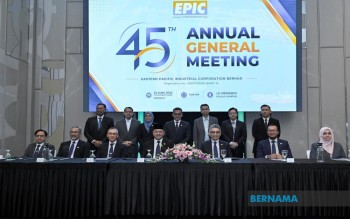
Eastern Pacific Industrial Corp Bhd (EPIC) is positioning itself for substantial expansion over the next five years, announcing an ambitious strategic blueprint that would nearly double its annual revenue and boost shareholder value by RM300 million by 2030. The integrated oil and gas solutions provider unveiled the EPIC Strategic Business Plan 2025-2030 (EPIC BEST 2530) at its annual general meeting, charting a course to achieve RM700 million in annual revenue and a net asset value of RM1 billion. The targets represent a marked acceleration from the company's current operational scale and reflect confidence in Malaysia's energy sector recovery and regional expansion opportunities.
The company's leadership articulated this growth ambition against a backdrop of strengthening financial performance. Group chief executive officer Dr Ts Muhtar Suhaili highlighted that EPIC has already demonstrated momentum, with net profit climbing to RM20.6 million in the year ended December 31, 2025, representing a 24 per cent improvement from RM16.6 million the previous year. Revenue similarly expanded to a record RM411.9 million, up from RM403.8 million, extending an upward trajectory that has now persisted since 2022. This consistent profitability underscores the company's operational resilience and positions management to execute on the more aggressive targets outlined in its five-year plan.
Several tactical developments contributed to last year's financial gains, offering insight into where EPIC believes growth opportunities lie. The acquisition of Rahar Niaga Sdn Bhd bolstered service capacity, whilst newly awarded contracts—specifically the Pan Malaysia Maintenance, Commissioning and Modification and Hook-Up and Commissioning work—expanded the revenue base with Petronas. These wins are particularly significant as they represent sustained trust from Malaysia's national oil corporation, traditionally the bedrock of offshore service demand. Additionally, heightened offshore rig arrivals and increased cargo throughput reflect regional activity rebounding as energy companies resume deferred projects and capital investment.
The company's contract pipeline demonstrates the substantive foundation underpinning management's revenue projections. EPIC's approved contract value for its oil and gas business currently sits between RM1.3 billion and RM1.5 billion, though actual earnings will fluctuate based on work orders and purchase orders issued by customers. Muhtar cautioned that this distinction matters for investors assessing near-term guidance, as project execution timelines and client ordering patterns introduce variability. Nevertheless, the scale of the pipeline suggests that translating even a modest proportion into realised revenue would support the path toward the RM700 million target. The company has also broadened its geographic footprint with Petronas contracts now extending beyond its traditional Terengganu base into the southern peninsula, including Pengerang and Melaka, whilst recent penetration into Sabah marks a territorial expansion into a growth frontier for upstream and subsea activity.
Expectations for 2026 appear uniformly bullish across the management team. Muhtar characterised the coming year as likely to be another record year for the group, with revenue growth remaining the focal point. This forecast carries particular weight given the company has consistently delivered on guidance and expanded operational scope with each passing year. The near-term trajectory suggests that momentum will carry into the medium term, provided that secured Petronas contracts are executed on schedule and no major disruptions materialise in global energy markets or domestic regulatory frameworks.
Beyond the traditional oil and gas pillar, EPIC is deliberately diversifying into renewable energy as part of its long-term value creation strategy. The company is competing for a hybrid hydro-solar project in Kenyir, doing so in partnership with its parent company Terengganu Inc. This venture signals management's conviction that Malaysia's energy transition will create substantial opportunities for integrated players capable of serving both hydrocarbon and clean energy sectors. Success in renewable procurement would diversify earnings streams and position EPIC as a more resilient enterprise against the gradual shift in global energy demand patterns.
Geographic diversification equally features prominently in management's strategic thinking. The board has formally mandated expansion into neighbouring Asian markets as a pillar of the 2030 strategy, acknowledging that Malaysia's offshore sector, whilst growing, remains finite in scale. Expansion into Indonesia, Thailand, and Vietnam would unlock substantially larger addressable markets and reduce concentration risk. Simultaneously, management is assessing West Asia opportunities despite geopolitical headwinds, suggesting a calculated appetite for higher-risk, higher-reward jurisdictions where integrated service providers often command premium pricing.
A notable strategic move earlier this year reinforced these ambitions. EPIC, through subsidiary EPIC OG Sdn Bhd, entered into a collaboration with Begas Energy Sdn Bhd to provide project management services for terminal turnaround, maintenance and modification work in Sabah. This partnership strengthens EPIC's foothold in Sabah and Sarawak, regions that historically have been underexploited by Peninsular-based service providers. The Sabah and Sarawak offshore basins represent growth frontiers as oil majors and regional players advance development projects, presenting genuine greenfield opportunities for contractors willing to establish local operating capacity and supply chain integration.
For Malaysian investors and stakeholders in the energy sector, EPIC's trajectory merits close attention. The company exemplifies how established Malaysian service providers are adapting to a changing energy landscape by simultaneously leveraging core competencies in oil and gas whilst building capabilities in renewable energy and geographic expansion. The RM1 billion NAV target implies disciplined capital allocation and potential shareholder returns as the company matures. Critically, EPIC's success will partly hinge on whether Petronas accelerates capital expenditure in subsea development and whether regional energy demand sustains the current momentum. The company's willingness to compete for hybrid renewable projects and pursue West Asian opportunities suggests management views the energy transition as an expansion thesis rather than an existential threat, a perspective increasingly vindicated by global trends favouring integrated energy companies.
The broader implication for Southeast Asia is that Malaysian companies are beginning to position themselves as pan-regional energy service players rather than domestically focused contractors. EPIC's international expansion mandate and renewable energy pivot reflect a mature understanding that future energy infrastructure will be hybrid and geographically diverse. If execution matches ambition, EPIC could emerge as a significant regional player by 2030, contributing to Malaysia's aspirations as a hub for offshore energy services and clean energy transition expertise.

