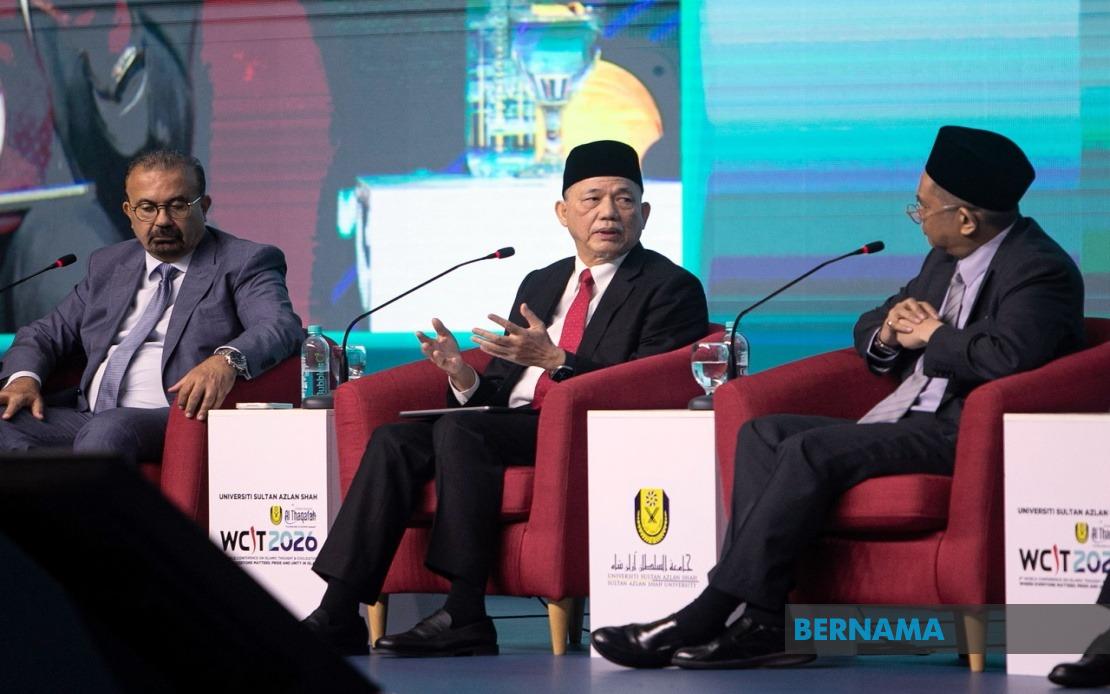
Deputy Prime Minister Datuk Seri Fadillah Yusof has underscored the growing nexus between energy security and maritime stability, warning that isolated geopolitical incidents thousands of kilometres away now reverberate through the global economy with immediate domestic consequences. Speaking as a panellist at the 8th World Conference on Islamic Thought and Civilisation in Ipoh on July 21, Fadillah, who also holds the Energy Transition and Water Transformation portfolio, noted that the escalation of tensions between the United States and Iran exemplifies this troubling shift in how international instability cascades across interconnected systems.
The minister explained that this deepening interdependence means events in distant theatres translate swiftly into tangible impacts on ordinary Malaysians. When conflict or uncertainty affects global energy markets or key shipping lanes, the consequences materialise not merely as abstract economic indicators but as concrete pressures on electricity tariffs, fuel availability at the pump, and the cost of goods flowing through supply chains. The translation of geopolitical risk into household economics has become immediate and unavoidable, leaving little buffer between international incident and local impact.
Fadillah specifically highlighted the strategic importance of the Strait of Hormuz, through which a significant portion of global oil trade flows. Recent developments in this critical waterway have already sent reverberations through Malaysia's economy and, more broadly, disrupted established patterns in international commerce. The minister stressed that Malaysia cannot remain insulated from such upheavals, given its reliance on open and predictable trade routes for its own economic sustenance.
Beyond raw energy markets, the minister articulated how maritime security challenges create compound effects across multiple economic dimensions. When tensions rise in strategic chokepoints, insurance premiums for vessels traversing those waters climb accordingly. Shipping companies respond by raising freight costs, which then cascade through supply chains and eventually appear as higher prices on retail shelves. The cumulative effect transforms what appears as a regional security issue into a broad-based cost spiral affecting manufacturers, logistics providers, and ultimately consumers.
Malaysia's own geographic position amplifies its vulnerability to such dynamics. As a nation straddling the Strait of Melaka, one of the world's busiest maritime corridors, Malaysia sits at the intersection of global trade flows. Any disruption to freedom of navigation or stability in the surrounding region carries direct implications for Malaysian commerce, employment, and economic growth. The strait's centrality to world trade means that regional instability becomes a Malaysian concern by simple geographic necessity.
Fadillah articulated Malaysia's response to these mounting pressures as measured and diplomatic. Rather than adopting confrontational stances or engaging in zero-sum competition, he indicated that Malaysia privileges dialogue, negotiation, and adherence to established international rules and norms. This approach reflects Malaysia's historical position as a nation that has benefited immensely from a stable, rules-based international order that respects national sovereignty and enables peaceful commerce across borders.
The principle of being a friend to all nations has served Malaysia well, particularly given the country's deep economic dependence on open, predictable global markets. Fadillah's invocation of this traditional Malaysian foreign policy orientation suggests that in an era of rising tensions, Malaysia seeks to remain a voice for stability and reasoned dialogue rather than aligning with particular great powers in their competitive struggles.
However, the minister's remarks also carry an implicit warning. The integration of energy and maritime security issues means that Malaysia cannot compartmentalise its concerns. A crisis in energy markets automatically becomes a maritime security issue, and vice versa. This fusion of domains complicates policy responses and leaves fewer options for selective engagement. Malaysia must therefore invest in understanding these interconnections and building resilience across multiple systems simultaneously.
The challenge extends beyond Malaysia to the entire Southeast Asian region, which collectively depends heavily on stable energy supplies and unimpeded maritime passage. Any region-wide disruption would affect everything from manufacturing competitiveness to inflation pressures across the bloc. For Southeast Asian policymakers, Fadillah's framing suggests the necessity of developing coordinated responses to energy and maritime security threats rather than treating them as isolated policy domains.

