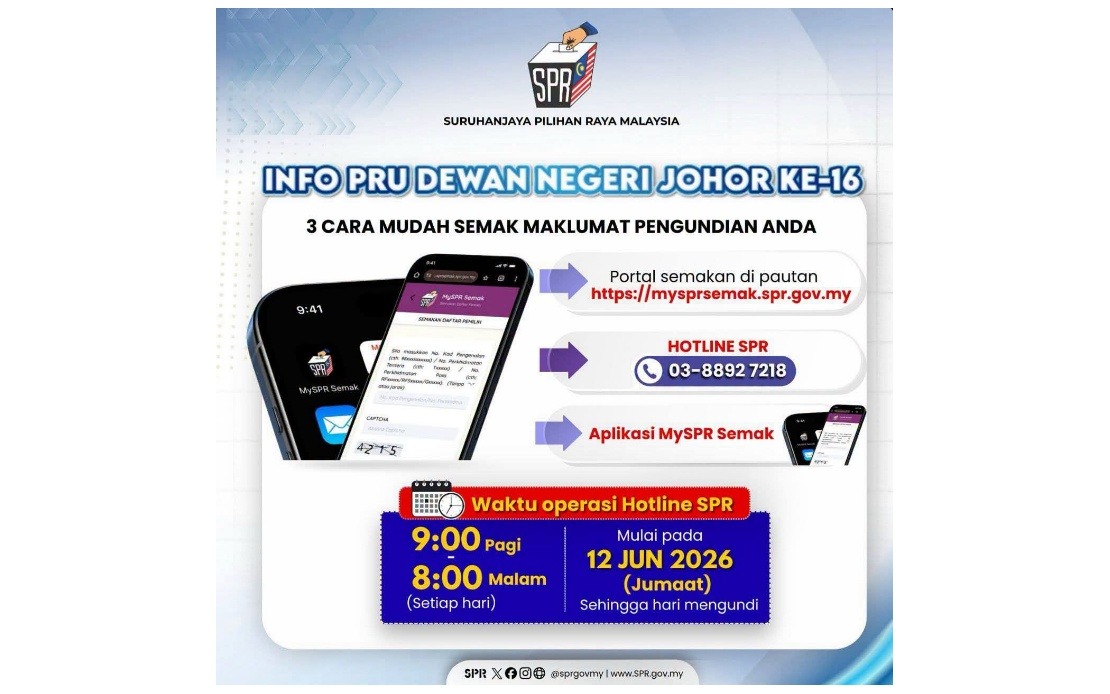
With Johor's 16th state election set to unfold this Saturday, the Election Commission has issued a timely advisory reminding the state's millions of registered voters to verify their polling station assignments and voting arrangements. The EC emphasised the importance of fulfilling civic responsibilities by visiting the MySPR Semak portal or downloading the MySPR Semak mobile application to check designated polling centres and voting streams ahead of the July 11 ballot.
The stakes for this election are substantial. Approximately 2.7 million eligible ordinary voters are expected to participate in selecting 56 state assembly representatives who will shape Johor's governance over the coming term. This represents a significant democratic exercise across Malaysia's second-largest state, with implications that extend beyond Johor's borders given the state's economic and political significance within the federation.
Early voting has already commenced, with 19,471 advance ballots cast last Tuesday. The voting population included 7,960 military personnel and their spouses, alongside 11,511 police officers from various units including the General Operations Force and their family members. This staggered voting mechanism accommodates security personnel whose regular duties would otherwise prevent them from participating on election day, ensuring that all citizen groups have meaningful access to the ballot regardless of professional obligations.
The election has attracted a diverse pool of candidates reflecting Malaysia's multi-party political landscape. A total of 172 candidates are contesting the 56 available seats, with the two major coalition blocs fielding complete slates. Pakatan Harapan and Barisan Nasional each put forward 56 candidates, while Perikatan Nasional has nominated 33 candidates across the state. These numbers underscore the competitive nature of the race and the genuine choice available to voters across Johor's constituencies.
Smaller political parties and independent candidates have also registered their presence in the contest. Parti Bersama Malaysia is fielding 15 candidates, marking its participation in a significant state election, while MUDA has entered four contenders. Additionally, candidates representing the Parti Orang Asli Malaysia and Parti Sosialis Malaysia are in the running, alongside six independent candidates who are seeking seats without formal party affiliation. This breadth of representation demonstrates Malaysia's functioning democratic system, even as competition remains dominated by established political movements.
The EC's advisory about checking polling details reflects administrative best practices that help streamline voting day operations and reduce voter confusion. By encouraging citizens to verify their information in advance through digital platforms, the electoral body aims to minimise queues, processing delays, and potential administrative errors that could impact the voting experience. This proactive approach has become standard practice in Malaysian elections, leveraging technology to enhance civic participation.
For Johor voters, the verification process is straightforward and accessible. The MySPR Semak portal and its accompanying mobile application provide real-time information about registered voters' particulars, including their assigned polling centres and voting streams. Given Malaysia's multi-ethnic and geographically diverse population, such tools are particularly valuable in ensuring that voters in both urban and rural areas can easily locate their polling stations without last-minute uncertainty.
The timing of this advisory is strategically important, coming several days before the election to allow voters adequate time to plan their participation. Those who discover discrepancies or cannot locate their assigned polling centre still have opportunity to contact the Election Commission directly for clarification or corrections. This window between the advisory and voting day represents a final administrative safeguard designed to ensure the integrity and smoothness of the electoral process.
Johor's election carries broader significance for Malaysia's political trajectory. As a major state with substantial population and economic output, the results will be closely watched by political observers, investors, and commentators seeking insights into voting trends and preferences. The outcome could influence national political calculations and provide momentum for the winning coalition heading into future federal considerations, making voter turnout and participation levels particularly significant.
The Election Commission's emphasis on voter responsibility reflects a wider national commitment to strengthening democratic participation. By framing voting as a civic duty requiring informed and prepared engagement, the EC reinforces that elections function most effectively when voters approach the process seriously and arrive at polling stations with their information already verified. This message resonates particularly with first-time voters and those in constituencies experiencing competitive races where every vote carries genuine weight in determining outcomes.

