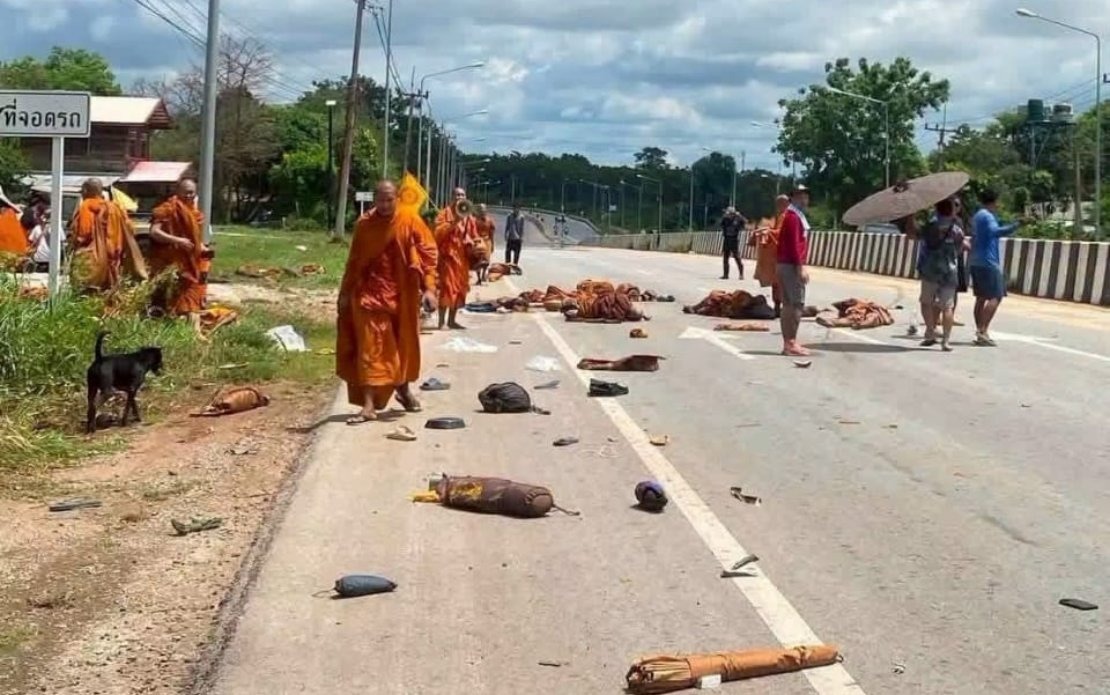
A tragic accident claimed the lives of eight Buddhist monks in Thailand's northeastern Mukdahan province on Thursday when a pickup truck driven by a juvenile struck a group engaged in a walking pilgrimage. The collision left 14 additional monks and a civilian with varying degrees of injury, with authorities now investigating the circumstances that led to the vehicle losing control and crossing into the pedestrians.
The monks had embarked on their religious journey at approximately 11 in the morning, walking along Ban Na Si Nuan Road in Mueang district toward Nam Khun in the neighbouring province of Ubon Ratchathani. According to Mukdahan Governor Warayan Boonnarat, the procession was deliberately positioned against the direction of traffic flow, a standard pedestrian safety measure intended to allow group members to monitor oncoming vehicles. The pilgrims were maintaining a position roughly two metres from the roadside when the accident occurred.
While the first five monks in the group managed to step clear of the vehicle as it approached, those behind were struck by the truck as it veered off the roadway. Five individuals perished at the scene, while three others were transported to medical facilities where their injuries ultimately proved fatal. This pattern of casualties reflects both the speed at which the vehicle struck the group and the limited reaction time available to those in its path.
Mukdahan Provincial Public Health Chief Dr Narong Chankaew reported that four of the injured monks remain in critical condition, whilst a further ten are receiving treatment for moderate injuries. In total, 23 patients—comprising 22 monks and one civilian—were admitted to hospital following the incident. The scale of admissions has placed significant strain on local medical services, prompting Mukdahan Hospital to issue an urgent appeal for blood donations to sustain ongoing treatment protocols.
The driver, identified as a minor under 15 years of age, was immediately placed into custody following the crash. Mukdahan Provincial Police Commander Police Major General Phairoj Thaiputra indicated that investigators are currently examining evidence and conducting interviews with the driver's parents to establish what triggered the loss of vehicle control. The inquiry extends beyond mechanical factors or road conditions, with authorities considering whether the young driver was operating the truck with parental permission or knowledge.
Particularly significant is law enforcement's assessment that the parents themselves may face negligence charges for permitting an underage and presumably unlicensed operator to handle the vehicle. This potential line of prosecution reflects growing concern across Southeast Asia regarding juvenile access to motor vehicles and the corresponding liability of guardians. The legal framework being applied suggests that Thai authorities view parental supervision as a critical factor in preventing such incidents.
For Malaysian readers, the incident underscores persistent road safety challenges throughout the region. Thailand consistently records among the world's highest vehicle-related fatality rates, a problem compounded by enforcement gaps and inadequate oversight of who operates motor vehicles. The fact that a child was able to access and operate a pickup truck—a heavy vehicle requiring substantial control—highlights systemic weaknesses in vehicle access controls and monitoring.
The religious context of the tragedy adds another dimension to public concern. Buddhist monks and nuns occupy a sacred position across Theravada Buddhist societies, and incidents resulting in monastic deaths carry profound spiritual and cultural significance beyond their secular impact. Communities in Thailand, Myanmar, Laos, and Cambodia will be closely monitoring how authorities handle this investigation and whether meaningful preventative measures emerge.
The timing of the pilgrimage—a common practice during the Thai calendar—means such processions regularly utilize public roads, creating recurring safety challenges that local authorities must manage. Road traffic throughout much of rural Thailand remains hazardous, with pedestrian protection measures often inadequate. Pilgrimage groups, typically comprising elderly and less mobile individuals, face particular vulnerability to high-speed impacts.
Investigations into juvenile involvement in fatal traffic incidents across Southeast Asia often reveal troubling patterns: inadequate supervision, insufficient driver education, and insufficient consequences for violations. The involvement of a child operator in this tragedy may prompt broader policy discussions in Thailand regarding the licensing age for vehicle operation and enforcement mechanisms preventing unauthorized use.
The hospital's call for blood donations reflects the immediate humanitarian consequences of such collisions. Beyond those directly injured, community institutions bear responsibility for supporting affected monks and their monasteries, many of which will face significant resource strains addressing the loss and recovery of their members.
As the investigation progresses, the police inquiry will likely examine whether the vehicle itself experienced mechanical failure or whether operator error was the determining factor. The distinction carries important implications for potential charges and public safety messaging. Either scenario—mechanical failure indicating inadequate vehicle maintenance, or operator error by an underage driver—reveals preventable gaps in Thailand's road safety infrastructure.
For the broader region, the incident serves as a stark reminder that road safety remains a critical development challenge. Malaysia, like its neighbours, must continue strengthening enforcement of vehicle access restrictions, improving driver licensing procedures, and ensuring that vulnerable road users—including religious pilgrimage groups—have adequate protection during journeys across shared transportation corridors.

