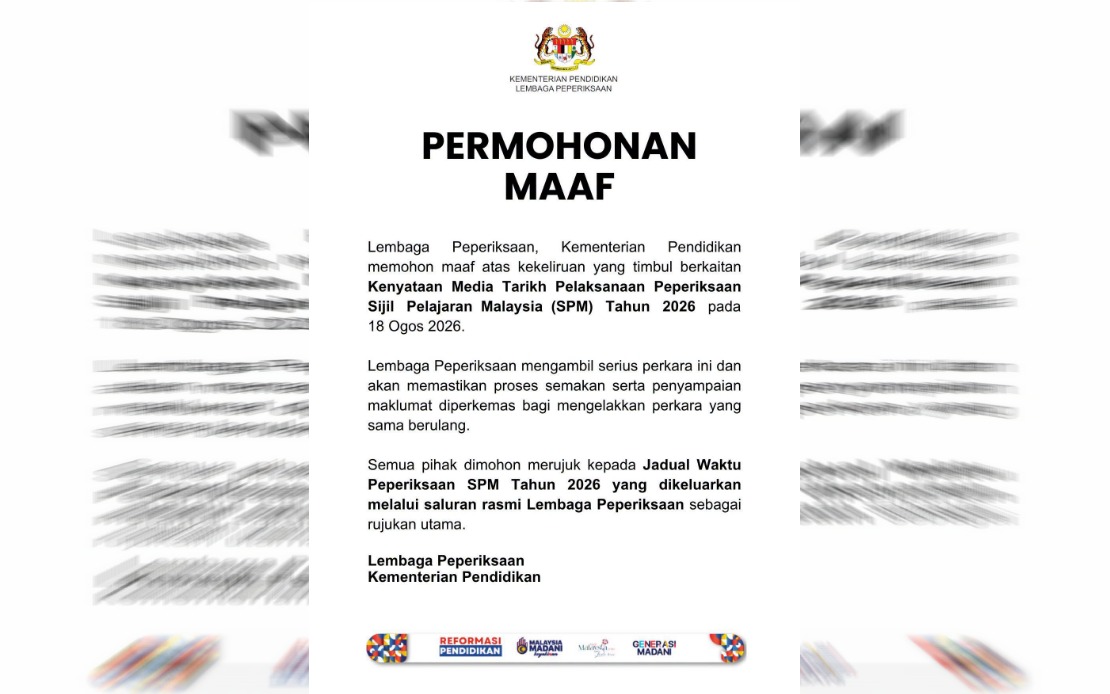
Malaysia's Examination Board under the Ministry of Education has issued a formal apology following widespread confusion generated by contradictory announcements regarding the schedule for next year's Sijil Pelajaran Malaysia examination. The clarification came a day after the board released information on the implementation dates for the 2026 SPM, which apparently conflicted with previously established timelines and created uncertainty among students, educators, and parents nationwide.
In its statement released on August 19, the Examination Board acknowledged that the matter warrants serious attention and has committed to overhauling its information verification and dissemination protocols. The board recognises that inconsistent communications undermine public confidence in examination administration and pledges to implement stronger quality control measures to ensure such miscommunications do not occur again. This incident highlights the critical importance of coordinating announcements across multiple government departments and communication channels to maintain clarity for stakeholders who depend on accurate, timely information.
To resolve the ongoing uncertainty, the Examination Board has directed all interested parties—students, schools, educators, and the general public—to treat the official 2026 SPM Examination Timetable distributed through the board's designated channels as the authoritative reference document. This guidance essentially resets the record and provides a single source of truth that supersedes any earlier conflicting statements. Educational institutions across Malaysia have been advised to use only this official timetable when communicating with their student bodies and making logistical arrangements for examination administration.
The 2026 SPM examination window spans nearly four weeks, beginning November 23 and concluding December 17. This extended examination period accommodates the large number of candidates sitting for the assessment simultaneously and allows examination centers across the country to manage scheduling efficiently. The timing places the SPM examinations in the final weeks of the calendar year, which has administrative implications for schools planning their academic calendars and students managing their study schedules around the year-end holidays.
Participation in the 2026 SPM has reached substantial proportions, with 420,879 candidates having already registered to participate in the examination. These students will sit for their tests across 3,334 examination centers distributed nationwide, demonstrating the logistical scale of administering Malaysia's premier secondary school assessment. The figure underscores the significance of the SPM to Malaysia's education system, as successful completion remains a gateway credential for furthering studies at tertiary institutions and entering the professional workforce.
The distribution of examination centers across the country reflects Malaysia's commitment to making the assessment accessible to students in both urban and rural areas. With over three thousand centers operating, the examination infrastructure ensures that geographical location does not become a barrier to participation. This dispersed network requires substantial coordination among state education departments, school administrators, and examination supervisors to maintain consistency in examination procedures and security protocols across all venues.
The SPM examination itself represents a pivotal moment in Malaysian students' academic trajectories, determining eligibility for enrollment in pre-university programs and technical institutions. The assessment covers multiple subjects spanning languages, sciences, mathematics, and humanities, testing both breadth of knowledge and depth of understanding. Performance in SPM examinations influences not only immediate educational placement but also scholarship opportunities and competitive entry into prestigious programs.
For schools and education administrators, clear and consistent communication regarding examination schedules is operationally essential. Institutions must coordinate examination invigilation staff, prepare examination halls and materials, communicate schedules to parents and students, and manage numerous logistical details. Conflicting information creates cascading difficulties as schools attempt to plan around uncertain dates, potentially disrupting other academic activities and causing anxiety among candidates already managing examination-related stress.
The Ministry of Education's commitment to streamlining review and information delivery processes reflects broader efforts to enhance governmental communications in Malaysia. As an examination body serving millions of students and their families, the Examination Board recognises its responsibility to communicate with absolute clarity. The apology and commitment to improved processes signal acknowledgment that examination-related announcements require heightened verification standards given their widespread impact on the education system.
Moving forward, students and educators should monitor official Examination Board channels for any supplementary guidance or clarifications regarding the 2026 SPM. The incident serves as a reminder of the importance of consulting primary sources rather than relying on secondhand reports when dealing with matters of educational significance. As the examination approaches, maintaining communication clarity will remain crucial for ensuring all candidates receive adequate notice and preparation time.

