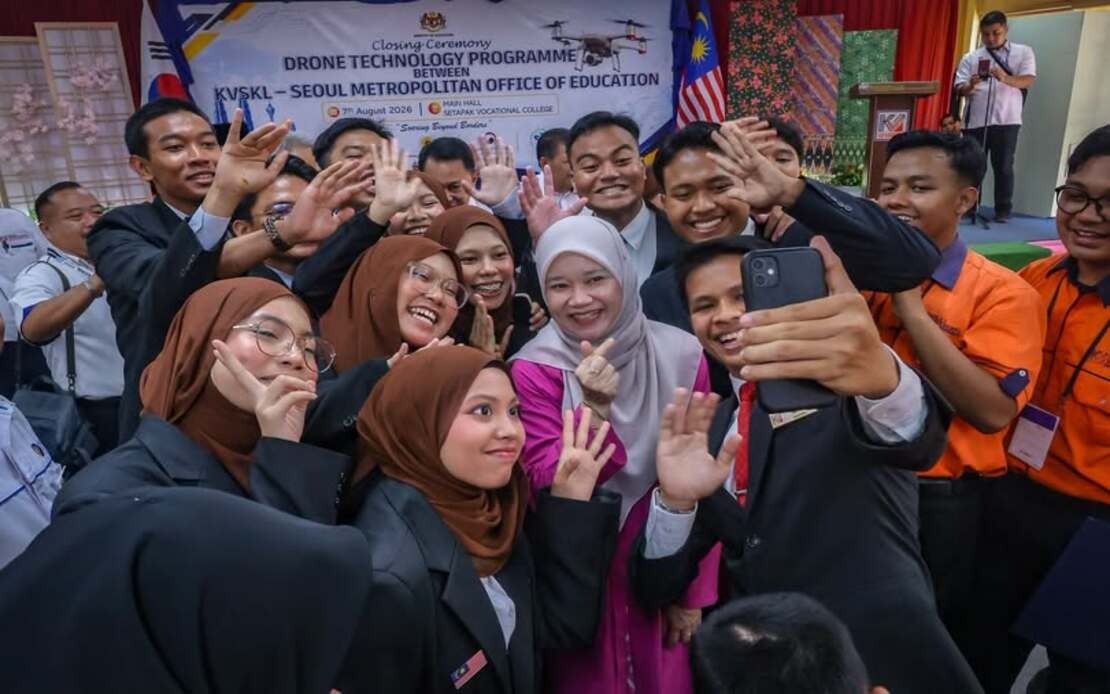
Education Minister Fadhlina Sidek has set an ambitious one-month deadline for students at Setapak Vocational College to conceptualize and present innovative applications of drone technology for enhancing campus security. The challenge, issued during a collaborative education programme with South Korea's Seoul Metropolitan Office of Education, reflects the ministry's commitment to bridging the gap between classroom learning and real-world technological implementation. South Korean Ambassador to Malaysia Yeo Seung-bae was present at the event, underscoring the international partnership's significance in facilitating knowledge transfer and cross-cultural educational exchange.
Fadhlina's initiative represents a strategic pivot in Malaysia's vocational education approach, moving beyond theoretical instruction toward practical problem-solving that addresses immediate institutional needs. By tasking students with identifying concrete applications for emerging technology rather than simply learning to operate equipment, the minister is pushing vocational institutions to cultivate entrepreneurial and critical thinking capabilities. This methodology aligns with evolving global workforce expectations, where technical proficiency alone no longer suffices without the ability to contextualize technology within broader organizational challenges.
The collaboration programme with Seoul's education authority introduces Malaysian vocational students to international best practices in robotics and drone technology education. South Korea has established itself as a leader in integrating advanced technology into secondary and vocational curricula, making this partnership particularly valuable for Malaysian institutions seeking to modernize their programs. The exchange of expertise and experience creates opportunities for Setapak students to access teaching methodologies and technological resources that might otherwise take years to develop domestically.
During her campus visit, Fadhlina observed students operating drones, robots, and other technological equipment, noting that the learning process itself—encompassing both successes and failures—holds greater educational value than flawless execution. Her observation that "some succeeded, some made mistakes, but they kept trying" captures an essential philosophy often absent from traditional examination-driven education systems. This emphasis on resilience and iterative learning aligns with innovation pedagogy increasingly adopted by leading vocational institutions worldwide.
The minister articulated a fundamental shift in how Malaysia should perceive technological competencies within education. Robotics, drone systems, and artificial intelligence are no longer distant future concepts but tangible tools already reshaping contemporary labour markets across manufacturing, agriculture, infrastructure development, and security sectors. Malaysia's ambition to achieve high-income nation status by 2050 depends critically on whether its workforce can operate within and adapt to technology-intensive environments. Vocational colleges, which train the largest cohort of school leavers entering direct employment, must therefore become incubators of technological literacy rather than narrowly focused trade-skill centers.
Fadhlina's challenge extends beyond mere capability demonstration. By requiring students to identify security applications for drones on their own campus, she is encouraging them to develop observational and analytical skills necessary for technological innovation. Campus security represents a tangible, localized problem that students can observe firsthand—inadequate coverage areas, blind spots, response time limitations, and resource constraints. This grounding in concrete reality transforms abstract technological learning into purposeful problem-solving with stakeholder input and measurable outcomes.
The security focus itself carries particular relevance for Malaysian institutions. Many schools and vocational colleges operate across sprawling campuses with multiple entry points, parking areas, and peripheral zones that traditional surveillance methods struggle to cover comprehensively. Drone technology offers potential advantages including flexible deployment, real-time aerial perspectives, and integration with existing security infrastructure. Students tasked with developing such proposals will necessarily grapple with technical specifications, cost-benefit analysis, privacy considerations, regulatory compliance, and practical implementation challenges—all components of professional engineering and management practice.
Fadhlina's intervention signals ministerial recognition that vocational education requires reimagining beyond its historical role as a pathway for academically weaker students. Instead, she is positioning vocational colleges as innovation laboratories where students develop commercially viable technological solutions. This reframing could gradually reshape societal perceptions of vocational pathways, potentially attracting higher-achieving students and facilitating the upward mobility of graduates through entrepreneurship and specialized technical careers.
The one-month timeline creates productive urgency while remaining achievable for structured project work. Students must rapidly transition from operational familiarity with drones to strategic thinking about deployment optimization, regulatory frameworks, maintenance requirements, and cost sustainability. This compression mirrors real professional environments where solutions must be designed and presented to decision-makers within constrained timeframes. Such experience prepares vocational graduates for employment contexts that increasingly demand agility and compressed development cycles.
For Malaysia's broader education ecosystem, this initiative carries implications extending beyond Setapak Vocational College. If successful, the project could establish a replicable model for other vocational institutions, demonstrating how international partnerships facilitate technology integration while generating practical solutions addressing institutional needs. Regional governments and private sector stakeholders might perceive vocational colleges differently—as potential collaborators in technology development rather than merely training grounds for traditional trades.
The challenge also reflects Malaysia's positioning within Southeast Asia's technology landscape. As regional neighbours including Vietnam and Thailand accelerate vocational modernization with government support, Malaysia must maintain competitive advantage through innovative pedagogy and industry-relevant skill development. International partnerships like that with Seoul provide important benchmarking opportunities and knowledge transfer mechanisms that would prove costly or time-consuming to develop independently.
Ultimately, Fadhlina's approach represents a philosophical commitment to vocational education as dynamic and forward-oriented rather than static and retrospective. By challenging students to envision technological applications for real institutional problems, she is cultivating the adaptive capacity and innovative mindset that characterize successful workforces in technology-driven economies. Whether Setapak students successfully develop viable drone security proposals matters less than the precedent established: vocational learners are capable of sophisticated technological reasoning, institutional problem-solving, and contributing meaningfully to their communities through applied innovation.

