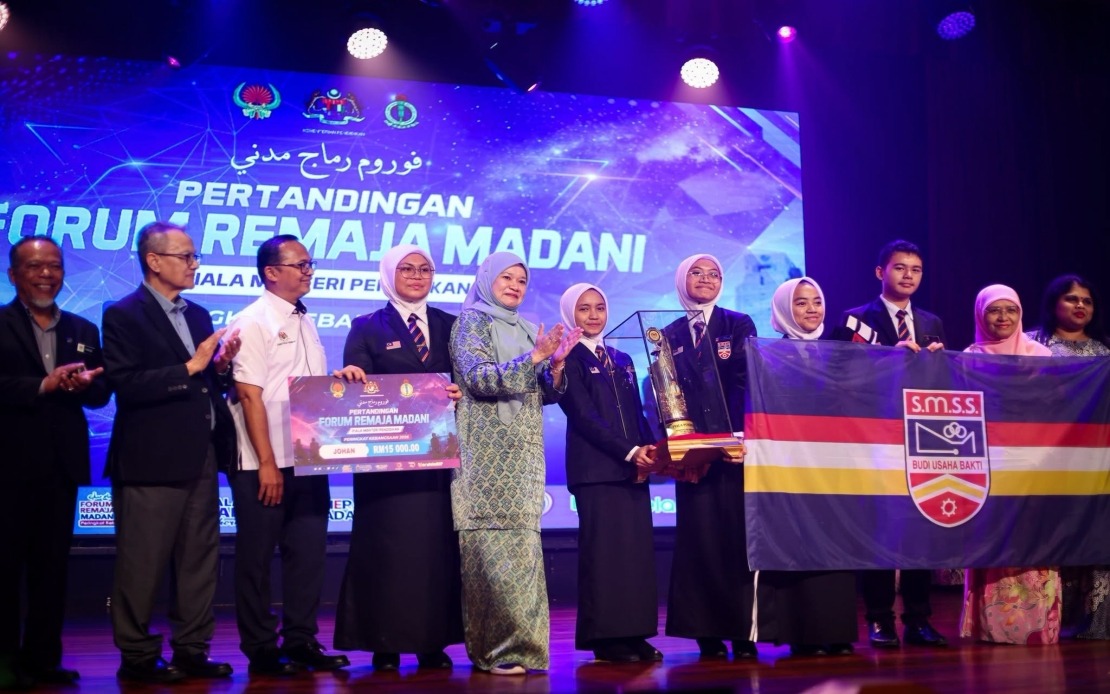
Education Minister Fadhlina Sidek has articulated a vision for character development that extends beyond traditional moral instruction, positioning critical thinking and respectful discourse as cornerstones of Malaysia's educational agenda. Speaking following observations at the National MADANI Youth Forum, Fadhlina outlined an approach to shaping young citizens that emphasizes their agency and intellectual autonomy rather than passive compliance with predetermined values.
The minister's perspective marks a deliberate pivot in how Malaysian education frames civic virtue. Rather than limiting character education to conventional notions of obedience and moral rectitude, Fadhlina advocates for cultivating young people who can articulate positions with confidence, engage with opposing viewpoints thoughtfully, and defend their reasoning with intellectual rigor. This approach recognizes that contemporary citizenship demands more than adherence to rules; it requires the capacity to participate meaningfully in a pluralistic society where diverse perspectives inevitably emerge.
Fadhlina observed directly how young forum participants demonstrated the capacity to formulate and express their thoughts, consider alternative viewpoints, and substantiate their arguments through reasoned discussion. She identified these competencies as representative of the character traits the education system should deliberately nurture. This observation carries particular weight given Malaysia's multicultural and multireligious composition, where the ability to navigate disagreement without fracturing social cohesion remains perpetually relevant.
The minister explicitly rejected a paternalistic model of education where authorities determine what students should think or say. Instead, she positioned the educator's role as preparatory: ensuring that when young people do speak, they possess the substantive knowledge to construct coherent arguments and the social discipline to listen to others with genuine consideration. This distinction reflects an understanding that education cannot—and perhaps should not—control content; it can only equip young minds with the tools for responsible self-expression.
Crucially, Fadhlina linked character education directly to language policy, arguing that the Malay language strengthens when successive generations perceive it as a sufficiently expressive vehicle for their own thoughts and concerns. This represents a pragmatic recognition that language vitality depends not on compulsion but on perception of utility and relevance. If young Malaysians view Malay as capable only of reproducing state-approved messages, they will naturally gravitate toward other languages for authentic self-expression. Conversely, if they see Malay as enabling them to articulate complex, independent, and even challenging ideas, they will embrace it as essential to their intellectual identity.
The minister's framing implicitly acknowledges that creating "more spaces" for youth to use Malay requires not just institutional provision but cultural permission for substantive, sometimes contentious speech in that language. This carries implications for curriculum design, classroom practice, and the broader policy environment surrounding how dissent and debate are treated in educational settings. Without genuine space for disagreement expressed in Malay, any effort to strengthen the language risks appearing instrumental rather than authentic.
Fadhlina's assertion that "a mature nation is not one where everyone agrees" challenges long-standing assumptions in Malaysian public discourse. This statement implicitly critiques consensus-seeking narratives that occasionally position disagreement itself as divisive or unpatriotic. Instead, the minister positions mature nationhood as requiring a citizenry educated in the difficult work of disagreeing well—that is, with intellectual honesty, factual grounding, and respect for the humanity of those holding contrary positions. This distinction has profound implications for how Malaysian society approaches polarization and political contestation.
The concept of educating young people to "defend their arguments" while maintaining courtesy toward opposing views addresses a persistent challenge in polarized public spaces. Rather than hoping that exposure to diverse opinions automatically produces respect, this formulation suggests that respect flows from understanding how argument itself works—recognizing the difference between attacking a position and attacking a person, acknowledging valid points even in positions one ultimately rejects, and recognizing the contingency rather than inevitability of one's own views. These are teachable skills rather than innate virtues.
For Malaysian education policymakers and school administrators, Fadhlina's remarks suggest a framework for character development that moves beyond abstraction. The challenge lies in translating these principles into curriculum standards, teacher training programs, and classroom assessment practices. How should schools measure whether students can defend arguments? What constitutes appropriate disagreement in classroom contexts? How can examination systems reward critical thinking without incentivizing mere contrarianism? These implementation questions will determine whether the vision remains rhetorical or becomes structural.
The timing of these remarks reflects broader global conversations about education's role in an era of information fragmentation and polarization. Malaysia, navigating its own tensions around religious expression, ethnic identity, and political participation, stands to benefit from an educational approach that equips citizens to engage across difference. However, this requires not just ministerial endorsement but consistent backing from school leadership, examination authorities, and the broader political ecosystem that education inevitably reflects.
Fadhlina's emphasis on teaching young Malaysians to listen even while disagreeing addresses a particular vulnerability in diverse societies: the tendency for groups to inhabit separate information ecosystems and attribute disagreement solely to malice or ignorance rather than to different values or evidence interpretations. By positioning courtesy and intellectual engagement as skills requiring deliberate cultivation, the minister acknowledges that respecting difference does not arise naturally from proximity alone. Young Malaysians will need explicit instruction in how disagreement can coexist with mutual regard.
The minister's vision ultimately rests on a particular faith: that young Malaysians, given the knowledge and permission to speak critically and the cultural expectation to do so respectfully, will generate a more robust and sustainable form of national cohesion than enforced conformity ever could. Whether the education system can deliver on this promise depends on whether similar commitments to critical thinking and respectful discourse become embedded throughout the institutional structures that shape how young Malaysians learn to think and communicate.

