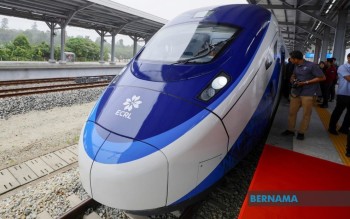
The East Coast Rail Link (ECRL) represents far more than a transportation infrastructure project—it is emerging as a catalyst for comprehensive economic transformation across Malaysia's eastern seaboard, according to Deputy Minister of Economy Datuk Mohd Shahar Abdullah. Speaking from Kuantan, Mohd Shahar articulated a vision where the ECRL functions as an anchor for integrated economic development spanning Pahang, Terengganu, Kelantan and Selangor, fundamentally restructuring how businesses access markets and organise their supply chains.
The strategic value of the ECRL extends throughout the entire economic value chain, encompassing not only the transportation function itself but also the auxiliary industries that cluster around such infrastructure. Construction activities, operational services, and maintenance operations will generate employment and business opportunities that ripple outward through regional economies. This multiplier effect reflects modern infrastructure planning philosophy, where physical assets catalyse broader sectoral development rather than existing as isolated projects.
Mohd Shahar, who represents Paya Besar in Parliament, emphasised that the project's true potential emerges through transit-oriented and cargo-focused development frameworks. These planning approaches integrate residential, commercial, and industrial zones around rail corridors, creating nodes of economic activity rather than dispersed, inefficient development patterns. Warehousing facilities, distribution centres, and industrial parks will emerge along the ECRL route, fundamentally altering logistics geometry for businesses throughout the affected states.
The cost structure advantages that ECRL will confer upon entrepreneurs represent a critical competitive lever, particularly for businesses currently operating within Malaysia's relatively fragmented regional markets. By dramatically reducing transportation costs and delivery timeframes between East Coast states and Selangor—the nation's economic engine—businesses can effectively expand their serviceable addressable markets without proportional increases in operational expenditure. This efficiency gain creates space for price competitiveness, volume expansion, or margin improvement.
The practical implications for manufacturing and production businesses warrant careful consideration by industry players and policymakers alike. A manufacturing enterprise capable of serving only local or immediate regional markets faces inherent constraints on production scale. The ECRL removes geographical friction from the market access equation, permitting businesses to achieve economies of scale previously unavailable. Doubling production volume from 10,000 to 20,000 units not only leverages fixed costs across a larger revenue base but typically enables procurement cost reductions and operational efficiency improvements that further strengthen competitive positioning.
Beyond manufacturing and logistics, the ECRL is anticipated to generate substantial tourism industry benefits. Enhanced accessibility to East Coast attractions—whether cultural heritage sites, natural attractions, or emerging tourism infrastructure—will likely increase visitor volumes. This tourism multiplier benefits not merely large hospitality enterprises but extends throughout local economies via small traders, food vendors, handicraft makers, and artisanal producers such as batik manufacturers. Tourism-driven demand creates relatively stable customer bases for locally-oriented businesses that traditionally faced limited growth ceilings.
Mohd Shahar delivered an important cautionary message to industry stakeholders, cautioning against complacency and technological conservatism. The availability of improved transportation infrastructure does not automatically translate into business success without corresponding adaptations in operational practices and technology adoption. Entrepreneurs must recognise that traditional business models—however effective historically—may not fully capture the opportunities that transformed logistics and market access create. This reflects broader Southeast Asian business environment trends where infrastructure investment only yields maximum returns when coupled with complementary technological and organisational evolution.
The project's construction progress underscores its advancement toward operational reality. As of April, the overall ECRL mega-project had attained 93.66 per cent completion, with December targeted as the delivery date. Within Pahang specifically, construction had reached 97.33 per cent progress, indicating imminent operational commencement in the state that will serve as the project's primary terminus. This timeline means that businesses must actively prepare for the market expansion opportunities the ECRL will unlock rather than treating its arrival as an abstract future possibility.
For Malaysian policymakers and regional economic strategists, the ECRL represents a strategic opportunity to rebalance economic development away from excessive Selangor concentration. By creating competitive logistics and market access conditions in peripheral regions, infrastructure investment can enable more distributed prosperity and reduce regional inequality. The East Coast states possess industrial capacity, skilled workforces, and raw material resources that have historically remained underutilised due to market access constraints. The ECRL addresses this structural economic inefficiency at a fundamental level.
The project's implications extend beyond national borders into broader Southeast Asian economic integration frameworks. As Malaysia's regional trade and investment position depends increasingly upon efficient connectivity with neighbouring economies, an enhanced East Coast transportation network supports Malaysia's role as a regional logistics hub. The ECRL strengthens Malaysia's capacity to serve as a transit point for goods flowing between ASEAN economies and external markets, potentially attracting investment in distribution and value-added services.
For entrepreneurs currently operating in Pahang, Terengganu, and Kelantan, strategic assessment of how to position businesses for post-ECRL operational landscapes should become immediate priorities. Companies that anticipate market expansion, invest in production capacity, develop supply chain capabilities, and embrace relevant technologies will likely capture disproportionate shares of growth opportunities. Conversely, businesses that maintain status quo orientations risk being displaced by competitors better prepared for transformed market conditions.
The ECRL project thus represents a rare convergence of infrastructure development, industrial policy, and regional development strategy, all oriented toward creating conditions for sustainable business growth and improved living standards across Malaysia's East Coast. Success will ultimately depend not merely on construction completion but on whether regional businesses and policymakers actively harness the structural advantages the project creates.

