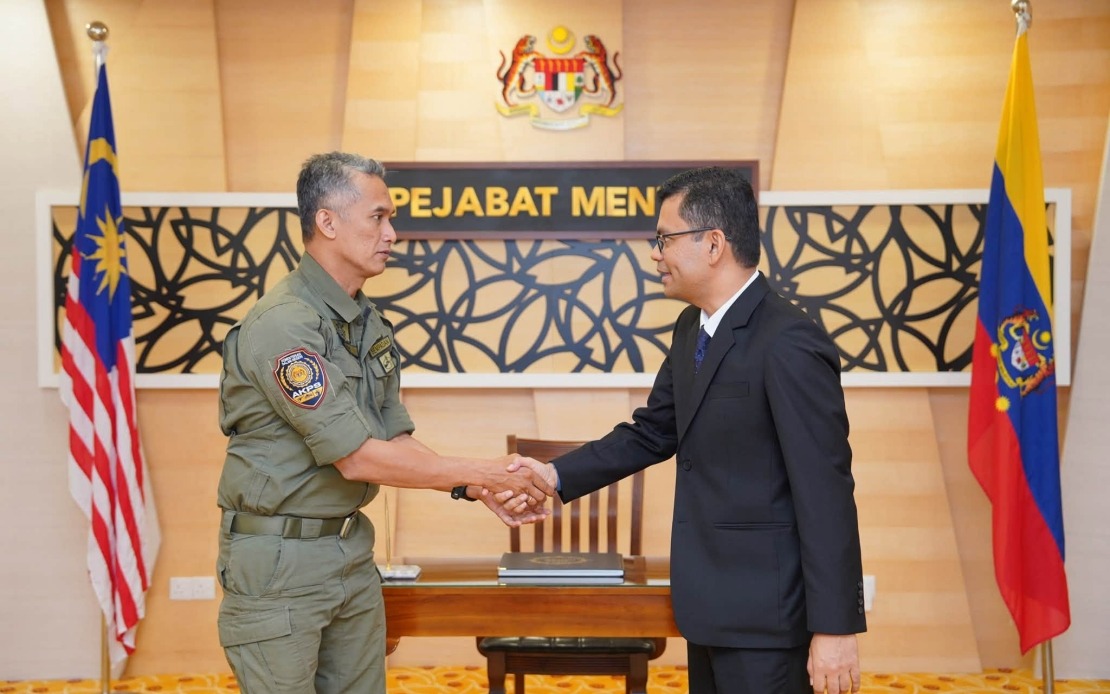
Officials from Malaysia's Economy Ministry have begun strategic discussions with the Malaysian Border Control and Protection Agency (AKPS) on securing development budgets to upgrade the country's border management systems. The talks, held in Putrajaya on August 5, involved AKPS director-general Datuk Seri Mohd Shuhaily Mohd Zain meeting with Economy Minister Akmal Nasrullah Mohd Nasir to outline funding needs for critical infrastructure projects and operational enhancements.
The discussions centred on how targeted investment can support AKPS's transition into a unified border authority since its official launch on January 1, 2025. This newly consolidated agency consolidated control functions at Malaysia's entry points by absorbing responsibilities previously scattered across six separate government organisations, marking a significant restructuring of how the nation manages its borders. The integration brought together the Immigration Department, the Royal Malaysian Customs Department, the Malaysian Quarantine and Inspection Services Department, the Health Ministry's functions, the Department of Wildlife and National Parks, and the Road Transport Department's transport-related border operations.
The Economy Ministry acknowledged in its statement that strengthening AKPS through comprehensive development planning serves multiple national interests beyond security. Enhanced border capabilities are expected to facilitate smoother commercial flows, reduce delays at critical trade gateways, and position Malaysia's entry points among the region's most efficient. This approach reflects broader government recognition that modern border management directly influences competitiveness in attracting regional commerce and investment flows.
According to Mohd Shuhaily, AKPS is prioritising three interconnected development areas as it establishes its long-term strategic direction. First, the agency is focused on reinforcing institutional integrity and operational efficiency while building human resource capacity to sustain the newly unified structure. These foundations matter substantially, as AKPS integrates personnel and procedures from organisations with different operational cultures and technical standards.
Second, the agency is pursuing advanced technological solutions to modernise border checkpoints across the country. Smart border technology lies at the heart of this strategy, incorporating integrated biometric systems that streamline identity verification for both passengers and officials. Automated cargo scanning systems will accelerate the inspection of goods entering and leaving Malaysia, while real-time data integration powered by artificial intelligence will enable officers to identify patterns, assess risks, and make decisions faster than traditional manual methods allow.
These technological initiatives carry particular significance for Southeast Asia's trade environment. Malaysia sits at a strategic position in regional commerce flows, and border efficiency directly affects supply chains running through the region. When processing times shorten and accuracy improves, the cost advantages for businesses using Malaysian entry points strengthen, potentially drawing additional trade activity through Malaysian ports and airports rather than competing regional gateways.
The third development priority centres on strategic asset creation and operational capacity building. This encompasses physical infrastructure upgrades at border checkpoints, equipment procurement, and training programmes that ensure officers can operate sophisticated systems effectively. The agency's ambition extends beyond simply preventing illegal activities; it aims to create entry points that simultaneously maximise security, facilitate legitimate commerce, and project operational professionalism.
The timing of these discussions reflects the practical realities facing AKPS as it moves beyond its inaugural phase. Consolidating six agencies into one functional structure creates opportunities but also operational challenges. Budgetary constraints could limit the agency's capacity to implement modernisation plans comprehensively, particularly for expensive technological systems that require ongoing maintenance and updates. Securing Economy Ministry support signals government commitment to providing necessary resources.
For Malaysian businesses engaged in international trade, improved border efficiency translates directly to competitive advantages. Faster clearance times reduce holding costs for perishable goods and time-sensitive shipments. Predictable processing schedules improve supply chain planning. Enhanced security systems, ironically, can support faster flows by building confidence that goods have been properly vetted and cleared.
Regional competitors are pursuing similar modernisation strategies. Singapore's land borders and maritime checkpoints operate with sophisticated technology that sets regional benchmarks. Thailand has invested heavily in integrated border systems. Indonesia is upgrading its major entry points. Malaysia cannot afford to lag in this competition for efficient, trustworthy border management that attracts legitimate trade and investment.
The discussions between the Economy Ministry and AKPS also underscore the economic rationale behind consolidating border functions. Rather than six organisations competing for limited budgets and sometimes working at cross-purposes, a unified agency can implement coordinated strategies. Technology investments benefit the entire system rather than improving only one component. Personnel can be deployed where bottlenecks emerge rather than remaining siloed within departmental structures.
Looking forward, the success of AKPS depends significantly on whether development budgets materialize as discussed. The agency's strategic vision is ambitious, but ambition requires resources. Modernising multiple entry points nationwide—from Kuala Lumpur International Airport to the Bukit Kayu Hitam checkpoint, from Port Klang to smaller land borders—represents a substantial investment programme. The Economy Ministry's apparent receptiveness to AKPS's requirements suggests the government recognises border efficiency as an economic priority rather than merely a security matter.
The discussions in Putrajaya represent an early stage in AKPS's institutional development, but they signal the direction the agency intends to pursue. Over the coming months, budgets will either materialise or prove insufficient. Technology pilots may launch or face delays. The true measure of AKPS's success will ultimately be whether businesses, travellers, and government agencies observe tangible improvements in how Malaysia's borders function.

