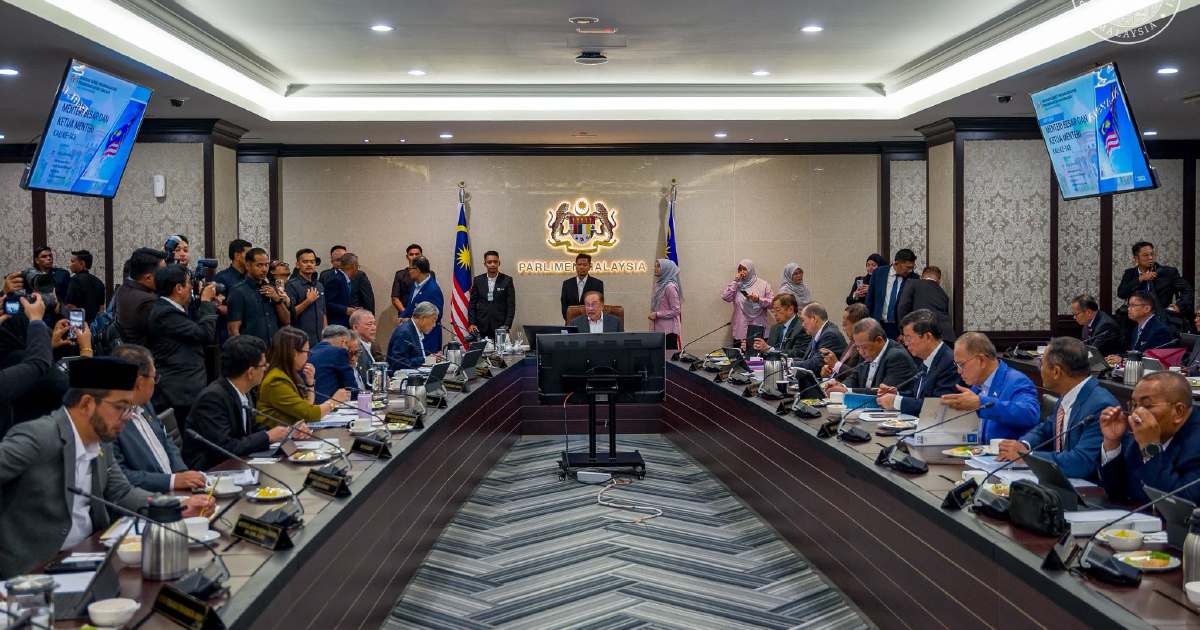
Prime Minister Datuk Seri Anwar Ibrahim brought together Malaysia's Menteris Besar and Chief Ministers at the Parliament building for their 149th collective meeting, directing attention primarily toward charting a course for economic renewal during a period marked by substantial global uncertainty. The gathering, which serves as a crucial platform for aligning state and federal governance priorities, underscored the administration's focus on fortifying the nation's economic foundations as international tensions, particularly those centred on Middle East conflicts, cast shadows over regional stability and investment flows.
The convening of this high-level assembly reflects the administration's recognition that subnational governments play an instrumental role in translating national economic strategies into tangible growth at the grassroots level. State governments, through their control of land, local development incentives, and regional infrastructure projects, function as critical partners in any comprehensive economic revival effort. By bringing these leaders into a single forum, the federal government signals its commitment to fostering coordinated policy responses rather than fragmented or competing regional approaches that could dilute overall impact.
The timing of this meeting carries particular significance given Malaysia's position as an open, trade-dependent economy vulnerable to external shocks. The Middle East conflicts, while geographically distant, reverberate through global supply chains, energy markets, and investor sentiment. Malaysian firms with exposure to regional trade networks or those reliant on imported components face potential disruptions. Similarly, Malaysia's strategic position as a shipping hub and financial centre means that any escalation affecting maritime routes or regional banking stability could directly impact the nation's economic performance. State leaders gathered would be acutely aware of these vulnerabilities within their own jurisdictions.
Economic revival at the current juncture necessitates more than conventional stimulus measures. The discussions likely encompassed diversification strategies, particularly for states traditionally dependent on single sectors such as agriculture, tourism, or commodity exports. With global demand potentially weakening due to geopolitical jitters, states require coherent plans to develop resilient, value-added industries. For instance, manufacturing-heavy states might explore automation and higher-skill production to compete amid uncertainties, while tourism-dependent regions could strengthen domestic tourism and develop new visitor markets less susceptible to international shocks.
The federal-state coordination mechanism illustrated by this gathering becomes especially crucial when considering that Malaysia's economic challenges are not uniform across all states. Peninsular states differ significantly from Sabah and Sarawak in sectoral composition, infrastructure development, and growth trajectories. A one-size-fits-all economic recovery strategy would prove counterproductive. Instead, customized approaches that recognize regional strengths and vulnerabilities, coupled with supportive federal policies, offer better prospects for meaningful revival.
Investor confidence represents another dimension likely discussed at the meeting. Foreign direct investment, pivotal for employment creation and technology transfer, tends to contract when uncertainty rises. State governments, as first points of contact for potential investors seeking to establish operations, bear responsibility for projecting stability and competence. Clear communication about policy consistency, regulatory environment predictability, and security assurance emanating from this unified platform helps counter negative perceptions that might otherwise deter capital inflows.
The geopolitical context deserves closer examination. Middle East tensions affect Malaysia through multiple transmission channels beyond direct trade links. Elevated crude oil prices, should they materialize from supply disruptions, inflate production costs across industries and raise consumer prices for fuel and energy. Shipping insurance premiums increase, making Malaysian exports costlier. Regional tourism declines affect not only international arrivals but also the purchasing power of regional tourists who represent substantial numbers for Malaysian attractions. These cascading effects underscore why economic revival requires anticipatory policy adjustments rather than reactive interventions.
The 149th meeting also serves a political function beyond technical economic discussion. It provides an arena where state governments, potentially governed by opposition coalitions or led by leaders with different agendas than the federal administration, can be brought into alignment with national priorities. The consensus-building exercise implicit in such high-level gatherings helps prevent states from pursuing counterproductive policies or making public statements that might undermine confidence. This coordinating function grows more vital when economic conditions are fragile.
Looking forward, the sustainability of economic revival depends critically on execution at state level. Discussions on paper achieve little without operational follow-through by state authorities responsible for issuing business licenses, maintaining infrastructure, and ensuring regulatory compliance. State-level capacity building, technology transfer, and knowledge sharing regarding best practices in attracting investment or facilitating business operations thus become essential components of any recovery strategy emerging from such meetings.
The emphasis on economic revival at this particular moment suggests recognition within government that complacency poses risks. Malaysia's middle-income status masks underlying productivity challenges, skills gaps, and infrastructure deficits that global uncertainty is unlikely to resolve independently. Rather, external pressures create urgency for structural improvements. State governments, sitting at the intersection of federal policy and local implementation, occupy the pivotal position from which such improvements can be meaningfully advanced, making their collective engagement in economic planning not merely procedural but fundamentally strategic.