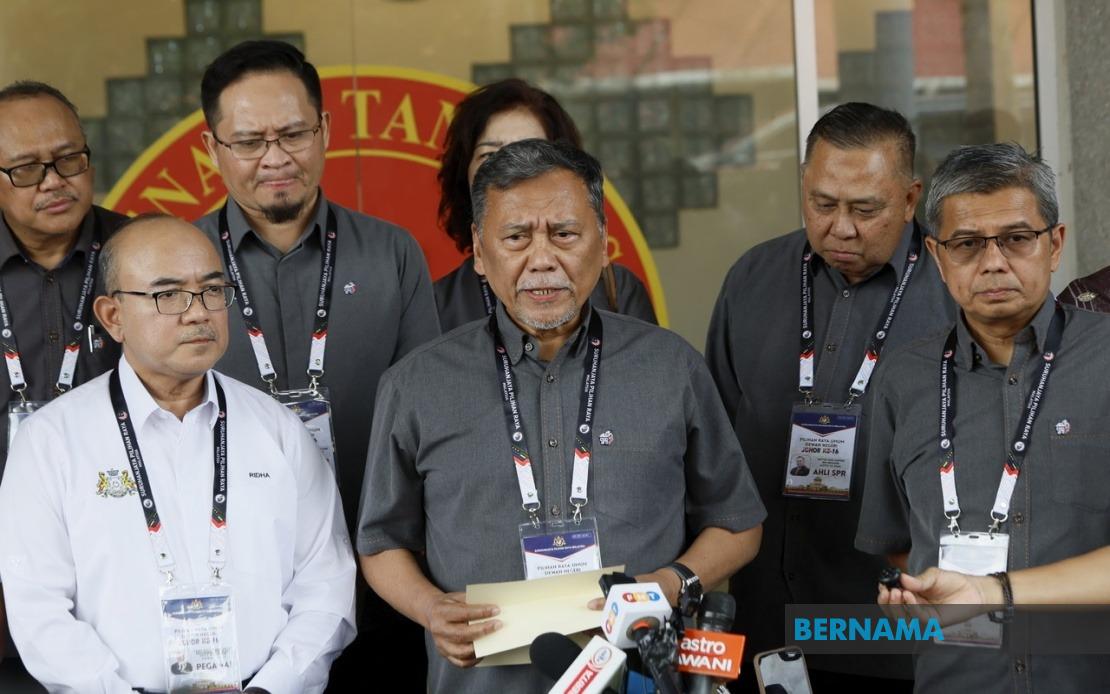
The Election Commission is banking on strong participation in early voting for the Johor state election, with EC chairman Datuk Seri Ramlan Harun announcing an ambitious 96 per cent turnout target on the day of polling. The projection reflects the commission's confidence based on performance in previous electoral exercises, suggesting that this level of engagement among early voters has become a reliable benchmark for Malaysian elections.
Ramlan made the announcement after visiting Kem Mahkota in Kluang, where he observed early voting procedures firsthand. The EC had established 62 early voting centres across Johor, each operating on staggered closing times to manage logistics and ensure orderly processing. Twenty-nine of these centres closed at midday, five shut down at 2 pm, and the remaining 28 remained open until 5 pm, reflecting a carefully structured timetable designed to accommodate the concentrated voter population eligible to cast ballots early.
The early voting exercise was limited to a specific demographic: military and police personnel together with their spouses. In total, 20,607 electors participated in early voting, comprising 8,544 members of the Malaysian Armed Forces and their spouses alongside 12,063 police officers and their family members. This arrangement is standard practice in Malaysian elections, recognising the deployment needs and operational demands placed on uniformed services during polling periods. Their early participation ensures that security and administrative personnel can focus on election day duties without personal voting constraints.
The logistics surrounding ballot security form a crucial component of the EC's election management strategy. Once voting concluded, all early ballots were secured at police stations, preventing any possibility of tampering or mishandling before the official counting process commenced. This protective measure underscores the commission's commitment to maintaining electoral integrity throughout every stage of the voting cycle.
Counting of early ballots will occur on Saturday, the actual polling day, beginning at 5 pm once general voting has concluded. The EC projects that full results could be announced before midnight, with hopes of publishing final numbers as early as 10 pm. This accelerated timeline reflects improvements in counting procedures and administrative coordination that have evolved through successive electoral cycles in Malaysia. The compressed results window also minimises the period during which political uncertainty hangs over the state, allowing for faster government formation and policy implementation.
Ramlan's appeal extended beyond the early voting cohort to encompass the broader electoral population. With 2.7 million ordinary voters eligible to participate on the main polling day, he urged citizens to recognise voting as both a fundamental right and a civic obligation. His framing positioned electoral participation as a tangible contribution to the nation's democratic functioning, emphasising the collective responsibility embedded in Malaysia's constitutional framework.
The Johor state election represents a significant political event within Malaysia's broader electoral calendar. State-level contests serve as important barometers of public sentiment and voter preferences between national general elections, often influencing the political positioning of major parties and shaping policy discourse at federal level. Johor, as one of Malaysia's largest and most economically significant states, carries particular weight in these calculations.
The EC's operational preparedness demonstrated through this early voting exercise suggests a well-coordinated institutional response to managing elections at scale. The variety of closing times across voting centres, the security protocols for ballot storage, and the accelerated counting timeline all reflect bureaucratic sophistication refined through decades of electoral experience. For Malaysian voters and political observers, these procedural elements form the backbone that enables democratic choice to function smoothly.
From a regional perspective, Malaysia's election administration processes often serve as models or points of reference for other Southeast Asian democracies grappling with their own electoral challenges. The systematic approach to early voting, the security measures, and the commitment to rapid, transparent results announcement demonstrate institutional capacity that extends beyond Johor's borders to influence regional perceptions of Malaysian governance standards.
Looking ahead to Saturday's general voting, the projection of high early turnout suggests momentum toward substantial overall participation. Electoral engagement rates carry implications beyond simple statistics; they reflect citizen confidence in democratic processes and investment in political outcomes. High turnout typically correlates with mandates perceived as more legitimate and representative, factors that influence both the implementing government's policy latitude and opposition parties' strategic positioning in the post-election landscape.

