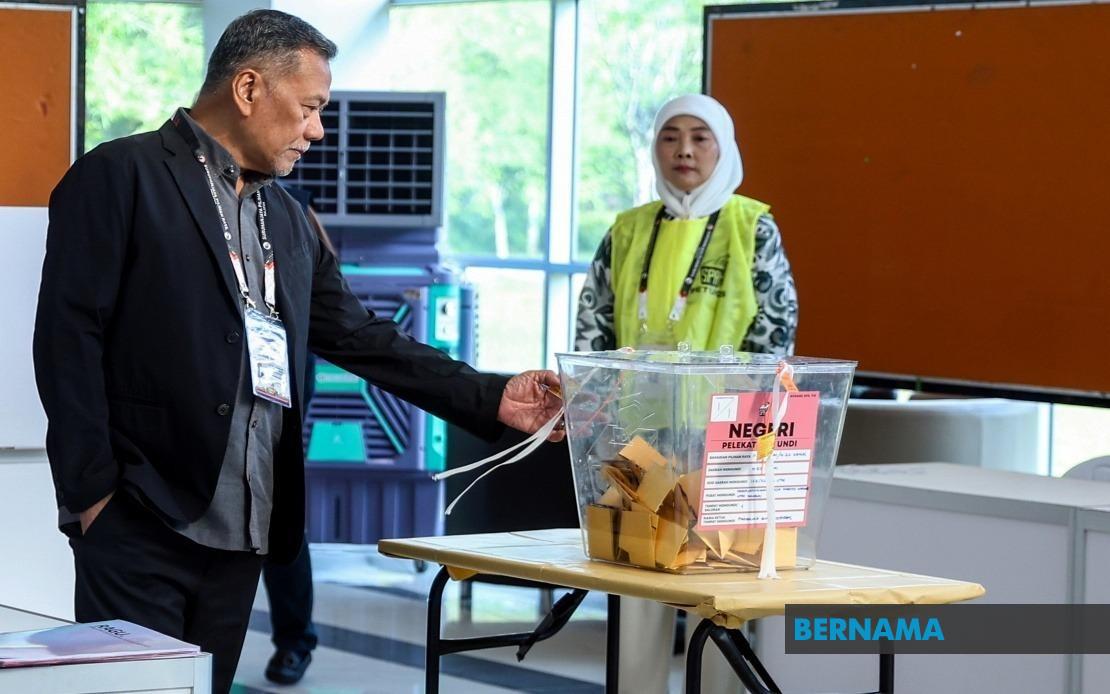
Election Commission chairman Datuk Seri Ramlan Harun undertook a series of inspections at polling venues across Johor Bahru on July 11, visiting four separate locations to assess voting operations during the 16th Johor state election. The inspection tour, which commenced mid-morning, allowed the EC leadership to directly observe electoral procedures in action and verify that voting was proceeding according to established protocols. The visits reflected the commission's standard practice of conducting quality assurance checks across constituencies during poll days, reinforcing institutional oversight of Malaysia's electoral process.
Ramlan's first stop was Dewan Raya Taman Ungku Tun Aminah in the Skudai constituency at approximately 8.50 am, where seven polling streams were operational. This early-morning inspection provided a snapshot of voting conditions in one of Johor's urban constituencies, allowing the chairman to assess how election staff managed multiple voting channels and whether queuing systems and voter flow were functioning efficiently. Skudai, as a populated urban area, typically experiences considerable voter turnout during state elections, making it a representative venue for assessing broader polling-day operations.
Following his assessment at the initial centre, Ramlan proceeded to Raja Zarith Sofiah Library situated within the Universiti Teknologi Malaysia campus, serving the Senai constituency. This facility operated two polling streams and represented a different electoral context—a university-based voting location where students and staff cast ballots. University polling stations often present unique challenges related to voter identification verification and management of younger, first-time voters, aspects the EC chairman would have evaluated during his visit. The UTM location also highlighted how the commission accommodates voting access for tertiary institution populations.
The chairman's third inspection took him to Sekolah Agama Taman Bukit Mewah in the Kempas constituency, which maintained six polling streams. Religious schools serving as polling venues are common across Malaysia, and this location provided insight into how such facilities accommodate electoral operations while maintaining their regular institutional functions. The visit allowed assessment of how school authorities and election officials collaborate to create appropriate voting environments within educational settings, balancing accessibility with proper security and administrative procedures.
Ramlan concluded his inspection tour at Sekolah Menengah Kebangsaan Bandar Uda Utama in the Perling constituency, the largest of the four centres visited with nine polling streams in operation. Secondary schools in urban areas like Bandar Uda Utama frequently serve as primary polling stations due to their size and infrastructure capacity. The nine polling streams at this location indicated substantial expected voter participation in Perling, and the chairman's visit to this larger-scale operation provided observation of how the EC manages complex multi-stream voting logistics.
During each venue visit, election officials provided Ramlan with detailed briefings regarding voting procedures, highlighting any operational matters requiring attention or clarification. These interactions represented a direct communication channel between ground-level election workers and the EC's highest-ranking officer, enabling rapid identification and resolution of procedural issues. The chairman also conducted direct inspections of voter facilities and personnel accommodations at each location, examining aspects such as queue management areas, voting booths, ballot security measures, and comfort provisions for election staff working extended polling-day hours.
The inspection regimen undertaken by Ramlan reflected the EC's commitment to maintaining electoral integrity throughout the voting process. By visiting multiple constituencies representing different demographic and geographic characteristics—from urban centres like Skudai to university populations at UTM to secondary school facilities—the chairman gained a representative understanding of how the election was unfolding across diverse Johor communities. Such systematic oversight demonstrates institutional accountability and provides assurance to voters and political participants that the electoral process operates under proper supervision.
For Malaysian readers, this inspection activity underscores how electoral management extends beyond pre-election preparations and voting-day administration into active real-time monitoring. The EC's presence at polling venues, particularly through senior leadership involvement, signals to voters, candidates, and observers that the commission takes its regulatory responsibilities seriously. In the context of state elections, such visible oversight helps maintain public confidence in electoral outcomes and demonstrates institutional responsiveness to any potential irregularities that might emerge during voting.
The scheduled press conference following Ramlan's inspection tour would provide an opportunity to communicate official observations regarding voting conditions to media and the broader public. Such briefings typically address voter turnout trends observed, any procedural adjustments implemented, security incidents if any, and preliminary assessments of compliance with electoral guidelines. These communications serve as public accountability mechanisms, ensuring that information about poll-day operations flows transparently from the EC to stakeholders and citizens monitoring the election process.

