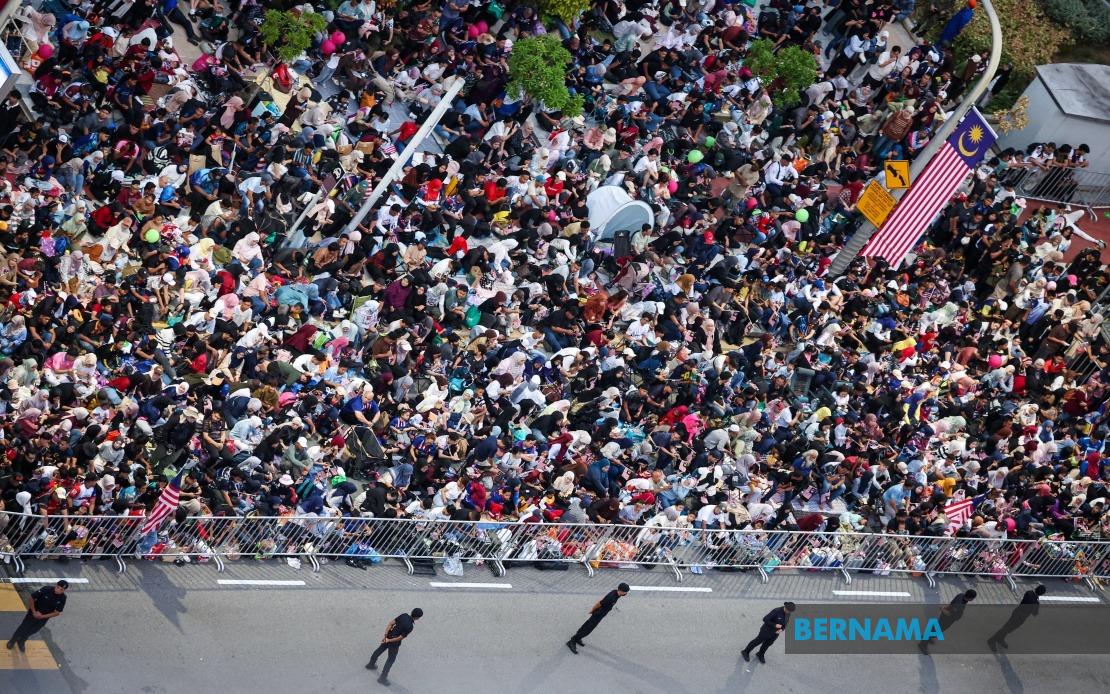
Anticipation for Malaysia's 69th National Day celebration drew crowds to Dataran Putrajaya from early evening onwards on August 30th, with visitors strategically positioning themselves along the parade route well ahead of the morning festivities. The gathering reflected the considerable public interest in the marquee annual event, as families and groups staked out advantageous spots from which to observe proceedings scheduled to commence at 8 am under the theme "Malaysia MADANI: Kesejahteraan Dinikmati".
For young content creators like Mock Wei Qi, 23, the occasion presented an irresistible professional opportunity. The freelance photographer and his companions arrived at the venue around 11 pm, driven by their shared commitment to capturing visually compelling imagery and video content. Their motivation extended beyond mere documentation—they sought to craft cinematically rich material that would communicate Malaysia's distinctive character and appeal to international audiences. Through their lens work, these digital creators aspire to showcase the nation's unique qualities to viewers worldwide.
The decision to arrive early proved particularly strategic for those prioritising photography and cinematography. By securing prime positions during the evening hours, practitioners like Wei Qi could access angles and sightlines that would become congested and inaccessible as the venue filled to capacity during morning hours. This logistical calculation reflected the competitive dynamics inherent in popular media capture at high-profile national events.
Family-oriented visitors adopted similarly forward-thinking approaches. A couple identifying themselves as As and Adib brought their children to Dataran Putrajaya by 5 pm, driven partly by their experience from the previous year. Having arrived tardily in 2023, they found themselves positioned at considerable distance from the central celebrations, obliged to observe proceedings from the periphery. This year's decision to arrive substantially earlier represented a direct response to that previous disappointment, with the couple aiming for a viewing location closer to the core activities.
Ahmad Azri Onn, 55, approached the overnight stay with creative parenting in mind. Arriving around 5:30 pm alongside his spouse and three children aged between 10 and 15, Ahmad Azri reframed the extended waiting period as an experiential activity rather than an inconvenience. Rather than viewing the evening hours as mere time to be endured, the family treated their presence at the venue as an impromptu camping adventure that coincided with the school holidays.
Environmental conditions presented potential obstacles to comfort that the attending visitors largely minimised through pragmatic perspectives. The previous evening's drizzle, while capable of dampening spirits, actually provided climatic relief from the typically intense heat encountered during outdoor gatherings in Putrajaya. Ahmad Azri's family reported contentment despite the outdoor sleeping arrangements, with the weather conditions failing to substantially diminish their experience or the children's enthusiasm for witnessing the national celebration.
The evolution of the gathering reflected conventional patterns observed at prestigious public events throughout Malaysia and the broader Southeast Asian region. What began as scattered arrivals during late afternoon hours accelerated into substantial crowd density by morning, with Dataran Putrajaya becoming progressively congested as dawn approached. This temporal clustering of visitors created both opportunities and challenges, as those who had invested time in early positioning secured advantages while later arrivals faced increasingly constrained options.
The motivation to attend the National Day celebration in person, despite the physical demands of overnight camping and early morning waiting, underscores enduring public engagement with Malaysia's most significant national observance. Rather than relying exclusively on broadcast coverage or social media documentation, substantial numbers of citizens and residents prioritised direct participation and experiential presence. This inclination suggests that televised or digital transmission, while providing convenience and broader reach, cannot entirely substitute for the communal resonance and personal connection generated by physical attendance.
Dataran Putrajaya's role as the ceremonial venue represents a deliberate governmental choice that carries symbolic weight beyond logistical considerations. The location in the administrative capital reinforces the celebration's status as a state-sanctioned occasion of paramount importance. For visitors like Mock Wei Qi, As and Adib, and Ahmad Azri's family, the significance of the site itself—combined with the magnitude of the staged event—justified the considerable investment of time and effort required to participate fully.
The diverse demographic composition of overnight arrivals, ranging from professional content creators to schoolchildren to middle-aged professionals, reflected the genuinely inclusive character of National Day observances. Rather than appealing narrowly to specific generational or occupational cohorts, the celebration attracted participation across Malaysia's social spectrum. This breadth suggests that national identity formation and civic engagement through commemorative occasions retain substantial salience even in an era of fragmented media consumption and digital-first engagement.
Looking toward future National Day celebrations, the patterns observed at this year's gathering offer insights for event organisers and municipal authorities. The substantial early arrival phenomenon indicates that venue capacity and crowd management infrastructure warrant ongoing evaluation and potential enhancement. As digital content creation increasingly drives participation motivation among younger demographics, organisers might consider optimising sightlines and technical infrastructure for photographers and videographers alongside accommodating traditional spectators.
The overnight camping phenomenon ultimately reflects something beyond mere logistical strategy—it demonstrates persistent public commitment to shared national moments. Regardless of whether participants arrived for photography, family bonding, or community participation, their willingness to sacrifice comfort testified to the continued resonance of Malaysia's founding anniversary as an occasion worthy of substantial personal investment and collective observance.

