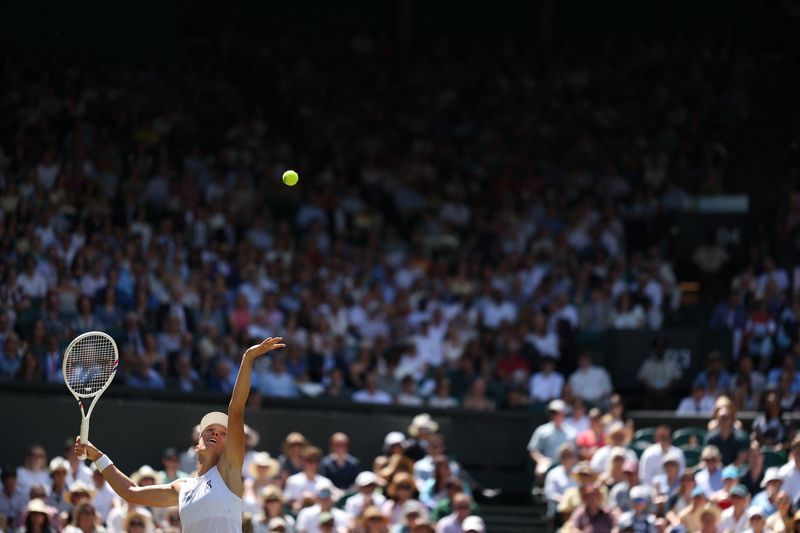
Alexandra Eala's fairy-tale run at Wimbledon continued on Saturday when the rising Philippine tennis star delivered a stunning upset, dismantling Poland's third-seeded defending champion Iga Swiatek with a commanding 7–6(9) 6–2 victory in a pulsating Centre Court encounter. The result ended Swiatek's bid to retain her crown and marked a significant breakthrough moment for Eala, who has steadily climbed the global rankings and now finds herself in unfamiliar territory at one of tennis's most prestigious tournaments.
Swiatek's campaign to defend her 2023 title had already encountered turbulence heading into the championship. The 25-year-old arrived at the All England Club having suffered an early exit at the Bad Homburg warm-up event, struggling to find the rhythm and confidence that had carried her to last year's triumph. That victory 12 months earlier had represented vindication for the Polish star, who had long faced questions from critics regarding her capacity to perform consistently on grass, a surface typically thought to suit explosive, attacking play rather than her baseline-grinding style. Her journey through the early rounds had provided some reassurance—she dispatched Taylor Townsend before posting an authoritative win over Karolina Pliskova—yet there remained an underlying fragility that would prove costly against Eala's inspired assault.
The opening set developed into a tactical chess match punctuated by moments of raw intensity and technical brilliance from both players. Neither competitor offered their opponent breathing room, with every service game fiercely contested and break opportunities seized with clinical precision. The dramatic tiebreak became a turning point, stretching to 9–7 before Eala closed it out, a conversion that proved psychologically significant. As the first set concluded, television cameras captured Swiatek's contrasting emotions—an initial smile giving way to visible frustration as she directed sharp words toward her coaching box before venting her irritation by striking her racket against a chair. Meanwhile, the Centre Court crowd responded enthusiastically to Eala's composed performance, their applause providing momentum for the Philippine player's second-set assault.
Eala's left-handed baseline attacking arsenal had troubled Swiatek from the opening stages of their clash, but the Filipino tennis player unleashed an even more aggressive approach as the second set commenced. By securing an early double break to establish a commanding 3–0 lead, Eala appeared to be coasting toward a routine victory. However, Swiatek's experience and championship pedigree began to surface, as the defending champion clawed back one break and mounted a spirited late-set comeback that momentarily suggested a potential revival. The momentum fluctuations in the second set showcased both players' capabilities—Eala's ability to dictate points through powerful groundstrokes and Swiatek's capacity to engineer opportunities through tactical court positioning and game intelligence.
Ultimately, Eala's nerve held firm during the crucial moments. She resisted Swiatek's comeback attempt by holding her serve decisively, then sealed her ascension to the fourth round with a penetrating forehand winner that left no margin for doubt. The victory carries particular significance given the historical context between these competitors. The pair had crossed paths previously in Miami, where Eala had recorded an upset victory that had subsequently prompted Swiatek to gain revenge during their Madrid clay-court meeting. That earlier Wimbledon result suggested that grass surfaces might prove especially unsuitable for the Polish champion's methodology—a reality that unfolded dramatically before a captivated crowd.
For Malaysian and Southeast Asian tennis followers, Eala's advancement represents an encouraging narrative. The 22-year-old has progressively established herself among the sport's rising talents, with consistent Grand Slam participation and recent tournament victories establishing her credentials as a genuine contender capable of defeating the world's elite players. Her comfort level on grass courts, demonstrated emphatically against Swiatek, suggests that she can compete effectively across different playing surfaces—a crucial quality for sustained success at the highest professional level.
Eala will now face 2024 Wimbledon runner-up Jasmine Paolini, a formidable challenge that will test whether Saturday's breakthrough performance represented a peak moment or the beginning of a genuine deep run. The Italian star's presence in last year's final indicates her substantial capabilities on the grass-court stage, presenting an opponent significantly more experienced in major tournament knockout stages. Nevertheless, Eala enters that encounter with genuine momentum and the confidence derived from eliminating a defending Grand Slam champion, psychological advantages that should not be underestimated when competing among tennis's elite.
Swiatek's exit from Wimbledon marks a disappointing conclusion to her title defence, raising questions about her suitability for this particular Grand Slam event despite her earlier breakthrough. The early Bad Homburg loss suddenly appears more consequential, having potentially disrupted her preparation and mental approach to the competition. For the Polish star, the focus will shift toward re-evaluating her grass-court tactics and ensuring that next year's Wimbledon campaign benefits from more thorough preparation and competitive match play on the surface. The loss demonstrates that Grand Slam success, regardless of whether defending a crown, remains a perpetually challenging endeavor in modern professional tennis.

