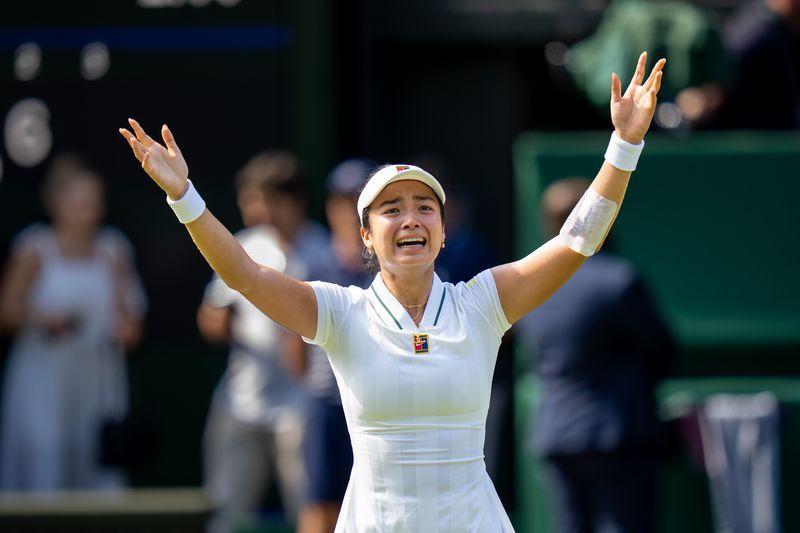
The women's singles competition at Wimbledon experienced seismic shifts on Saturday as two of the tournament's highest-seeded players crashed out in stunning fashion, signalling an unpredictable run towards the title. Alexandra Eala, the 29th seed from the Philippines, proved far too composed and aggressive for defending champion Iga Swiatek, overwhelming the Polish third seed 7-6(9) 6-2 in a performance that showcased remarkable poise under pressure. The result was compounded by the exit of second seed Elena Rybakina, who stumbled against Belgium's Elise Mertens in a one-sided 7-6(4) 6-1 defeat that raised questions about the Russian-born player's form on grass.
The opening set between Eala and Swiatek became the day's centerpiece, a tense battle that consumed nearly 90 minutes of tennis and demonstrated why such matches define Grand Slam tournaments. Trading precision forehands and exploring every inch of the baseline, the two players seemed evenly matched until Eala seized control in the tiebreak, ultimately prevailing 9-7 after saving a set point when Swiatek's forehand went long. The psychological impact of that tiebreak proved decisive; once Swiatek's grip loosened, Eala accelerated decisively through the second set, breaking serve three times en route to a commanding 6-2 victory that stunned Centre Court observers.
Rybakina's departure was less dramatic but equally consequential for her championship hopes. After competing narrowly in the opening set, the 2022 champion appeared to lose focus entirely, surrendering the second set with alarming ease to Mertens. For Rybakina, who had won the Australian Open earlier this year, the loss represented a crucial missed opportunity; had she progressed to the quarter-finals and beyond, she could have ascended to world number one. Instead, the Belgian secured her fourth appearance in the last 16 at the All England Club, denying Rybakina the momentum that might have salvaged a disappointing week.
Eala's triumph carries extraordinary significance for tennis in Southeast Asia and the wider Asian region. The 29-year-old became the first Philippine player to reach the fourth round of any Grand Slam tournament, a breakthrough that resonates throughout her home country and among Filipino sports enthusiasts across the region. Wearing a cap inscribed with a Tagalog message meaning "once it grows, it cannot be stopped," Eala delivered an emotionally charged victory speech to the Centre Court crowd. She recounted her childhood training sessions alongside her brother and grandfather after school, describing the humble origins that propelled her to this extraordinary moment. Yet she tempered her evident emotion with competitive hunger, declaring her satisfaction as temporary and immediately turning attention to her next opponent, 13th seed Jasmine Paolini.
Eala's path through the opening set against Swiatek revealed a player unafraid of the moment. In the tiebreak, she saved a set point with clinical composure while her opponent's frustration visibly mounted; Swiatek's sardonic laughter and complaints directed at her entourage suggested the psychological pressure of facing a determined challenger. Once Eala seized that crucial set, she never relinquished control, demonstrating the kind of mental resilience that distinguishes champions from talented players. Her ability to maintain composure while Swiatek deteriorated offered a masterclass in pressure management at sport's highest level.
Swiatek, by contrast, appeared increasingly disengaged as the match progressed. Following her exit, the three-time Grand Slam champion offered candid reflections on her struggles, acknowledging that her results-oriented mindset had become counterproductive. "I've been so focused on results that it's hard to continue like that," she told reporters, suggesting a player confronting deeper issues with confidence and mental resilience. For a world-class competitor accustomed to performing under pressure, such admissions hinted at a temporary crisis requiring substantial recalibration.
The women's draw was not alone in producing surprises. American 26th seed Madison Keys orchestrated an impressive 3-6 6-2 6-3 victory over sixth seed Amanda Anisimova in an all-American blockbuster on Centre Court. Keys, energised by her title run at Eastbourne the previous week, seized control after losing the opening set, dominating the remainder of the contest with aggressive grasscourt tennis. Ashlyn Krueger, a qualifier, delivered another American success with a comprehensive 6-3 6-2 dismissal of Ukraine's Daria Snigur, though the U.S. contingent experienced disappointment when 23rd seed Emma Navarro fell to fellow Ukrainian Marta Kostyuk.
The men's draw proved far more stable, with higher seeds largely protecting their positions. Alexander Zverev, fresh from his French Open triumph, advanced methodically past American Marcos Giron 6-2 7-6(4) 6-4, maintaining his impressive early tournament form. The men's competition offered particular intrigue regarding Italian representation; with defending champion Jannik Sinner already secured in the last 16, the nation harboured hopes of four men advancing simultaneously for the first time since 1947. Flavio Cobolli, the ninth seed and runner-up at Roland Garros, recovered from dropping the opening set 6-0 against Russia's Karen Khachanov to engineer a remarkable five-set reversal, ultimately prevailing 0-6 7-6(4) 6-7(5) 6-2 6-2.
Cobolli's comeback victory demonstrated the resilience Italian tennis has cultivated over recent years, a trait that has elevated the nation's standing in world rankings and Grand Slam tournaments. Having lost the opening set without scoring a game, facing a deficit that would have broken many competitors, Cobolli exhibited the mental fortitude necessary to engineer a comeback against a skilled opponent. His victory sets up a fourth-round clash against Australian Alex de Minaur, who eliminated American qualifier Zachary Svajda 6-2 5-7 6-2 6-4. However, Italian hopes were tempered when sixth seed Taylor Fritz of the United States proved too consistent for Lorenzo Sonego, prevailing 4-6 6-3 6-4 7-6(5) in a tight contest.
Beyond the elite seedings, the day belonged to the underdogs and those willing to embrace chaos and uncertainty. British player Arthur Fery captured the affections of home supporters on Court 18 with a remarkable comeback that required overcoming a two-set deficit and a double break at 4-1 in the final set against Belgium's Zizou Bergs. Fery's determination transcended the usual vocabulary of sports; he endured three nosebleeds during the contest, a physical toll that testified to his commitment. Refusing to surrender, he clawed back from seemingly hopeless circumstances to claim victory in a deciding-set tiebreaker, extending the match to the longest duration yet witnessed at the tournament.
These developments at Wimbledon carry implications extending beyond the All England Club and the immediate pursuit of titles. For Malaysian and Southeast Asian tennis followers, Eala's breakthrough offers inspiration and validation that players from the region can compete at the sport's highest level. Her fourth-round matchup against Paolini promises to be fiercely contested, with both competitors harbouring genuine aspirations of advancing further. For regional tennis development programmes, Eala's success demonstrates that investments in talented young players can yield dividends on the Grand Slam stage, potentially encouraging greater focus and resources directed towards identifying and nurturing regional talent.

