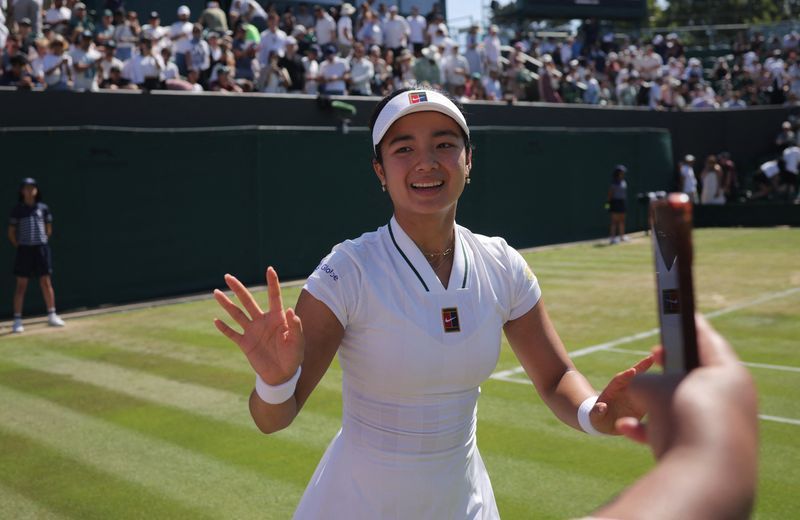
Alexandra Eala has achieved a watershed moment for Philippine tennis by becoming the first player from her nation to reach the third round of a Grand Slam tournament. The 21-year-old from Quezon City secured this historic milestone at Wimbledon on Thursday with an impressive comeback victory against Australian Maya Joint, prevailing 3-6 6-2 6-0 in a dominant display that showcased her improved form on grass courts.
Eala's journey to this achievement carries particular symbolic weight given her deliberate choice to carry her heritage with her onto the court. Inscribed on the back of her sun visor during the tournament is a Tagalog phrase—"Kapag lumago, hindi na hihinto"—which translates to "once it grows, it cannot be stopped." The sentiment proved remarkably fitting as she recovered from losing the opening set against Joint, who had eliminated American legend Serena Williams in the first round, to claim consecutive set victories with commanding margins.
The 29th seed will now face a formidable examination in the next round against defending champion Iga Swiatek, the Polish six-time Grand Slam winner. However, Eala's composure and tactical improvement displayed throughout her victory suggests she approaches the encounter without intimidation. At the post-match press conference, the young Filipino conveyed both realistic optimism and measured confidence, acknowledging Swiatek's pedigree while expressing determination to render the match competitive.
Eala's conscious integration of Filipino cultural symbols into her professional attire reflects a deliberate philosophy about identity and representation. Working in collaboration with her sponsor Nike, she incorporated the Tagalog phrase onto her kit, a decision that transcends simple patriotic gesture. In discussing the importance of these details, Eala emphasized how such elements anchor her connection to home and provide psychological grounding during high-pressure competition.
This commitment to cultural representation has evolved throughout her career. During her Wimbledon debut the previous year, Nike provided her with a custom hair tie featuring a single sampaguita bloom, the Philippines' national flower. Such thoughtful touches reveal how major international sports brands increasingly recognize the commercial and cultural value of supporting athletes' connections to their origins, particularly from emerging tennis nations in Southeast Asia.
Eala's trajectory has accelerated remarkably over recent seasons. Having broken into the top 50 rankings the previous year, she has maintained upward momentum through 2024, with her performances on grass proving particularly impressive. Her title victory at Birmingham last month followed earlier success reaching the semi-finals in Berlin, establishing her among the world's elite grass-court players. This Wimbledon run represents the culmination of sustained improvement and strategic tournament selection.
The 21-year-old competes at the Rafa Nadal Academy in Mallorca, one of the world's premier training facilities, a base that has clearly contributed to her refined technical execution and tactical maturation. This represents a significant investment in professional development for a Southeast Asian player, reflecting both her potential and the academy's willingness to work with emerging talents from outside traditional tennis powerhouses.
Eala's presence as the sole Filipino representative in the Wimbledon main draw carries considerable weight for Philippine tennis development. Her breakthrough in one of sport's most prestigious tournaments provides visibility and inspiration for younger players in her country, potentially catalyzing increased participation and investment in the sport. For a nation where tennis infrastructure and international exposure remain limited compared to regional neighbors like China or Thailand, such individual achievements carry outsized significance.
When reflecting on the magnitude of her accomplishment, Eala articulated a clear-eyed perspective about both national pride and personal aspiration. She acknowledged the emotional resonance of each milestone achieved while emphasizing that she pursues tennis through authentic self-expression rather than performative representation. This measured approach—balancing genuine pride in representing the Philippines with commitment to personal excellence—suggests a maturity beyond her years and a sustainable perspective on the pressures of being a trailblazer.
The intersection of Eala's tennis excellence, cultural identity, and international platform reflects broader patterns in global sport where individual athletes increasingly function as ambassadors not merely for their nations but for underrepresented regions and communities. Her success at Wimbledon should be understood not purely as a tennis achievement but as a significant moment for Southeast Asian sports development, demonstrating that world-class performance can emerge from outside traditional tennis strongholds when proper infrastructure and individual determination combine effectively.
Looking forward, Eala faces the immediate challenge of competing against Swiatek, a substantially more experienced competitor with far greater Grand Slam success. Yet her recent form, confidence on grass, and demonstrated ability to recover from adversity suggest she possesses the psychological tools to remain competitive. Whatever the outcome, her third-round appearance already guarantees her place in Philippine sporting history and establishes a benchmark for future generations of Filipino tennis players to build upon.

