The impeachment trial of Philippine Vice President Sara Duterte took a significant turn on Wednesday as her defence team launched a comprehensive assault on the prosecution's case, arguing that the controversial statements she made last year do not satisfy the constitutional threshold for impeachable offences. The defence presented its opening challenge during the third day of proceedings before the Senate impeachment court, centring on the question of whether Duterte's remarks about protecting herself and her family truly amount to the "other high crimes" enumerated in Article XI, Section 2 of the 1987 Constitution as grounds for removal from office.
The defence strategy hinged on reframing Duterte's statements made during a November 23, 2024 online press briefing as expressions of a concerned family member rather than deliberate threats from a sitting vice president. According to defence counsel Mark Vinluan, when Duterte voiced those controversial words, she was acting in a personal capacity as a wife, mother, daughter, and sister seeking to shield her loved ones from perceived danger, not wielding the authority of her office. This framing represented a fundamental attempt to sever the connection between her official position and the statements in question, thereby potentially removing them from the scope of impeachable conduct.
Vinluan's cross-examination of the National Bureau of Investigation's senior agent John Mark Calilung exposed what the defence characterised as critical evidentiary gaps in the prosecution's case. Notably, the defence highlighted the absence of direct evidence linking Duterte to any assassination plot, repeatedly emphasising that no proof had been presented demonstrating she actually contracted an assassin to harm President Ferdinand Marcos, first lady Liza Araneta-Marcos, or former Speaker Martin Romualdez. The prosecution itself had implicitly acknowledged this weakness during earlier questioning by Senator Risa Hontiveros, conceding that the video recordings of Duterte's statements did not conclusively establish that she had hired anyone to commit murder.
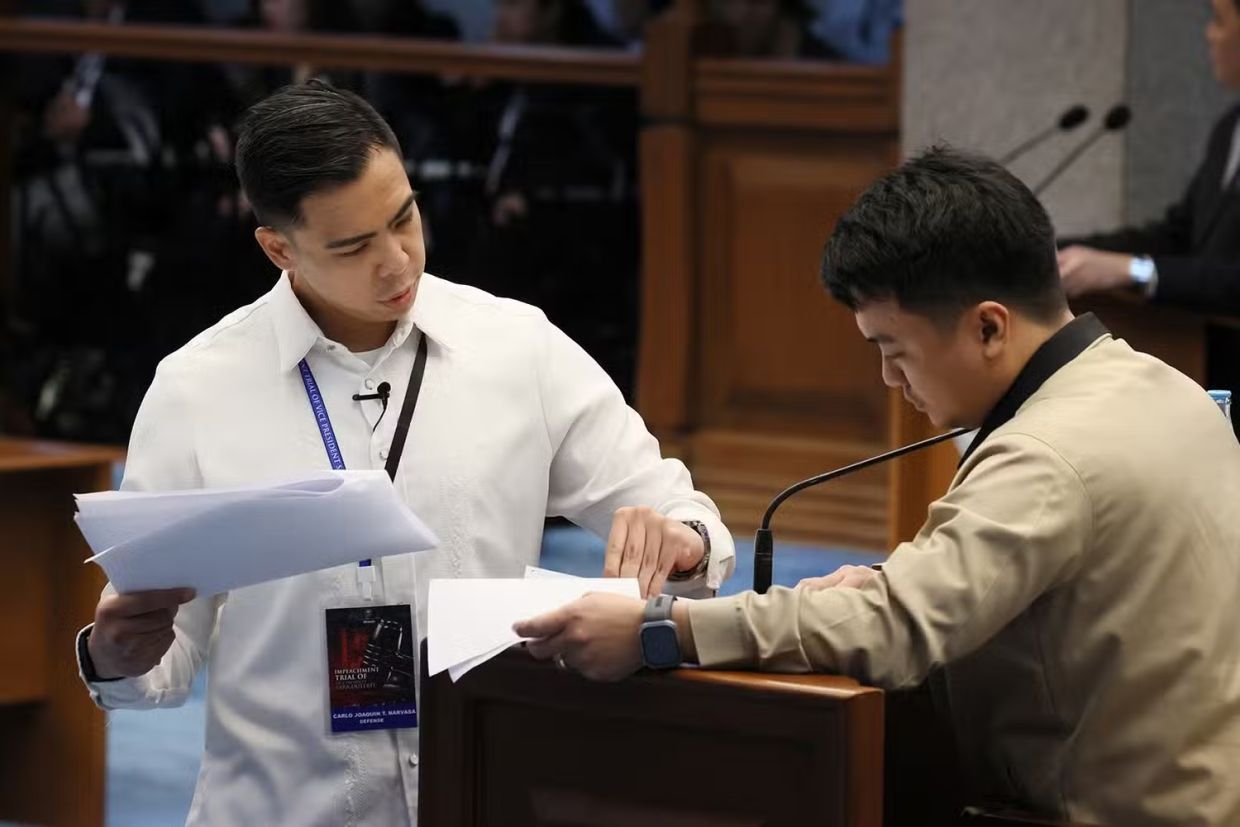
The context provided by the defence painted a picture of escalating governmental pressure against Duterte and her staff in the days preceding her controversial statements. Defence lawyer Carlo Narvasa presented evidence that Zuleika Lopez, Duterte's chief of staff, had been cited in contempt by the House committee investigating the Office of the Vice President's confidential funds and faced planned transfer to the Correctional Institution for Women in Mandaluyong City. Video footage shown during the proceedings captured Lopez's emotional distress as she objected to the transfer, claiming she was not a criminal and expressing fears for her personal safety. The defence contended that this backdrop of institutional pressure and perceived persecution of her staff directly triggered Duterte's statements, transforming what prosecutors characterised as threats into defensive responses to what she believed were unjust governmental actions.
Invocations of "Operation Romanov" featured prominently in the defence narrative, with Vinluan arguing that Duterte had been subjected to unauthorised intelligence and surveillance operations by government agents. He claimed her residences in both Davao and Manila had been profiled, a assertion the defence said was supported by classified surveillance reports. Additionally, the defence alleged that Duterte's trusted security personnel had been systematically removed, creating genuine security vulnerabilities for the vice president and her family. This framing shifted the narrative from one of criminal intent to one of self-preservation, suggesting that Duterte's unconventional response, while perhaps inappropriate in form, was substantively justified by the circumstances she faced.
The distinction between statements that merely indicate intent versus those that constitute actual conspiracy proved central to the defence's legal argument. Defence counsel emphasised that even the prosecution acknowledged Duterte's remarks did not "100 per cent" establish that she had hired an assassin, raising the fundamental question of whether ambiguous or indirect language could possibly satisfy the constitutional standard for impeachment. Vinluan further contended that the term "assassin" itself had been supplied by other parties who deliberately interpreted Duterte's remarks outside their proper context, suggesting that the prosecution had engaged in construction of meaning rather than literal interpretation of what was actually said.
The procedural integrity of the National Bureau of Investigation's investigation came under sustained attack as the defence examined Calilung. Narvasa pointedly asked whether the NBI had genuinely investigated the matter, highlighting the extraordinary fact that none of the three alleged victims—Marcos, the first lady, or Romualdez—had personally filed criminal complaints or appeared before the NBI. Instead, the bureau had proceeded motu proprio, or on its own initiative, without a formal complaint from any of the affected parties. Furthermore, the NBI's revised affidavit dated February 10, 2025, conspicuously lacked sworn statements from the offended parties themselves or from the journalists who had attended Duterte's November 23 briefing. These absences suggested to the defence that the investigation lacked the corroboration typically expected in serious criminal matters.
The concept of "systematic oppression" by the House of Representatives emerged as a crucial theme in the defence's narrative of persecution. Narvasa argued that Duterte and her associates had endured coordinated institutional pressure dating back to the House committee's initial investigation, with particular emphasis on the targeting of her staff member Lopez. He stressed that Lopez had been cited in contempt notwithstanding her cooperation, and that her lawyer had been prevented from accompanying her during the transfer to Mandaluyong City. This systematic pressure, the defence suggested, provided essential context for understanding Duterte's subsequent statements not as premeditated threats but as reactions to felt injustice.
Senator Francis Escudero's interjection during the proceedings underscored the trial's central interpretive challenge. Escudero noted that the discussion had already gravitated toward the fundamental issue before the impeachment court: whether Duterte's conduct truly constituted impeachable offences under the 1987 Constitution. This observation highlighted the potentially dispositive nature of the constitutional interpretation question, suggesting that even if all factual allegations were conceded, a serious legal question remained about whether the charged conduct fell within the scope of impeachable offences. The distinction between statements that demonstrate intent to commission a crime and actual evidence of contracted criminal activity became increasingly critical to the trial's ultimate resolution.
When Senator Risa Hontiveros probed whether legitimate contextual reasons could justify grave threats, defence lawyer Narvasa clarified that the defence was not arguing threats could be constitutionally justified based on motivation alone. This careful demurral attempted to maintain the defence's credibility while still asserting that the totality of circumstances surrounding Duterte's statements fundamentally altered their legal character. The procedural guidance offered by Escudero, who reminded senator-judges to avoid questions requiring legal conclusions and to reserve such matters for closing arguments, indicated growing awareness that the trial had entered its most consequential phase.
The broader implications for Philippine governance extend beyond Duterte's individual fate. The trial reflects profound tensions within the executive branch and between legislative oversight and executive prerogative, with questions about what constitutes impeachable conduct versus permissible political speech remaining unsettled. For Southeast Asian observers, the proceedings illustrate ongoing challenges in presidential democracies regarding institutional accountability, the boundaries of executive power, and the procedural safeguards surrounding removal proceedings. Malaysia and other regional democracies monitoring the case will assess whether Philippine constitutional jurisprudence will establish clear precedents defining the scope of impeachable offences or whether ambiguity persists regarding the standards that govern presidential accountability.

