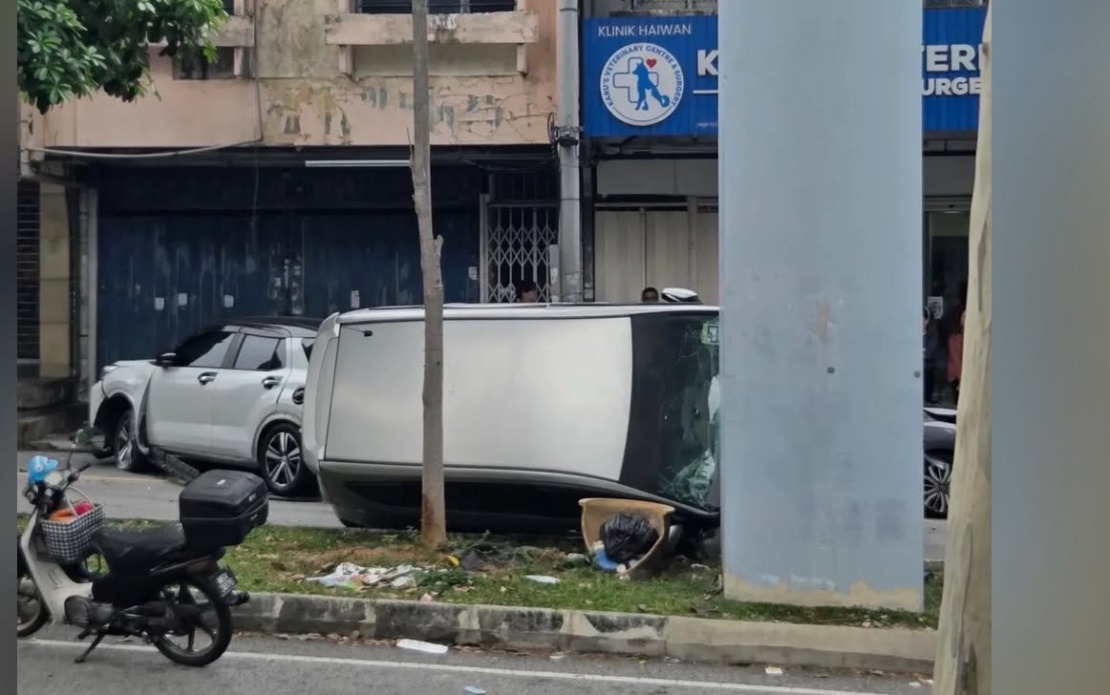
A medical emergency turned into a traffic accident in Cheras this morning when a 28-year-old motorist experienced a seizure whilst driving, leading to a multi-vehicle collision along Jalan Midah 1. The incident unfolded at approximately 8.30 am as the driver was making his way from home to work at Taman Midah 1, when the sudden medical episode caused him to lose command of his BMW 320i. The vehicle subsequently veered off the roadway and struck six vehicles that had been parked along the left shoulder of the street.
According to Kuala Lumpur Traffic Investigation and Enforcement Department (JSPT) chief ACP Mohd Zamzuri Mohd Isa, the sequence of events was straightforward though fortunate in its outcome. The driver's sudden loss of consciousness triggered by the seizure left him unable to maintain control of the vehicle, which then drifted across the road surface before making contact with the stationary automobiles. The six parked vehicles that sustained damage belonged to four women aged between 29 and 43 years old, a 39-year-old man, and a single commercial vehicle, though the owners or operators were not present at the time of the collision.
Fortunately, the incident resulted in no personal injuries despite the scale of the damage inflicted. The absence of occupants in the parked vehicles meant that what could have been a catastrophic event—with multiple people potentially struck or trapped—was limited to property damage. This element of fortune highlights how road safety outcomes often depend on circumstances beyond anyone's control, such as the timing of when vehicles are left unattended.
Investigation by traffic authorities revealed that the 28-year-old driver carried a medical history of seizures extending back approximately ten years. This background is significant as it raises questions about the appropriate management of chronic neurological conditions and the responsibilities placed on individuals with such conditions when operating motor vehicles. The discovery of a decade-long seizure history suggests this was not an isolated or unexpected medical occurrence but rather a recurring health challenge that the driver may have been managing.
To rule out alternative explanations for the incident, police conducted a breathalyser test on the motorist immediately following the accident. The examination returned a negative result with a reading of 0 milligrammes per 100 millilitres of breath, definitively establishing that alcohol consumption played no role in the collision. This finding shifts focus entirely onto the medical aspect of the incident and away from questions of impaired driving or negligence related to intoxication.
The classification of this incident under Rule 10 of LN 166/59—the relevant traffic regulations—indicates that authorities have processed the case according to standard protocol for traffic accidents. Rather than treating the matter as a criminal offence involving recklessness or dangerous driving, the framework recognizes the medical nature of the underlying cause. This classification approach reflects the legal distinction between accidents resulting from deliberate or careless conduct and those arising from sudden medical emergencies beyond the driver's control.
The ongoing investigation signals that while the immediate cause has been identified, authorities continue to examine broader circumstances and details surrounding the incident. This thoroughness is essential not only for establishing a complete factual record but also for determining whether any regulatory or medical oversight considerations should be addressed. Questions may emerge regarding whether the driver's known seizure history was being properly managed through medical supervision and whether appropriate precautions had been taken.
The incident carries implications for road safety discourse in Malaysia, particularly concerning how society manages the intersection between medical conditions and driving privileges. Unlike simple traffic violations that can be addressed through enforcement and penalty systems, medical episodes require a more nuanced approach balancing individual rights with public safety concerns. The case demonstrates that even conscientious drivers managing chronic conditions may encounter situations where their medical status creates dangerous circumstances despite their best efforts and precautions.
Police have appealed for any witnesses or members of the public who observed the accident to come forward with information. Assistance can be provided by contacting the Tun H.S. Lee traffic police station at 03-2071 9999 or the nearest police facility. Such public cooperation often provides crucial details that might not be immediately apparent from the accident scene itself, potentially clarifying the exact sequence of events and contributing to a more complete understanding of how the incident unfolded.
The broader context of this accident adds to the ongoing conversation about medical fitness to drive in Malaysia's rapidly urbanizing landscape. As traffic volumes continue to increase and commuting distances expand, the potential for medical emergencies to create traffic incidents also grows. This case serves as a reminder that road safety encompasses not only driver behaviour and vehicle maintenance but also the physical and neurological fitness of those operating vehicles on public roads.

