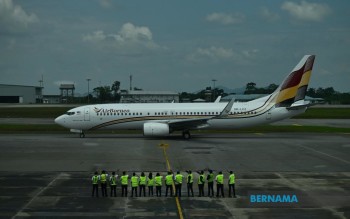
Deputy Prime Minister Datuk Seri Fadillah Yusof received AirBorneo Airways' maiden commercial flight at Kuala Lumpur International Airport Terminal 1 on Saturday, marking a significant moment for Malaysia's aviation landscape and Sarawak's long-held aspirations toward air transport autonomy. Flight MY5005 arrived from Kuching carrying Sarawak Premier Tan Sri Abang Johari Tun Openg, state ministers, and dignitaries, underscoring the political importance attached to the airline's debut in the country's competitive domestic market.
AirBorneo represents a substantial investment by the Sarawak state government to establish independent control over regional air connectivity, an issue that has remained central to the state's economic strategy for years. The airline's entry into commercial service with two wet-leased Boeing 737-800 aircraft signals a transition from the preliminary phases of planning and preparation into active revenue-generating operations. This development reflects broader efforts within Sarawak to position itself as a regional hub and reduce dependency on carriers based in Peninsular Malaysia for essential air links to the state's major economic centers.
According to AirBorneo chairman Datuk Amar Mohamad Abu Bakar Marzuki, who simultaneously holds the position of Sarawak state secretary, the Kuching-Kuala Lumpur route represents more than a routine domestic service launch. Instead, the airline frames its operations within a comprehensive vision of strengthening Sarawak's economic fundamentals through improved transportation infrastructure. The connectivity provided by the twice-daily service commencing July 21, 2026, addresses longstanding bottlenecks in business travel and passenger movement between Sarawak and the federal capital, potentially facilitating commerce, tourism, and professional exchanges across the peninsula-Borneo divide.
The strategic importance of aviation to Sarawak's development trajectory cannot be overstated. Air transport serves as the primary mechanism for integrating remote interior regions with coastal economic centers and connecting the state to national and international markets. By establishing its own carrier, Sarawak gains leverage over scheduling, pricing, and service frequency while retaining revenues that would otherwise accrue to competing operators. This vertical integration into aviation ownership aligns with the state's broader push toward economic diversification and reduced exposure to commodity-dependent sectors.
Ticketing data released by AirBorneo indicates competitive positioning within the domestic market. One-way economy fares are set at RM375, while business class passengers can expect to pay from RM736. These price points suggest the airline is targeting both leisure travelers seeking value and corporate clients requiring premium service, attempting to establish itself across market segments rather than pursuing a narrow niche strategy. The pricing structure implies confidence in the route's demand fundamentals, supported by Sarawak's growing economy and established business links with Kuala Lumpur.
The presence of multiple federal ministers at the inaugural ceremony—including Tourism, Arts and Culture Minister Datuk Seri Tiong King Sing, Women, Family and Community Development Minister Datuk Seri Nancy Shukri, and Deputy Transport Minister Datuk Hasbi Habibollah—reflected federal acknowledgment of the venture's significance within national aviation policy. Their attendance signaled tacit approval for a state-owned competitor entering a market previously dominated by private operators, a positioning that may influence future regulatory considerations and infrastructure allocation decisions.
AirBorneo's leadership emphasizes operational reliability and service quality as foundational commitments, with chief executive officer Megat Ardian Mohd Aminuddin projecting measured ambition for the airline's expansion trajectory. The emphasis on safe, dependable service reflects awareness that reputation in aviation markets is built incrementally through consistent performance rather than dramatic gestures. For an airline entering a competitive domestic sector where established carriers possess brand recognition and loyalty programs, establishing a reputation for operational excellence provides essential differentiation.
The Kuching-Kuala Lumpur route functions as the initial phase of what planners conceive as a broader network expansion strategy. AirBorneo has publicly identified Singapore as its intended first international destination, suggesting ambitions to position Kuching as a regional hub serving Southeast Asian connectivity needs. Such expansion would require navigation of bilateral air service agreements, airport slot availability, and competitive dynamics with incumbent carriers already operating these routes. The progression from domestic trunk routes to international services typically spans several years, during which an airline must establish sufficient profitability, regulatory compliance, and operational capacity to justify international expansion investments.
For Malaysian aviation consumers, particularly those in Sarawak and travelers to the state, AirBorneo's entry introduces additional competitive supply on a heavily trafficked route. The twice-daily frequency provides scheduling flexibility that some travelers currently lack, potentially shifting demand away from existing carriers and pressuring incumbent pricing. Regional economic implications extend beyond passenger convenience; improved air connectivity supports business expansion, professional networking, and tourism development critical to Sarawak's post-pandemic recovery and longer-term growth objectives.
The timing of AirBorneo's launch reflects broader dynamics reshaping Southeast Asian aviation markets, where regional carriers increasingly challenge dominance by legacy full-service airlines. Sarawak's decision to establish a state-owned airline follows patterns observed elsewhere in the region, where governments view aviation as strategic infrastructure essential to economic competitiveness and political autonomy. The success or struggles AirBorneo experiences over its first operational years will influence perceptions of whether such ventures represent viable long-term models or unsustainable exercises in political ambition.
From a regulatory perspective, AirBorneo's operations may prompt Malaysian aviation authorities to reexamine frameworks governing state involvement in commercial carriers and competition dynamics in protected markets. The dual roles held by senior AirBorneo officials—combining government positions with airline leadership—raise governance questions about decision-making transparency and potential conflicts between public interest representation and shareholder value maximization. These structural considerations will merit monitoring as the airline matures and its operations interact with broader national transportation policy.
The inaugural flight ceremony itself represented carefully choreographed symbolism, with high-ranking officials lending legitimacy and visibility to an enterprise representing state institutional capacity and economic ambition. Such ceremonial dimensions matter considerably in Malaysia's political economy, where state-backed ventures often derive strategic support from visibility and symbolic endorsement by senior figures. AirBorneo's success will depend substantially on converting this initial political goodwill and public attention into sustained market demand, operational excellence, and financial sustainability across competitive conditions that show no signs of moderating.

