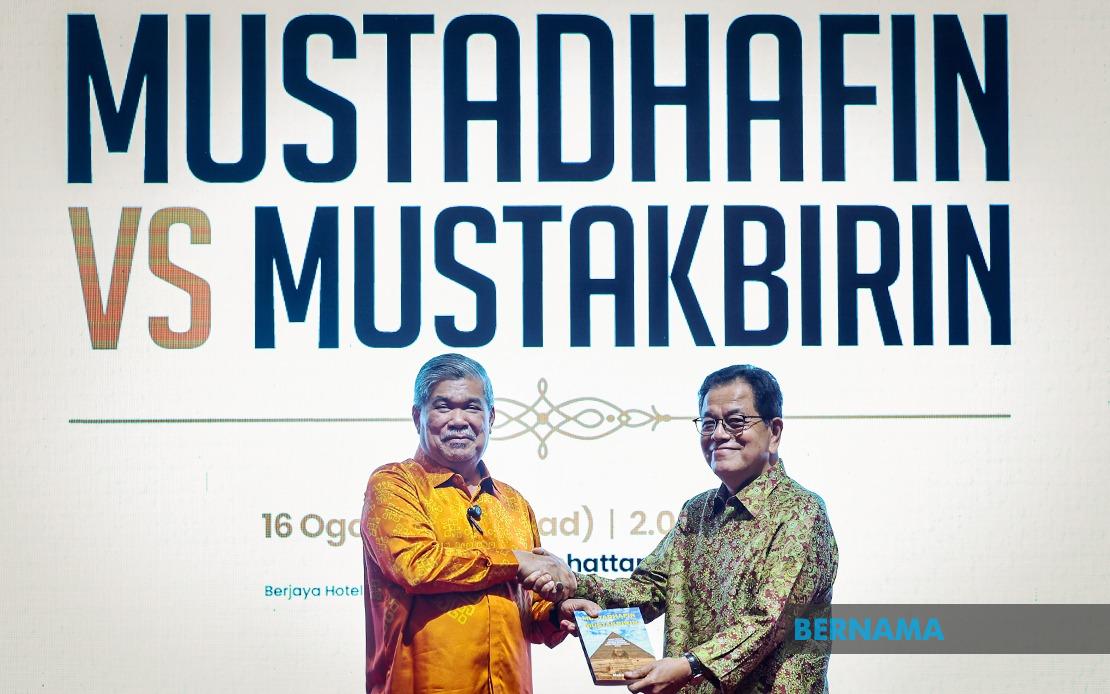
In a pointed intervention on the state of political discourse in Malaysia, Amanah president Datuk Seri Mohamad Sabu has urged citizens to exercise greater discernment when encountering claims and accusations circulating through public channels. Speaking at the launch of his book in Kuala Lumpur on August 16, the Agriculture and Food Security Minister stressed that accepting allegations without rigorous examination could entrench 'asabiyyah'—a term rooted in Islamic scholarship describing the tendency to defend one's own faction reflexively whilst dismissing the merits of rival groups with equal reflexivity.
The distinction Mohamad drew reflects growing concern among moderate political figures that Malaysia's polarised environment has degraded the quality of public deliberation. Rather than engaging with substantive policy disagreements, he observed, political actors increasingly rely on unverified claims that spread with particular velocity through social media platforms where verification mechanisms are weak or absent. This dynamic creates a feedback loop: allegations gain traction not through logical force but through sheer volume and repetition, eventually ossifying into received wisdom among partisan audiences.
Mohamad's remarks carried an unmistakable subtext regarding the recurring assertion that the Democratic Action Party (DAP) harbours communist sympathies and that any coalition partner cooperating with it implicitly endorses communist ideology. This framing has haunted Malaysian politics for decades, resurging periodically to delegitimise multiethnic, secular political arrangements. By pointedly asking "is DAP really communist," Mohamad invited his audience to move beyond rhetorical flourishes and examine actual evidence—a seemingly elementary appeal that underscores how degraded standards of proof have become in contemporary Malaysian political debate.
The minister emphasised that facts and substantive knowledge require considerably more cognitive effort to absorb than suspicions and accusations do. This asymmetry matters immensely for democratic politics. Accusations are inherently simple and emotionally resonant; they require no supporting architecture of evidence or logical scaffolding. By contrast, factual claims demand engagement with complexity, nuance, and sometimes uncomfortable ambiguities that resist simple categorisation. The ease with which allegations propagate against the friction encountered by measured analysis creates a structural imbalance in the marketplace of ideas.
Within Malaysian political culture specifically, this dynamic intersects with historical legacies and communal anxieties that make certain allegations particularly potent. Fears surrounding communism, religious doctrine, and ethnic cohesion carry emotional weight accumulated over generations. When political entrepreneurs deploy these loaded themes, they tap into deep wells of historical consciousness. The remedy Mohamad proposed—insisting on verification and demanding clarity about actual positions and programmes—requires audiences to override these affective reactions and engage more deliberately with evidence.
Mohamad illustrated his philosophical approach by recounting his personal methodology. From his youth, he explained, he resisted the impulse to accept information passively. Instead, he sought to verify claims through direct observation and investigation rather than merely absorbing propaganda circulating within his immediate environment. This approach—call it experiential epistemology—reflects a distinctly modern sensibility valuing empirical verification over inherited orthodoxy. Yet it remains countercultural in contexts where group loyalty and trust in authority figures traditionally supersede individual verification.
The book launch itself served as a vehicle for articulating these concerns about contemporary Malaysian politics. According to Mohamad, the volume documents his encounters with diverse political and social actors as he pursued understanding grounded in lived experience rather than ideological formulas or second-hand accounts. By framing his political formation as a journey toward more rigorous knowledge acquisition, Mohamad positioned himself against both dogmatic opponents within the political right and credulous supporters within his own coalition who might accept claims uncritically simply because they advance partisan interests.
Beyond domestic political fractures, Mohamad's book reportedly addresses broader geopolitical questions including colonialism, Islamic movements, the Palestinian question, and shifting global power distribution. These international dimensions connect to Malaysian political anxieties, as domestic actors frequently mobilise global narratives to legitimise local positions. The Palestinian conflict, for instance, has become a touchstone in Malaysian Islamist rhetoric for validating particular approaches to religious identity and international relations. Colonialism shapes postcolonial anxieties about sovereignty and external intervention. By bringing these themes into conversation with his personal political trajectory, Mohamad attempted to demonstrate how rigorous thinking about international affairs could illuminate domestic political choices.
The significance of Mohamad's intervention extends beyond his personal philosophy to reflect emerging fissures within Malaysia's centre-left and Islamist political coalitions. Amanah has consistently positioned itself as an alternative to more ideologically rigid competitors, emphasising pragmatism, cross-communal cooperation, and evidence-based policymaking. By urging voters to think more carefully before embracing allegations, Mohamad was implicitly defending coalition arrangements that draw fire from both the right wing—which views DAP cooperation as incompatible with Islamism—and from within the opposition itself, where some Islamist voices have questioned such partnership.
For Malaysian voters observing this advice about allegation-scrutiny in action, the practical challenge remains formidable. Verification requires time, access to reliable information sources, and interpretive skills that cannot be evenly distributed across a diverse population. Social media algorithms actively undermine careful deliberation by prioritising engagement over accuracy. Political actors across the spectrum benefit from a cognitively distracted public that makes snap judgments rather than demanding evidence. Yet Mohamad's call for heightened scrutiny, however difficult its implementation, articulates a democratic aspiration worth preserving: that citizens possess agency in resisting manufactured consent and that political legitimacy ultimately rests on something more solid than accumulated allegations.

