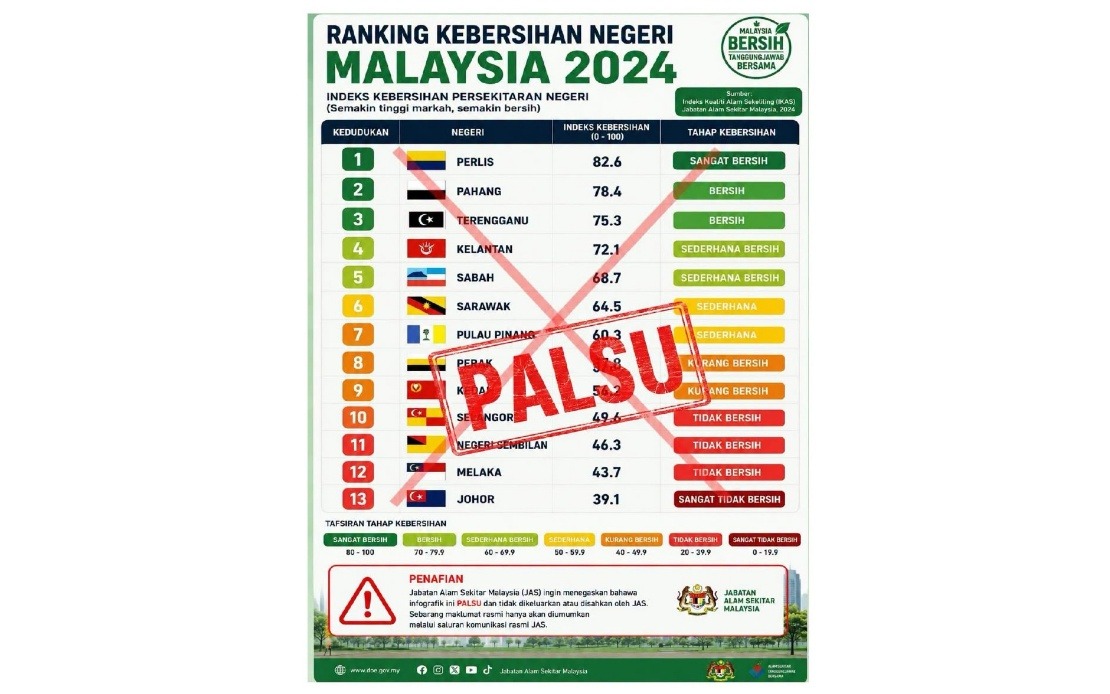
The Department of Environment (DOE) has issued a forceful denial regarding a cleanliness ranking infographic that has gained significant traction across Malaysian social media platforms and messaging applications. In a statement released from Putrajaya on July 7, the department explicitly clarified that it had neither authored, published nor authenticated the graphic titled "Ranking Kebersihan Negeri Malaysia 2024," which purports to rate Malaysian states by cleanliness standards. The DOE emphasised that no official media statement, formal report or departmental response concerning such a state-by-state ranking assessment has ever been released by the organisation.
This development underscores a persistent challenge in Malaysia's information ecosystem, where unverified graphics claiming government endorsement circulate widely before official agencies can respond. The viral nature of the infographic—spreading rapidly through WhatsApp, Facebook and Instagram—highlights how quickly misinformation can establish false credibility in the digital age, particularly when it appears to carry the visual trappings of governmental authority. The DOE's swift public response reflects growing awareness among Malaysian government bodies of the need to combat misleading claims before they become entrenched in public consciousness.
The department has now directly cautioned citizens to exercise caution when encountering such materials online, explicitly advising against treating unverified content as factual reference material without first seeking confirmation through official channels. This warning carries particular weight given the environmental sector's technical complexity; citizens lacking specialist knowledge may readily accept ostensibly authoritative rankings without questioning their authenticity. The potential for such misinformation to mislead the public extends beyond mere factual confusion, the DOE noted, potentially undermining confidence in legitimate environmental management information released by the department.
The broader implications of this episode reveal vulnerabilities in how official information competes with fraudulent materials in Malaysia's digital landscape. When counterfeit governmental claims circulate unchecked, they can erode public trust in genuine environmental data and official statistics. This erosion of confidence becomes particularly problematic in Malaysia's context, where environmental management intersects with complex issues of state governance, resource allocation and federal-state responsibilities. Citizens confused about which entities hold authority over environmental matters may find themselves unable to distinguish reliable sources from fabricated ones.
The DOE has stressed that all legitimate communications from the department—including media statements, statistical reports, infographics and formal announcements—are exclusively distributed through its official portal and authorised communication channels. This policy reflects a deliberate strategy to create a single, verifiable source of truth, enabling citizens to distinguish authoritative information from imposters. By consolidating official outputs through one pathway, the department aims to prevent confusion and allow the public to verify claims independently. However, the effectiveness of this approach depends largely on public awareness that such official channels exist and how to access them.
The department's assertion that it takes seriously any misuse of its name, logo or institutional identity points to potential legal consequences for those responsible for the misleading infographic. The DOE has indicated willingness to pursue appropriate legal action against parties found deliberately spreading false information attributed to the department. This stance suggests the graphic's creators may have either deliberately impersonated the DOE or recklessly failed to verify their claims before publication. Either way, the department's warning signals that accountability mechanisms exist, though enforcement against anonymous social media actors often proves challenging in practice.
For Malaysian environmental advocates and policy observers, this incident raises important questions about data governance and public communication standards. The absence of an official state cleanliness ranking—at least one formally released by the DOE—suggests that such comparative assessments may not represent current departmental priorities or methodologies. This absence itself becomes informative; if the DOE has not published such rankings, it may indicate that meaningful comparative cleanliness metrics are complex to establish or that state-by-state competition lacks policy utility. Alternatively, if such rankings do exist but remain internal documents, their viral circulation highlights tensions between governmental transparency and control over public information.
The episode also reflects broader Southeast Asian patterns in misinformation circulation, where citizens in rapidly digitalising societies encounter increasing volumes of false governmental claims. Malaysia's experience parallels challenges in other regional nations where social media literacy remains uneven and visual materials designed to mimic official formats proliferate. The DOE's educational messaging—urging citizens to verify claims independently and avoid spreading unconfirmed information—represents a damage-control approach that depends on significant portions of the audience actively implementing verification habits.
Looking forward, this incident demonstrates why Malaysian government agencies require sustained investment in digital communication infrastructure and public education campaigns. The DOE's commitment to ensuring all public information remains accurate, authentic, transparent and credible faces practical challenges when competitors—whether malicious actors or simply careless sharers—can create more eye-catching content and distribute it faster through informal networks. Building institutional credibility and public trust demands not only denying false claims but also consistently delivering reliable, accessible environmental information through channels citizens actually use.
The department's response also carries implicit recognition that misinformation in environmental policy carries real consequences. False narratives about state cleanliness rankings could inappropriately influence citizen perceptions of governance, public health outcomes and environmental management effectiveness. When such perceptions shift based on fabricated data rather than reality, political accountability becomes distorted. Malaysian voters might blame administrations for poor environmental performance based on false statistics, while genuinely effective environmental programmes remain underappreciated. This distortion of democratic feedback mechanisms represents the deeper damage misinformation inflicts beyond simple factual confusion.

