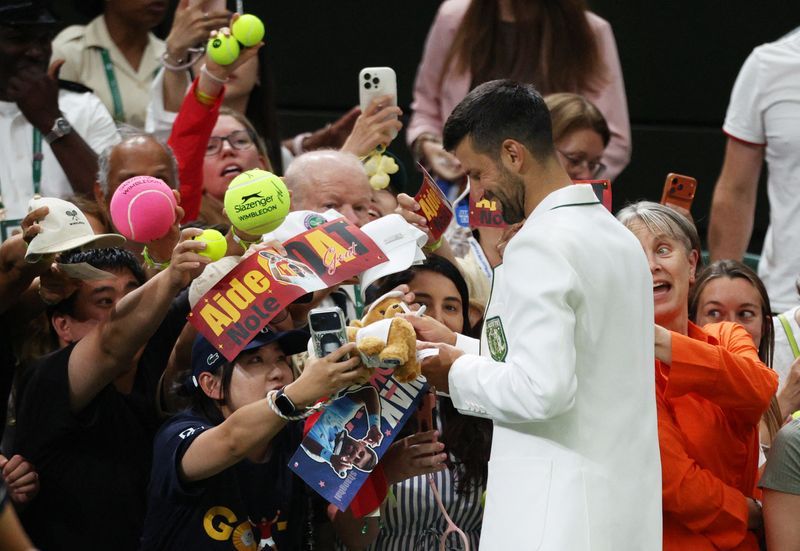
Novak Djokovic's commanding performance against Stefanos Tsitsipas at Wimbledon revealed not only his dominance on grass courts but also a relaxed temperament that allowed him to enjoy the occasion. The Serbian champion's 6-3 6-4 6-2 demolition of the Greek fourth seed on Wednesday was so complete that he found himself in a playful mood, even finding time for a lighthearted prank on an unsuspecting ball girl that exemplified his comfort level during the match.
As Djokovic required his shoulder tape to be trimmed during the encounter, he requested a ball girl to cut away some black tape using scissors. The 24-time Grand Slam winner then suddenly cried out as though he had been injured, causing the young attendant visible alarm. She visibly recoiled, clutching her chest in apparent panic at the prospect of having accidentally wounded one of tennis's greatest players in front of millions watching globally. The moment of panic lasted only seconds before Djokovic burst into laughter, revealing the entire incident as an elaborate joke.
The prank quickly dissolved any tension, with the ball girl joining Djokovic in laughter once she realised she had been the subject of good-natured ribbing. The champion's willingness to engage in such humour speaks volumes about his psychological state during the match. When interviewed after his dismissal of Tsitsipas, Djokovic acknowledged the jest, attributing his relaxed demeanor to the overwhelming advantage he had built on court. He noted that such levity emerges naturally when a player commands a commanding lead rather than facing adversity, and expressed mild apology for startling the young official while crediting the interaction with loosening his tension during play.
Beyond the on-court pranks, Djokovic's confidence extended to his interaction with spectators in the Royal Box at Centre Court. Spotting twice Masters champion Rory McIlroy watching from the distinguished viewing area, the Serbian star engaged in a spontaneous exchange that captured the playful atmosphere surrounding his convincing victory. McIlroy, the Northern Irish golfer, was displaying his Masters jacket—the iconic green blazer awarded annually to the champion of golf's most prestigious major championship.
Djokovic, dressed in his personalised cream-coloured blazer that he has worn throughout the current championship, complimented McIlroy's attire with theatrical appreciation. Upon learning that the jacket was indeed the famous Masters green coat, Djokovic seized the opportunity to propose a wager that drew roars of approval from the crowd. The tennis champion suggested that he and McIlroy engage in a tennis match with their respective jackets on the line, explicitly stipulating that the contest would be played on the tennis court rather than the golf course.
The exchange highlighted a rare moment of cross-sporting camaraderie at one of the world's most prestigious tennis tournaments. McIlroy, acknowledged as a two-time Masters winner, responded to Djokovic's good-natured challenge with visible amusement, nodding confirmation of the jacket's provenance. The crowd's enthusiastic response underscored how Djokovic's confident demeanour and quick wit had extended beyond athletic performance into entertainment value.
For Malaysian and Southeast Asian sports enthusiasts, such moments remind us that professional athletics transcends individual competition and corporate sponsorship. The spontaneity of Djokovic's interactions—from amusing a nervous ball girl to engaging with a fellow champion across sporting disciplines—demonstrates how sporting excellence frequently correlates with personality and charisma. These instances of genuine human connection resonate far more broadly than scoreboards suggest.
Djokovic's psychological dominance over Tsitsipas was evident not merely in the one-sided scoreline but in his capacity to maintain composure and creativity throughout the match. His willingness to engage with the moment, to incorporate humour and spontaneity into a high-stakes championship encounter, distinguishes elite athletes who transcend their sports. The prank on the ball girl and the jacket exchange with McIlroy were not distractions from his focus but rather expressions of a player so completely in control that he could afford such diversions.
The significance of Djokovic's performance extends beyond individual glory. His continued dominance on grass courts reinforces his position as arguably the most complete player in modern tennis. Meanwhile, the casual reference to McIlroy's Masters achievement, and the implicit suggestion that Djokovic would relish competitive engagement across sporting boundaries, underscores the universal language of athletic excellence. Whether on tennis courts or golf courses, champions recognise and respect fellow champions.
Looking forward, Djokovic's demonstrated comfort level and psychological strength at Wimbledon provide insights into his mental preparation for remaining competition this season. Players who can maintain relaxation and humour while dominating high-pressure matches typically carry that psychological advantage into subsequent challenges. The Serbian's facility for connecting with crowds and fellow athletes, even during competition, suggests a maturity that transcends pure technical tennis ability.

