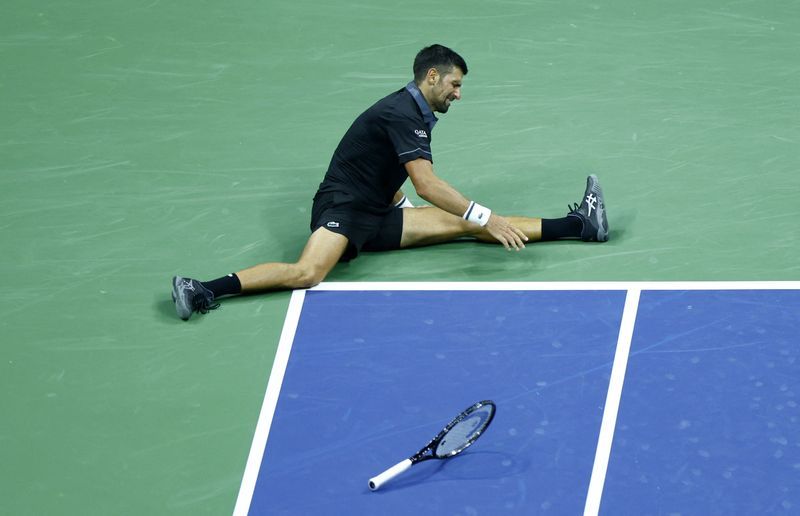
Novak Djokovic's quest for an unprecedented 25th Grand Slam title has been extinguished in the most unexpected manner at Flushing Meadows. The legendary Serbian player fell to unseeded Argentine Mariano Navone in a tightly contested first-round encounter on Sunday, succumbing 7-6(5) 5-7 4-6 6-2 6-1 after nearly four hours and 36 minutes of intense competition. The result marks a historic low point for the 39-year-old, representing his earliest departure from a Grand Slam tournament since the Australian Open in 2006—a span of nearly two decades during which Djokovic has dominated the sport.
Djokovic arrived in New York already burdened by doubts regarding his physical condition and competitive form. His recent defeat to Thiago Agustin Tirante at the Cincinnati Open just two weeks prior had raised serious questions about whether the ageing champion possessed sufficient fitness to mount another title challenge. Those concerns proved prescient when, during the match itself, he was forced to vomit into a courtside bin in the third set, a stark physical manifestation of the medical struggles he has endured throughout the year. The incident underscored deeper physiological problems that would ultimately prove insurmountable.
The encounter unfolded in an emotionally charged atmosphere at Arthur Ashe Stadium, where humid conditions and an intermittent rain shower that prompted closure of the roof created challenging circumstances for both competitors. Djokovic, seeded fourth, made a commanding start by establishing a 3-0 lead in the opening set, suggesting the experience and poise associated with four previous US Open championships would carry him through. However, Navone, ranked 49th globally, demonstrated the resilience and tactical acumen that characterises emerging professional players, levelling the set at 4-4 and ultimately forcing a tiebreak that he claimed amid audible gasps and cheers from the crowd.
The subsequent sets became a fluctuating contest between Djokovic's struggle for consistency and Navone's growing confidence. After dropping the opening set, Djokovic recovered sufficiently to claim the second, his experience momentarily reasserting itself. The third set proved particularly revealing of his deteriorating condition—despite vomiting midway through the period, he managed to force a 5-4 lead and appeared poised to level the match. Yet this apparent recovery proved merely temporary, a final flicker of his championship mettle before cascading physical failures overwhelmed his capacity to compete.
Navone's breakthrough came in the fourth set, when Djokovic's serve—the foundation of his dominance throughout a 24-year professional career—progressively faltered. Back issues that had plagued the Serbian throughout the encounter intensified at precisely the moment when maintaining precision and power would have proved decisive. Sensing his opponent's vulnerability, Navone claimed the fourth set and subsequently demonstrated remarkable composure in the fifth, holding his concentration and nerve to seal an extraordinary victory.
In a post-match interview conducted through visibly suppressed tears, Djokovic presented a candid assessment of his condition. He acknowledged that the vomiting episodes that plagued him throughout 2024 represented a persistent and serious medical concern, one that triggered a cascade of physical deterioration. The initial physiological distress, he explained, precipitated broader muscular breakdown characterised by cramping and widespread pain that systematically dismantled his physical resilience. By the match's conclusion, both his back and shoulder had essentially capitulated, leaving him unable to execute the technical demands of professional tennis at the highest level.
The implications of this defeat extend beyond mere tournament mathematics or statistical rankings. For Djokovic, who remains locked in competition with rivals for the all-time Grand Slam record, this early elimination represents a significant setback in his historical narrative. At 39, each Grand Slam opportunity diminishes in likelihood, and the record of 25 titles that once seemed achievable now appears increasingly distant. More fundamentally, the medical issues he disclosed suggest concerns about his physical sustainability that transcend any single tournament outcome.
Mariano Navone, by contrast, experienced the career-defining moment that professional athletes pursue throughout their competitive lives. The 25-year-old Argentine demonstrated that unseeded players competing against legendary champions can succeed through tactical intelligence, physical resilience, and mental fortitude. His stunned reaction on court—expressing almost disbelief at having defeated someone he considers the greatest player of all time—reflected the magnitude of his accomplishment. He subsequently acknowledged being overwhelmed by the subsequent attention, describing his phone as continuously ringing with inquiries from media and supporters throughout Argentina.
Navone's perspective on the victory, offered in subsequent broadcast interviews, conveyed genuine awe at the implications of his performance. Five sets against Djokovic at a Grand Slam, he reflected, represented an achievement that transcends ordinary professional accomplishment. The intensity of the adrenaline response he experienced indicated the psychological weight of competing at elite level, transforming a single match result into a transformative career moment. His references to the significance for his home nation suggested that Argentine tennis observers were celebrating a notable upset with national pride.
For Malaysian and Southeast Asian observers of professional tennis, this result carries particular resonance regarding athlete longevity and the declining trajectory of careers even among the most exceptional performers. While Djokovic remains globally ranked, this defeat crystallises questions about the sustainability of elite athletic performance into one's late thirties, particularly when confronted with emerging talent and physical limitations. The medical complications he disclosed—nausea, muscular breakdown, and shoulder dysfunction—are physiological realities that affect even the most accomplished practitioners.
The broader context of Djokovic's 2024 season suggests systematic decline requiring serious medical investigation and intervention. His description of persistent vomiting throughout the year, occurring with sufficient regularity to characterise multiple tournaments, indicates an underlying condition extending beyond typical match-day fatigue. The interdependency between initial physiological distress and subsequent systemic failure he articulated demonstrates how singular medical issues cascade through athletic performance, progressively undermining technical execution and competitive viability.
Djokovic's statement that he never contemplated withdrawing despite his condition reveals the psychological determinism that characterises championship-level athletes. The refusal to quit, even when physical circumstances suggested insurmountable obstacles, reflects the mentality that sustained his dominance throughout decades of competition. Yet this encounter demonstrates that psychological resolve alone cannot overcome physiological reality—a recognition that may ultimately prove more consequential than any single tournament result.
The unexpected nature of this outcome reshaped the US Open narrative immediately. Where Djokovic's participation had promised another chapter in his legendary Grand Slam story, his first-round elimination instead became a defining moment in an emerging player's trajectory and a sobering reminder that even the sport's greatest champions confront declining years. Navone's improbable victory will be remembered less as a fluke and more as the moment when an ascending professional player announced himself capable of competing at the highest level, even against opponents whose names are synonymous with tennis excellence.

