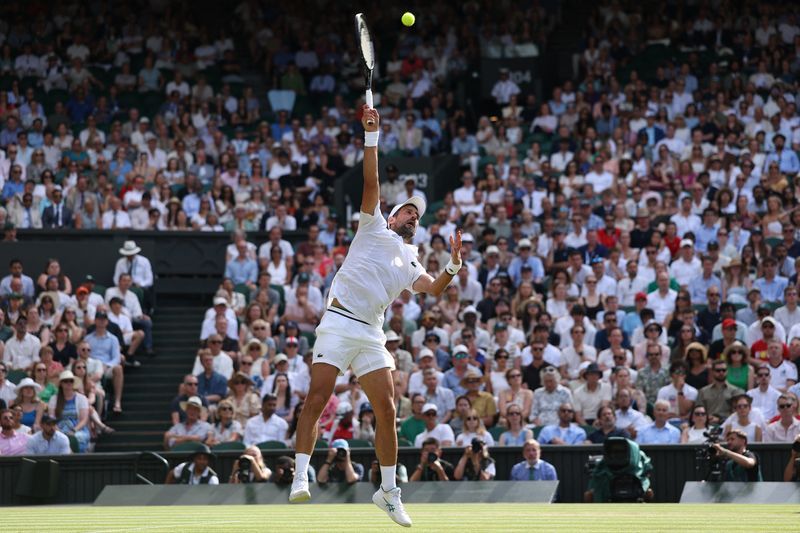
Novak Djokovic added another milestone to his illustrious Wimbledon record on Sunday, moving past a stubborn Roman Safiullin with a 7-6(6) 6-3 3-6 6-3 victory that marked his 106th match win at the grass court Grand Slam. The Serbian champion has now eclipsed Roger Federer's storied achievement on the same surface, a feat that underscores the 39-year-old's remarkable staying power and competitive hunger at one of tennis's most prestigious tournaments. With this triumph, Djokovic advanced to the quarter-finals and continues his pursuit of an eighth Wimbledon title—matching the Swiss legend's benchmark in a competition that has defined much of his career.
The path to victory proved far more demanding than Djokovic's seeding and ranking might have suggested. Safiullin, a world number 132 qualifier who was only recently returning to competitive tennis following a hip injury layoff, demonstrated impressive resolve under the blazing Centre Court sun. The Russian launched an aggressive baseline assault that visibly unsettled Djokovic's rhythm, forcing multiple service breaks and compelling the defending champion to adapt his tactics throughout the nearly three-hour contest. This was hardly the dominant performance one might expect from a seven-seed facing a lower-ranked opponent, yet it exemplified Djokovic's ability to find ways through adversity—a characteristic that has sustained his dominance across multiple decades of elite tennis.
The opening set crystallized the struggle Djokovic faced. Down 2-5 and staring at set-point opportunities slipping away, he found himself in a precarious position that would have ended the set for most players. Instead, he saved two set points through sheer willpower before forcing a tiebreak that went to 6-6 on the breaker itself. Djokovic ultimately prevailed 7-6(6), but the effort required signaled that Safiullin's preparations and confidence posed a genuine threat. The uncharacteristic service breaks and baseline errors that haunted Djokovic early suggested that his groundstroke positioning and court geometry were slightly off—a marginal gap that in tennis separates dominance from difficulty.
Acknowledging the challenges Safiullin presented, Djokovic articulated his discomfort with prolonged baseline exchanges. The Russian's solid return game and aggressive groundstroke execution created conditions where Djokovic felt compelled to shorten rallies rather than engage in the kind of extended exchanges where his superior court sense typically prevails. This tactical admission is notable: across his career, Djokovic has rarely expressed feeling at a disadvantage from the baseline. That he found himself in that position on Sunday testified to Safiullin's quality and the unpredictability that Grand Slam tennis always harbors, regardless of player rankings or seeding.
The second set initially appeared to swing Djokovic's way as he built a 4-2 lead through more aggressive serve-and-volley play and first-serve accuracy. Yet Safiullin's resistance remained stubborn. The third set saw an unexpected reversal: Djokovic's frustrations seemingly boiled over as Safiullin broke serve and claimed the set 6-3, extending what had become a genuine battle rather than a ceremonial progression. For a player of Djokovic's stature, dropping a set against a qualifier after leading the match represented a minor alarm, though such occurrences have become more frequent in his recent tournament runs.
The fourth set proved decisive. After holding serve to start the frame, Djokovic elevated his intensity considerably, taking command through improved accuracy with his opening serve. This shift in performance level—what might be termed a shift from surviving to dominating—allowed him to close out Safiullin 6-3 and secure passage to the quarter-finals. Djokovic's own reflection on his performance captured the essential truth: he recognized that merely surviving the opening week would need to transition into thriving in the knockout stages if he harbored realistic ambitions of capturing an eighth Wimbledon crown.
Djokovic's record now stands at 106 victories at the All England Club, surpassing Federer's previous tally and underlining the Serbian's extraordinary commitment to this particular tournament across more than a decade and a half of professional tennis. That he continues to add to this record at age 39, when most players have either retired or experienced significant decline, represents a testament to his conditioning, mental resilience, and technical mastery. The record itself carries symbolic weight beyond mere statistics: it represents the number of opponents overcome, the number of adverse circumstances navigated, and the cumulative effect of one player's dominance at a single venue.
His quest to equal Federer's eight Wimbledon titles provides Djokovic with a clear historical objective for the remainder of the tournament. Currently sitting on seven titles at the All England Club, one more championship would place him level with Federer's achievement. Additionally, capturing this year's trophy would move Djokovic closer to his broader goal of claiming a 25th Grand Slam title overall, a pursuit that continues to motivate his participation in these events despite his advancing years. The convergence of these record-chasing narratives creates compelling storylines as the tournament progresses into its business end.
Looking ahead, Djokovic will face either third seed Felix Auger-Aliassime or Alejandro Davidovich Fokina in the quarter-finals. These opponents present different stylistic challenges: Auger-Aliassime's power game and athleticism versus Davidovich Fokina's crafty court movements and consistency. Regardless of the opponent, Djokovic's narrow escape against Safiullin will likely steel his approach. His observation that he must transition from mere survival to genuine thriving encapsulates the challenge facing him. While his record at Wimbledon demonstrates an almost unparalleled mastery of grass court conditions, the tournament's format and the quality of contemporary opponents ensure that complacency carries genuine costs.
For Malaysian and Southeast Asian tennis followers, Djokovic's continued excellence at Wimbledon offers a reminder that dominance in professional sport extends across decades when talent meets dedication and mental fortitude. His willingness to battle through discomfort against a qualifier, rather than expecting an easy passage, illustrates why longevity separates legends from merely accomplished players. The tournament will continue into its final stages with Djokovic still positioned as a serious title contender, his historical records accumulating even as younger challengers emerge with their own ambitions to reshape tennis's storied landscape.

