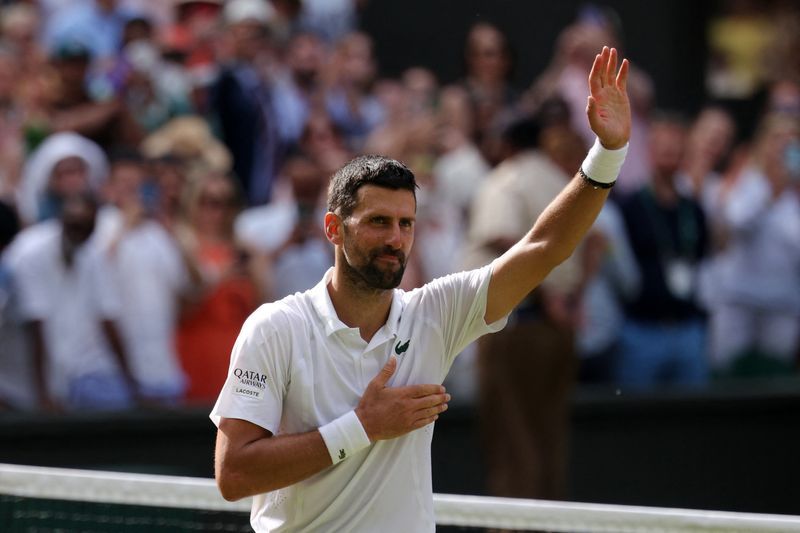
The All England Club enters its decisive phase with four quarter-final matches on Tuesday that will reshape the trajectory of both the men's and women's tournaments. Among the standout fixtures, 39-year-old Novak Djokovic continues his chase for an elusive 25th Grand Slam title against third-seeded Canadian Felix Auger-Aliassime, while 14th-seeded Japanese player Naomi Osaka looks to consolidate momentum following a stunning victory over world number one Aryna Sabalenka in the previous round. The quartet of matches promises to deliver compelling tennis and crucial insights into which players possess the stamina and mental fortitude required to claim the championship.
Djokovic's path to the quarter-finals has been marked by grinding, competitive battles rather than the kind of dominant performances that characterised his peak years. His 106 Wimbledon victories now constitute a record at the All England Club, surpassing all previous competitors. However, the Serbian champion's recent matches have stretched into four sets, most notably his 3.5-hour encounter with qualifier Roman Safiullin that exposed the physical demands still facing even the most decorated players in professional tennis. The 39-year-old's willingness to embrace these protracted contests reflects a philosophical adjustment to his role at an age when many peers have retired.
Reflecting on his approach to such demanding matches, Djokovic acknowledged that although he does not actively seek extended battles, he has developed the mental resilience to navigate them successfully. His quote about enjoying "the suffering, to some extent" speaks to a professional who understands that longevity in elite sport requires embracing discomfort rather than avoiding it. This perspective becomes particularly significant when considering whether his body can withstand the cumulative fatigue of a two-week tournament, especially against a younger, hungrier opponent like Auger-Aliassime.
Auger-Aliassime enters the quarter-final with recent competitive experience against Djokovic, having faced him twice in 2022 with each player securing one victory. The 25-year-old Canadian represents the new generation of tennis talent that has progressively closed the gap on the sport's established champions. His comments about Djokovic's body of work reveal a player acutely aware of the statistical impossibility of his opponent's achievements, yet determined to prove his own development and competitiveness. The generational contrast—a 39-year-old defending his legacy against a 25-year-old building his—encapsulates broader patterns in professional tennis where experience increasingly competes against youth.
On the women's side, Osaka's demolition of Sabalenka represents a watershed moment in her rehabilitation as a serious title contender. The Japanese player, who last captured a Grand Slam in 2021, has faced considerable scrutiny regarding both her form and her mental resilience following previous withdrawals from tournaments. Her victory over the world number one demonstrated the returning quality of her serve-and-forehand combination, technical elements that had made her a four-time Grand Slam finalist in her peak years. More significantly, her characterisation of the match as "a really big crowd for this practice match" suggests a psychological recalibration that allowed her to approach the contest with liberation rather than pressure.
Osaka's opponent, Czech 10th seed Karolina Muchova, has acquired her own narrative of overcoming adversity and uncertainty in professional sport. While Muchova has now reached three Wimbledon quarter-finals, she has never progressed beyond this stage at the All England Club, creating an additional layer of motivation and psychological pressure. Their head-to-head record is evenly split across their past six meetings, with Muchova holding the advantage on grass courts following her victory at the Bad Homburg Open just weeks before Wimbledon. Muchova's strategic decision to compete in two preparatory tournaments before arriving at Wimbledon indicates a deliberate approach to grass-court acclimatisation, a surface that requires specific tactical preparation distinct from hard courts or clay.
Defending champion Jannik Sinner arrives at the quarter-finals as the overwhelming favourite in his section, though he faces an intriguing narrative in German opponent Jan-Lennard Struff. The Italian's three consecutive victories against Struff suggest tactical superiority and consistent execution, yet Sinner's acknowledgment that "whatever happened in the past, it's gone already" reflects the necessity of psychological compartmentalisation in elite sport. His recognition that quarter-finals generate different emotional textures compared to earlier rounds demonstrates heightened awareness of the psychological dimensions of tournament progression.
Struff's presence in the quarter-finals carries particular significance as the 36-year-old becomes the oldest man in the Open Era to reach a Grand Slam quarter-final for the first time. This achievement, facilitated by Hubert Hurkacz's retirement due to hip injury in their round-of-16 encounter, nonetheless represents genuine accomplishment. Struff's ascent underscores that professional tennis, while increasingly dominated by players in their twenties and early thirties, occasionally rewards longevity and persistent competitiveness. His journey to this stage reflects both the unpredictability inherent in tournament sport and the possibility of meaningful achievement regardless of age.
The quarter-final matchups reveal fundamental tensions within contemporary professional tennis between youth and experience, established champions and emerging talent, and the physical durability required to sustain elite performance. Djokovic's quest for a 25th major remains captivating precisely because it challenges assumptions about athletic decline and competitive viability in the fourth decade of life. Simultaneously, Osaka's resurgence narrative carries considerable interest for audiences throughout Southeast Asia, where her return to prominence offers inspiration regarding comeback trajectories and mental fortitude. These matches will determine not merely who advances toward the finals, but what these outcomes communicate about the future structure of professional tennis and the relative weight of experience versus youth in determining championship success.

