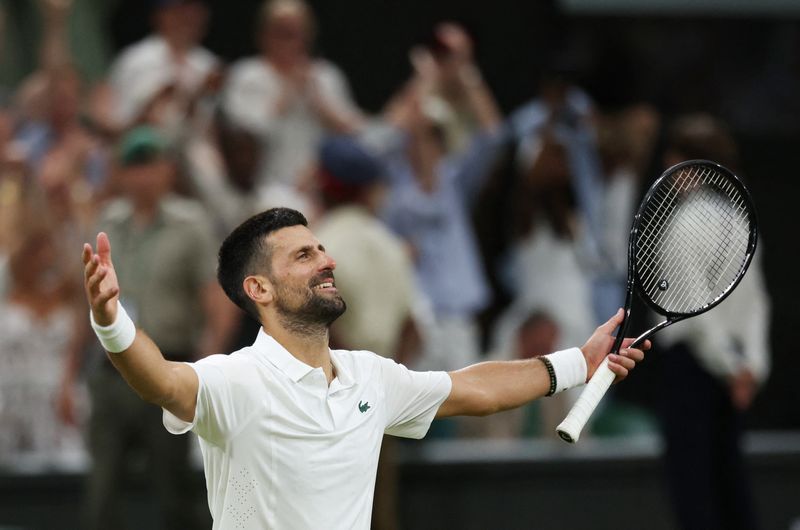
Novak Djokovic has extended his remarkable Wimbledon streak to eight consecutive semi-final appearances, grinding through a monumental quarter-final showdown against Canadian Felix Auger-Aliassime that lasted five hours and 15 minutes—the longest such match in the tournament's history. The 39-year-old Serbian overcame his opponent 7-6(10) 3-6 6-3 6-7(4) 7-6(10-4) in a display that combined tactical discipline with sheer determination, setting the stage for a highly anticipated semi-final clash against defending champion Jannik Sinner.
Djokovic's milestone achievement carries particular historical weight. By reaching the last four for an eighth consecutive occasion, he became the first male player in tennis history to accomplish the feat, surpassing the achievements of Roger Federer. This comes on the heels of his 106th match victory at the All England Club in the previous round, another record he claimed from his Swiss rival. The 39-year-old remains on course for an eighth Wimbledon title, which would equal Federer's record, while a 25th Grand Slam title would surpass the record held by retired Australian Margaret Court.
The quarter-final encounter unfolded as a test of endurance and mental fortitude rather than elegant tennis. Auger-Aliassime, displaying the attacking prowess that has defined his career, kept Djokovic under sustained pressure throughout the match, forcing the veteran to dig deep into his considerable reservoir of experience. The opening set epitomized the intensity of the encounter, with both players navigating a lengthy tiebreak that ultimately went to 10-6 in Djokovic's favour after Auger-Aliassime's miscued volley at a crucial moment.
Momentum shifted decisively in the second set when the Canadian broke Djokovic's serve to establish a commanding 5-3 lead. Auger-Aliassime consolidated this advantage and held serve to level the match, forcing the resumption of play under the Centre Court roof as darkness fell around 7:40 p.m. local time. The roof closure, which initially drew protests from Djokovic regarding the change in conditions, ultimately proved to be a turning point in the match's trajectory.
Djokovic's response to the environmental change demonstrated the temperamental and tactical adjustments that have defined his championship career. Rather than allowing frustration to mount, he refocused his energy and began striking the ball with noticeably greater clarity and conviction in the third set. His breakthrough came in the sixth game when he finally managed to break Auger-Aliassime's serve, establishing the platform from which he would gradually reassert control over proceedings. The set concluded 6-3 in Djokovic's favour, shifting the psychological balance of the encounter.
The fourth set proved equally contested, with Auger-Aliassime losing his opening service game but subsequently demonstrating considerable resilience by recovering to force another tiebreak. The Canadian's frustration occasionally boiled over, most notably when he struck his chair with his racket, yet he channeled this emotional intensity into competitive aggression rather than allowing it to derail his performance. The set ultimately went to the tiebreak, which Auger-Aliassime captured 7-4 to force a decisive fifth set.
The final set presented a study in contrasts between youthful energy and veteran composure. The two players remained inseparable through the opening 12 games, neither able to construct a decisive advantage under intense pressure. The tiebreak that followed became the climactic moment of their encounter. Djokovic drew on decades of experience navigating such high-stakes situations, ultimately prevailing 10-4 to conclude the marathon contest. The spectators, having endured over five hours of compelling tennis, delivered a deafening ovation in recognition of the match's quality and drama.
Djokovic's own assessment of the contest reflected both relief and genuine appreciation for the magnitude of the achievement. "I won with a racket and a lot of heart," he remarked, acknowledging the emotional and physical demands the match had imposed. He further elaborated on the psychological pressures inherent in fifth-set competition, noting that the management of nerve and tension ultimately separated victor from vanquished. His reflection on the scoreline remaining level throughout the contest underscored how narrowly the result had hung in the balance, particularly in the climactic tiebreak.
The Serbian star displayed the characteristically pragmatic mindset that has sustained his longevity at the elite level, emphasizing that while individual matches provide satisfaction, the true measure of his career will only be assessed upon retirement. Nevertheless, he acknowledged the significance of competing in moments of such magnitude and intensity, suggesting these high-stakes encounters remain the primary motivation for his continued participation at professional tennis's highest level. The physical toll of the contest clearly registered with the competitor, who expressed concern about how his body would respond to the demands of preparing for the semi-final.
For Malaysian and Southeast Asian tennis enthusiasts, Djokovic's trajectory at Wimbledon carries broader significance. His continued dominance at 39 years old challenges conventional wisdom about athletic longevity and demonstrates that championship-level tennis performance can be sustained well into what would ordinarily be considered the twilight of a professional career. This sends powerful messages about training philosophy, mental resilience, and the importance of tactical adaptation.
The impending semi-final confrontation between Djokovic and Sinner represents one of tennis's most compelling contemporary narratives. Sinner, currently ranked as the world's number one player, arrives as defending champion, while Djokovic approaches the encounter as a challenger seeking to extend his dominance at this particular Grand Slam. The age gap between the rivals—Sinner is 22 compared to Djokovic's 39—encapsulates the sport's generational transition, yet Djokovic's progression to this stage demonstrates that experience and tactical sophistication remain formidable weapons in an era increasingly defined by youthful exuberance and power-based tennis.
The quarter-final victory also reinforced the competitive depth evident at this year's Wimbledon. Auger-Aliassime's performance, though ultimately unsuccessful, showcased the technical proficiency and mental toughness that Canadian tennis has cultivated. His ability to remain competitive against one of history's greatest players across five sets suggests that emerging talents continue to challenge the established hierarchy, even if the outcomes have not yet shifted decisively in their favour.

