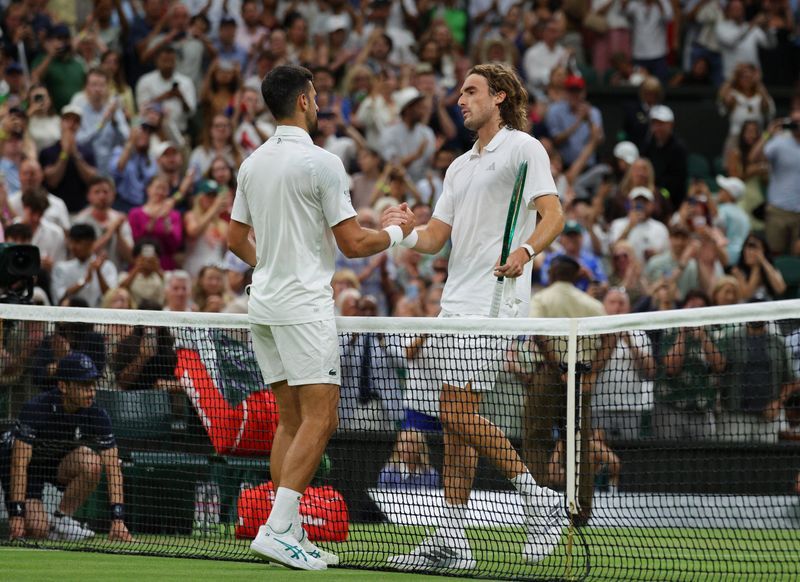
Novak Djokovic's path through the second round at Wimbledon on Wednesday unfolded as a masterclass in clinical tennis, with the Serbian defending champion dismantling Stefanos Tsitsipas 6-3 6-4 6-2 in what had been billed as a heavyweight Centre Court confrontation. The ease with which the 39-year-old seized the initiative transformed the match into a one-sided affair, with Tsitsipas finding little answer to Djokovic's composure and precision.
The pivotal moment came in the second set when, trailing at 4-4, Tsitsipas squandered a critical break-point opportunity. With two overhead chances to seize the initiative, the Greek player's failure to convert either put him at a decisive disadvantage. Djokovic capitalized immediately, breaking serve and then reeling off eight victories in the final ten games to effectively end all competitive tension. The momentum shift highlighted a recurring pattern in their head-to-head record, extending Tsitsipas's losing streak against the Serb to twelve consecutive defeats.
Djokovic's achievement now positions him on the cusp of equalling Roger Federer's cherished record of 105 match-wins at Wimbledon, a milestone that underscores the Serbian's extraordinary sustained excellence at the grass-court championship. His pursuit of an eighth title here and a record 25th Grand Slam crown continues unimpeded, with 25th-seeded Frenchman Arthur Rinderknech awaiting in the third round. The nature of this victory suggests momentum is building at precisely the right moment in the tournament.
For Tsitsipas, the encounter represented far more than a sporting setback. The 27-year-old arrived at the All England Club battling considerable personal turmoil, having parted ways with his long-time coach—his own father, Apostolos—mere days before competition began. Combined with a ranking that has plummeted to world number 87, Tsitsipas carried the weight of recent disappointment into Centre Court, where he has endured previous heartbreak against his opponent.
The Greek player's recent history at Wimbledon carried particular sting. He had withdrawn midway through his opening match during last year's grass-court major, derailed by chronic back pain that threatened his entire career trajectory. This year's return suggested the physical troubles had subsided, yet the psychological scars of past defeats lingered. Tsitsipas had twice contested Grand Slam finals against Djokovic, losing at Roland Garros in 2021 and again at the 2023 Australian Open, each encounter reinforcing the gulf between their present capabilities.
Djokovic's composure throughout the encounter reflected a player entirely at ease with the demands of Centre Court at an age when most competitors have long since retired. In his post-match observations, the Serb acknowledged the privilege of competing at this level, noting that while advancing years might concern others, he views age as merely a numerical consideration. His sporting of a cream blazer—garb more suited to academy hallways than professional tennis—underscored his apparent detachment from conventional sporting aesthetics, a confidence that matched his commanding play.
The Serbian's statement that he felt "great" and that his performance brought him genuine satisfaction spoke to an athlete operating at peak capability. He described the experience of walking onto Wimbledon's most celebrated court at his stage of career as something not to be taken for granted, a sentiment that rings authentic given the rarity of such longevity at elite levels. The victory consumed less than two hours, suggesting Tsitsipas offered minimal sustained resistance once the trajectory became apparent.
For Malaysian and Southeast Asian tennis followers, this encounter illustrates the widening gulf between Djokovic's current form and even accomplished challengers. Tsitsipas, despite his Grand Slam pedigree and earlier promise, remains caught between generational demands, unable to breach the Serb's imperious defences. The coaching separation adds intriguing complexity—whether Tsitsipas can recalibrate and challenge again remains uncertain, but recent evidence suggests considerable work lies ahead.
Djokovic's march toward his eighth Wimbledon triumph gathers momentum with each successive victory. Reaching the third round without setback or controversy positions him ideally for a deep tournament run. The record 25th Grand Slam title remains tantalizingly close, and the grass surface where he has traditionally excelled offers perhaps his most favourable terrain for achieving this historic milestone before the competitive window inevitably closes.

