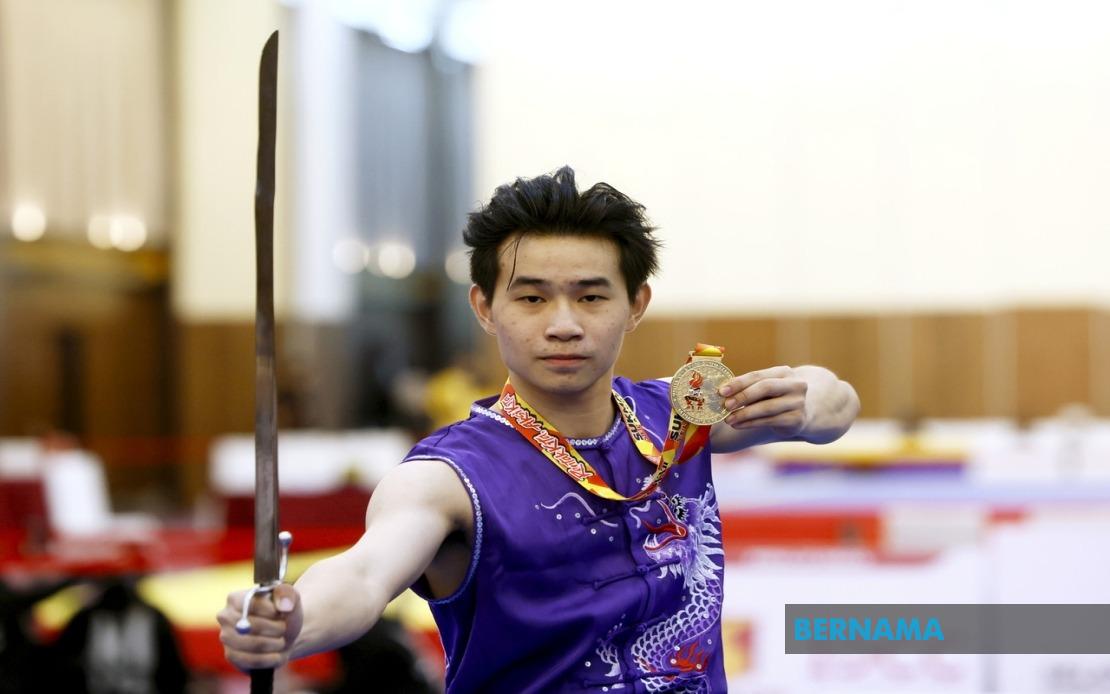
Wee Din Jun's wushu career has followed an uneven trajectory through Malaysia's premier multi-sport spectacle, but the Penang athlete's final chapter at the Malaysia Games (SUKMA) has rewritten an otherwise troubled narrative. Competing at the Ideal Convention Centre in Shah Alam on August 21, the 21-year-old seized gold in the men's nandao nangun event with a commanding performance that secures his place among Penang's accomplished wushu representatives. His victory comes as vindication after enduring both physical setback and competitive disappointment in the months leading to SUKMA 2026.
Din Jun's margin of victory underscored the quality of his execution under pressure. His score of 9.600 points proved sufficient to overtake Sarawak's John Phang, who captured the silver medal with 9.563 points, whilst Selangor's Tan Yu Zhe rounded out the podium with 9.550 points. The narrow spread between the top finishers reflected the precision demanded by wushu competition, where judges assess both technical proficiency and artistic expression. In such a competitive field, Din Jun's ability to edge rivals by mere fractions of a point demonstrates the consistency and discipline required to succeed at the national Games level.
The backdrop to this success deserves particular attention. Approximately one month prior to SUKMA 2026, Din Jun sustained a hip injury that threatened his participation entirely. For most athletes, such an injury would have prompted withdrawal or resignation to suboptimal performance. Yet the Bayan Lepas native managed his recovery sufficiently to not only compete but to claim the sport's highest honour at these Games. His medical setback adds genuine sporting drama to what might otherwise be routine medal reporting, illustrating the determination that characterises elite Malaysian athletes.
Din Jun's trajectory through SUKMA has been anything but linear. At SUKMA 2022 in Kuala Lumpur, he entered the Games as a rising prospect and departed with a bronze medal, a respectable if not outstanding result. However, SUKMA 2024 in Sarawak proved devastating. Competing across three events, he struggled to execute his routines effectively, committing multiple errors that cascaded into a medalless campaign. For an athlete of his ability, returning empty-handed from a major national competition represents profound disappointment. Such experiences reshape athletes psychologically, either fuelling redemptive ambition or fostering doubt and hesitation.
In Din Jun's case, the setback catalysed a mental recalibration. Speaking to media after his gold-medal performance, he articulated how his coaching staff guided him towards a fresh psychological approach. Rather than fixating on outcomes or haunted by previous failures, he adopted a philosophy of enjoying the competitive moment itself. This shift from results-focused anxiety to process-oriented engagement represents a sophisticated understanding of performance psychology that many aspiring athletes never master. His coach's counsel to remain composed and concentrate solely on technical execution proved instrumental in unlocking his capabilities.
The personal significance Din Jun attached to this medal extends beyond the obvious achievement of winning gold. He had long aspired to demonstrate his capacity to claim the sport's highest honour at SUKMA, a goal that eluded him through two previous appearances. This victory therefore represents not merely a sporting outcome but rather the fulfilment of a longstanding objective. Such personal investment in specific goals drives many elite athletes, transforming competition from abstract professional duty into meaningful personal accomplishment.
Din Jun also directed recognition towards his former coach, who has since relocated to China. The coach was unable to witness Din Jun's medal victories at SUKMA 2022 and 2024, but the athlete seized this gold-medal moment partly as acknowledgment of that mentor's influence and investment in his development. This gesture reflects the collaborative nature of elite athletic achievement, where success belongs as much to coaching staff and support systems as to the athlete themselves. The relationship between Din Jun and his coach illustrates how cross-border coaching arrangements have become increasingly common in Malaysian wushu, with international expertise enriching the sport's competitive standard.
Looking forward, Din Jun's SUKMA journey will extend slightly further. He remains scheduled to compete in the nanquan event the following day, offering the prospect of capping his final Malaysia Games appearance with additional hardware. Whether he captures further medals or not, the psychological burden of redemption has already been lifted. His gold in nandao nangun has restored his reputation at SUKMA, moving beyond the disappointment of 2024 and demonstrating that his bronze from 2022 represented legitimate achievement rather than a false promise.
The implications of Din Jun's success ripple beyond his individual career narrative. Penang's wushu programme continues to produce athletes capable of competing at the highest levels within Malaysia, sustaining the state's reputation in a sport where it has historically excelled. His redemption arc also provides encouragement to other athletes navigating injury and previous tournament disappointments. The demonstration that mental reorientation and coaching support can unlock latent ability offers practical evidence that setbacks need not be terminal. For Malaysian wushu more broadly, Din Jun's performances contribute to the sport's competitive depth and reinforce the quality of training infrastructure available domestically.

